
Author’s note: This is a discussion of how I personally did not thrive in my position, not a diatribe against the company I worked for. I’m just not a good fit for sales, y’all.
I’ve written in the past about my library job, which I have since left to try my hand at selling insurance. My motivation was that my husband, who’s partially blind and cannot drive, is employed there, and a major part of the job is being able to get to many places (managers emphasize that 25 a day should be the bare minimum) to meet people and attempt to sell them things. It’s possible to do it over the phone, but it gets far fewer results. So I convinced myself that I could do it too, despite being an introvert with painfully low self-esteem. Most things remind me of horror movies, but to me the health insurance game is a horrific one indeed.
*Caution: SPOILERS!!!*
5.) Saw VI

This one’s a no-brainer as to why it’s in my listicle; it prominently features Jigsaw victimizing the staff of a health insurance company. His major beef is with William, who denies his request for coverage of an experimental cancer treatment, which is IRL in full extent of the law (though the company I worked for is massively dedicated to prevention of and assistance with cancer and pays benefits for experimental treatments). But then William does cancel Jigsaw’s policy when he decides to get the treatment anyway (majorly illegal–believe it or not, insurance coverage is tightly regulated at the state and federal level, with a keen eye on what benefits the policyholder). This is my summary of Jigsaw’s conversation with William: Jigsaw: “I want an experimental cancer treatment that sort of has results.” William: “I’ve researched this treatment, and it’s questionable. In fact, a few movies later, you’re gonna find out it’s a hoax and then you’ll be really pissed. Also, your doctor Cary Elwes says you aren’t a good candidate.” Jigsaw: “Fuck that guy. I have money to pay for it, but I still want your company to cover it. It’s the principal of the thing.” William: “Did you not see my fish tank of piranhas? Symbolism!” Jigsaw: “Well, then my only recourse is to kidnap you and literally every other person who works in this office and torture them.”
The film occasionally makes an elegant point about how there should be more humanizing ways to decide who gets financial help when they’re sick than a remote corporation going purely on statistics, and to be fair, Jigsaw is also affronted about William turning down coverage for a man who made a mistake on his insurance application, effectively killing him. BUT its depiction of insurance agents as killers with blood on their hands, particularly William’s “Dog Pit”, a team of ruthless execs gleefully finding mistakes and loopholes in insurance claims, is way over the top.
4.) The Rite

Michael is a seminary student on the verge of quitting because he’s lost his faith. His mentor suggests he spend two months in Rome at an exorcism class instead. He is introduced to Father Lucas, who does lots of exorcisms. Michael soon finds out that an exorcism is no quick procedure. It’s a slog. The parish priest must be consulted, all alternative explanations for wonky behavior must be exhausted, and the priest must forward his assessment to his bishop, and then with the bishop’s permission they can summon an exorcist to determine whether an exorcism is appropriate. And THEN, it still takes time. Lucas has a patient he meets with once or twice a week; he yells at her in Italian and she goes home. Lucas explains to Michael, “Spiritual liberation can take months, even years.” Michael replies, “So she’s still possessed?” “Yeah,” Lucas replies nonchalantly. He sees her a total of three times throughout the movie, and ultimately she dies still possessed. And then the demon possesses Lucas instead. (Fortunately, Michael has so much faith that he succeeds in driving out the demon in a few minutes, despite the work that the filmmakers had put in thus far to plant the idea that exorcisms take a long time and need to be done by experts.)
Selling insurance is also not a one-and-done. Here’s a summary of the general procedure: Start by making a list of potential businesses to visit. If the person who makes decisions about insurance coverage is present when you go, swell. But more often than not, that person is nowhere to be found, and the person you come across instead has been coached to be vague about what time or what day they’ll be in, so you have to come back. Provided you can ever catch the decision maker, you have to get them to agree to a sit-down meeting to discuss whether it makes sense for them to purchase insurance. They tend to be of the mindset that they should be getting insurance but have been putting it off as one more drain on their time and money, and are none too pleased to be reminded about the obligation. Or if their objection is that their employees wouldn’t want it, they do an informal poll, basically asking, “Hey, you guys want more money taken out of your paycheck?” It’s insulting because there’s a fuckton to know about what the policies actually entail, which is why I always wanted to coo, “Do you have a license in health insurance? Because IIIIIII do.” If you can get past all that, then there’s the employee presentation. After the employee presentation there is the enrollment meeting, in which the ideal result is that at least some of the employees want to get them some coverage. And after that, if all goes well, there is the post-enrollment meeting and heaps of paperwork. Which is repeated yearly.
3.) The Belko Experiment

In the movie, a branch of the Belko Corporation, home to eighty employees, is under siege one day by a voice commanding that two people die. The next order is that thirty people must die or sixty will be killed instead. The employees have been implanted with chips that will explode if those in charge are provoked. As one character says, when everyone is wondering whether the order to kill is a joke, “Oh, that’s great. Like I didn’t already feel trapped in this job.” The action is counterpointed by cheesy business slogans and in the final fight scene, a PowerPoint of more corporate gibberish. Even at the end, when the final character meets the person in charge, he can’t give a coherent answer for why the experiment is being done. The film as a whole is an indictment of the western workplace, people doing pointless busywork and hating their jobs.
Working for a large company, as I did, it’s easy to feel faceless. The job also felt hollow. Ostensibly I was helping people, when I could convince them that supplemental health insurance was a thing that they wanted, but it felt like a massive hustle for little or no reward. Again and again, I was told that it’s a numbers game, and if I just talked to enough people that eventually I would start making some strides. I did manage to open a couple of accounts, but not nearly enough to earn a living wage.
2.) They Live

The earth is facing a socioeconomic crisis caused by invading aliens who pass for human. Their plot involves insidious subliminal messages such as “OBEY”, “NO INDEPENDENT THOUGHT”, “CONSUME”, and “BUY”. Money carries the message, “THIS IS YOUR GOD”. The aliens are able to come into power by manipulating people into being more materialistic; some humans are given a small measure of power in exchange for going along peaceably. Overall, the aliens’ plan for humans is to “Keep us asleep, keep us selfish, keep us sedated”.
In my experience, the culture in sales fosters a sense of greed, of a primal longing to advance. At least once a week we were chided by management for not making the sales that were expected of us and fed the statistics of the veteran sales associates to make us feel bad. The managers are expected to increase their sales every year, despite their workload already teetering on overwhelming. In addition to their quota, they’re expected to help the agents they manage with their quotas. Literally no amount of sales is ever enough.
1.) The Silence of the Lambs
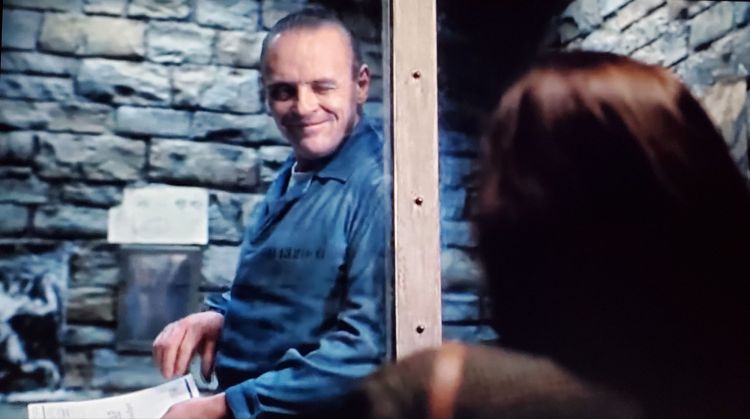
A big part of sales is establishing trust and rapport. Business owners, even those who own very small businesses, have various salespeople in their face all day, and they’re often not thrilled to see another one. In some places, I could tell they pegged me immediately as a sales rep, and they were having none of that. The trick is to get past their defenses and get them to like you, but I was really shitty at that, and I couldn’t help but think of Clarice Starling and Hannibal Lecter’s first meeting in The Silence of the Lambs. At the beginning of the movie, Starling, an FBI agent in training, is given an assignment to interview notorious serial killer Lecter and pump him for information about a new killer. He gives her a chance out of curiosity, but is ultimately quick to dismiss her:
Lecter: “Memory, Agent Starling, is what I have instead of a view.” Starling: “Well, perhaps you’d care to lend us your view on this questionnaire, sir” [Nervous laugh]. Lecter: “Oh no, no, no, no. You were doing fine. You were courteous and receptive to courtesy, you had established trust with the embarrassing truth about Miggs, and now this ham-handed segue into your questionnaire. It won’t do […] You’re so ambitious, aren’t you. You know what you look like to me, with your good bag and your cheap shoes? You look like a rube. A well-scrubbed, hustling rube. With a little taste.”
I didn’t even have a good bag or a little taste. I gave it five months full of mini panic attacks before work and extended ugly-cry sessions after work, but it did not in fact work, and I have conceded defeat. As of this writing, I am working in a warehouse (thankfully one that has decent benefits and pay) and trying to get back to the library, where I can give people things they want for free, the best damn job in the world.
 GhoulieJoe
This is a great post Ghoulie Joe! I could never do sales either. I’m just not a salesperson. I usually have a hard time selling people on new restaurants I’ve tried 😐
LikeLiked by 1 person
Thank you! Same here!
LikeLike
I love this! Have the ugly-cry sessions tapered off in duration and frequency? There’s no library in my town and to use neighboring libraries they want me to pay like $100 a year! It’s all a scam, even the book-lending business! But here’s hoping you make your way back.
LikeLiked by 1 person
Thank you! Yes, much less crying, thank you. In my town there are 17 libraries, but if you don’t live or work there you have to pay $25 a year, which I disagree with, but it’s for tax purposes?
LikeLiked by 1 person