Belief. It’s a major player in the world of horror movies. Often the characters who don’t believe in the monster are the first to go. Frequently the antagonist thrives on the fear that comes along with belief, like Pennywise in It. In psychology, belief is tantamount to mental health. A common tactic for improving self-esteem and coping with depression and anxiety is Cognitive Behavioral Therapy, the cornerstone of which is confronting and changing destructive thought patterns. The following ten movies illustrate, in the words of Marie Forleo in her book Everything is Figureoutable, “It doesn’t matter what’s true, it matters what you believe.” (PS: I have an associates degree in Social Science, which means I am qualified to…write listicles about certain aspects of psychology as they relate to horror movies. That’s it.)
The Skeleton Key
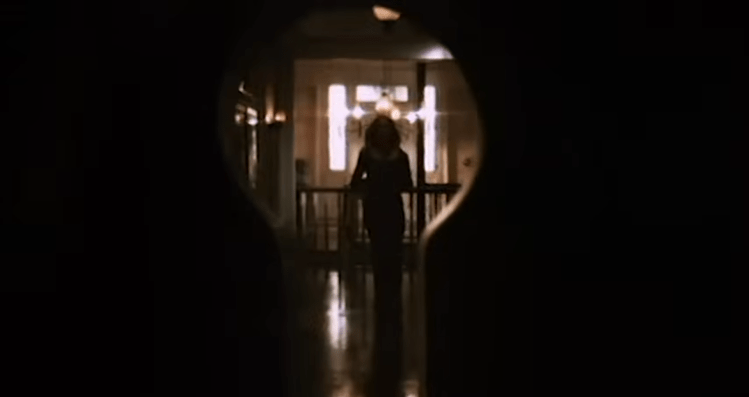
Caroline is an in-home caretaker who has just taken a job for an older couple. The husband, Ben, had a stroke and is almost completely paralyzed. Unfortunately for her, Caroline is now in the midst of hoodoo country, and soon she discovers that something sinister is behind Ben’s condition. As one does, she begins spending her time snooping rather than doing her job, and finds a shocking truth that upends her sense of reality.
The philosophy regarding magic in the film is “It can’t hurt you if you don’t believe.” Naturally Caroline starts off as a stodgy skeptic, illustrated rather cringily as a learned white lady going among superstitious weirdos of color in the bayou. There’s a consistent image system of locks and chains, with magic being the key to the locks; therefore, by association, lack of belief can hold a person captive. It’s her self-assured attitude that gets her in trouble; she’s warned repeatedly that she’s in danger if she stays, but her refusal to listen paired with a trauma-driven urge to stay with Ben no matter what keeps her in harm’s way.
A Cure for Wellness
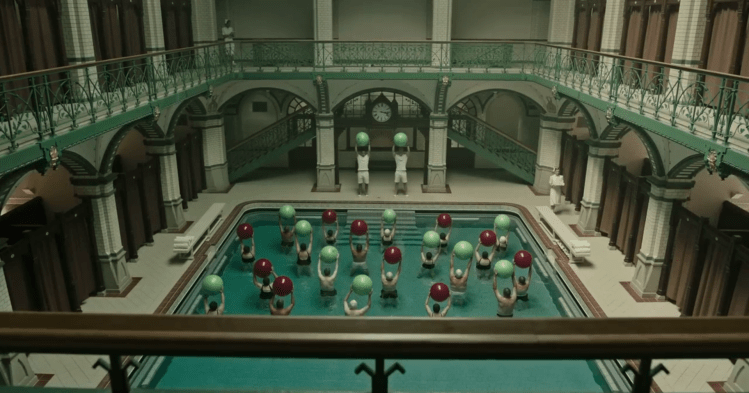
Lockhart is a high-powered businessman sent by his firm to a Swedish health spa to fetch Pembroke, who went there for a two-week treatment and suspiciously refuses to return. On his way out, Lockhart is in a car wreck and wakes up in the spa with his leg in a cast. He finds himself under the staff’s care whether he likes it or not. And, given their horrifying methods of “treatment” (for example eels going into orifices they one hundred percent do not belong in), he really doesn’t like it.
Lockhart discovers that no one is actually getting cured, and the place is in fact feeding off of its clients. But the wily director Dr. Volmer has a way of convincing people they’re ill, from the patients to his ward Hannah, a sickly childlike waif. Volmer’s patients feel better because they’re told they feel better, even as they’re dehydrating and losing their teeth. You can read the film as a diatribe against the emptiness of modern life. Lockhart is endlessly chasing prestige and a corner office, because in our culture we’re told that is the thing to want, despite a flashback showing his father jumping off a bridge, briefcase in hand, after a stock market downturn. Lockhart’s superiors are ruthless and cruel, as is the world of business: the film opens with a prominently featured salesman of the year having a heart attack at the office and dying alone. Success is an illusion.
Bug
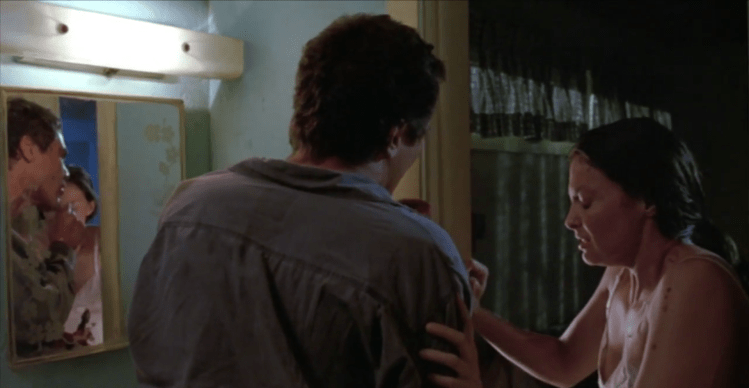
Agnes is a lonely waitress living in a dank motel room when she meets Peter, a veteran who’s convinced he’s being followed by the Army in order to experiment on him. We later find out he’s schizophrenic, but Agnes is vigorously in denial that anything’s amiss, even when Peter sees bugs everywhere, including in his blood under a microscope, and he drags her into his delusions.
Agnes is easy to convince. Part of it is her crushing isolation, exacerbated by the disappearance of her young son and her good-for-nothing ex Jerry. She’s willing to believe anything so she won’t have to be alone, even if that belief is “You’re never really safe.” When Peter tells her that smoke alarms are radioactive, she believes him immediately, concluding that that’s why she feels so lousy all the time. Peter is self-destructive and paranoid, and they feed off of each other. As time goes by, Peter is yanking out his own teeth and Agnes is digging so fiercely at her skin that she’s getting rashes and gouges. The two are twitchy and swatting at invisible insects. They’re not in danger, they’re a danger to be around.
Oculus
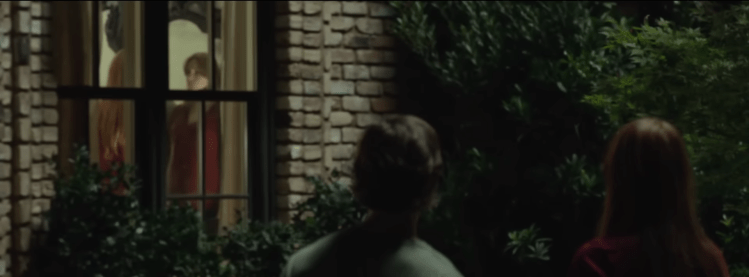
Kaylie and her brother Tim are dealing with the trauma of their father torturing and killing their mother while under the influence of an evil mirror. The ghosts that inhabit it are highly influential, capable of inducing realistic hallucinations. As adults, Kaylie snatches Tim fresh out of a mental facility and plans to capture video evidence of the glass’s shenanigans. She takes super precautions like having her fiancé call on the hour, setting alarms to eat and drink, and rigging an anchor to smash the mirror. Meanwhile, Tim, attempting to hold on to his hard-won sanity, tries to talk her out of it.
The Lasser Glass is able to completely unmoor people from reality. They believe that things that are harmful don’t hurt. They are confused about what is real, for example a scene when Kaylie is eating an apple, which changes into a lightbulb. She sees the bits of bulb and fishes a shard out of her bloody mouth, but then it’s revealed she was actually only eating the apple after all. Characters doubt their memories and rationality. Tim tells Kaylie, “You’re remembering it wrong.” “I’m not crazy!” their mother Marie shrieks. It’s all too easy to fall under the mirror’s spell; unfortunately, there’s not a cut-and-dried solution. In the end, as the movie trailer puts it, “What is past What is present What is real What is deception You see what it wants you to see.”
God Told Me To
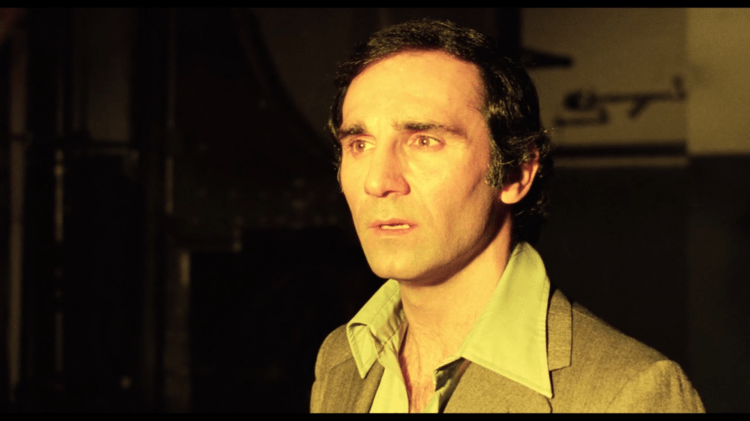
Peter is a detective witnessing an alarming uptick in senseless murders committed by people claiming “God told me to.” A deeply religious man, Peter is unshaken in his faith and sets out to solve the case. He discovers a devastating truth about himself instead.
The murderers, if they live (some kill themselves after), are oddly jovial. One man, after shooting his wife and two children, discusses how good it felt to make a sacrifice for one who gives so much and asks so little, telling Peter, “You don’t love God the way I do.” The film is a study of a man who actually does love God very much but is forced to choose more than once between his feelings and the rules set forth by God–he cheats on his estranged wife and lives with his new lover. Both women are surprisingly chill about it (oh the ’70s!), but the Bible clearly states that’s a no-no. He’s baffled by the series of unexplainable events happening around him, but it’s pointed out in the film that God is wont to use fear to motivate people rather than miracles. Is God demanding a sacrifice? Are the victims destined to die? How do you decide what is right when you’re chosen to do something unspeakably awful?
The Deliverance
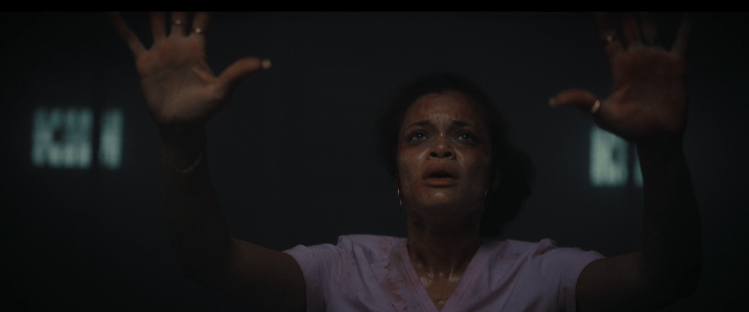
Ebony is a single mother of three who along with her mother has just moved into a cheap murder house inhabited by a demon. They’re a deeply troubled bunch, and the entity preys on the family tension.
As the title cards in the opening state, “I need forgiveness for what I have done, but I also need deliverance from what I am.” Ebony is a hot mess. She’s an alcoholic and battling major childhood trauma of multiple kinds. She feels guilty afterwards, but she’s abusive to her loved ones as a result. Even if you’re not a Christian, you must concede that Ebony needs Jesus. The literal demon symbolizes personal demons and the power of self-destructiveness. Ebony can’t fight back until, as Apostle Bernice says, “You gotta know that you’re loved.” In order to get rid of the demon, she has to conquer doubt and fear and the notion that “Nobody loves you.”
She Dies Tomorrow

Amy has just bought a house, one of the basic tenets and lengthy commitments of adulthood. Buuuut sadly she’s dating a feller named Craig who suddenly has a premonition that he will die the next day. Amy is taken in by the notion and becomes convinced that she too is going to die. Her friend Jane becomes invested as well, and soon everyone Jane speaks to shares the conviction that tomorrow is their last day on earth.
The film explores the state of denial that most of us tend to live in about how much time we do or don’t have. We know for a certainty that we’re going to die, but a lot of times we don’t act like it. The characters in the film, while devastated, begin to try to make the most of their situation. Jane’s brother Jason’s friends Brian and Tilly are motivated to painful but necessary acts, Brian by taking his father off of life support and Tilly by breaking up with Brian. Jane’s sister-in-law Susan muses about the stupid stuff people care about (in an earlier scene she has a monologue about dolphin mating habits). Amy and Craig discuss their regrets. Jason admires the sunrise. Jane seeks out the company of strangers, who are already also possessed of the idea that they’re going to perish the next day. None of them have concrete evidence that they’ll actually die so soon, but they have a compelling certainty, and it’s enough. As Brian says: “We all have to die at some point. Why not tomorrow?”
We Go On
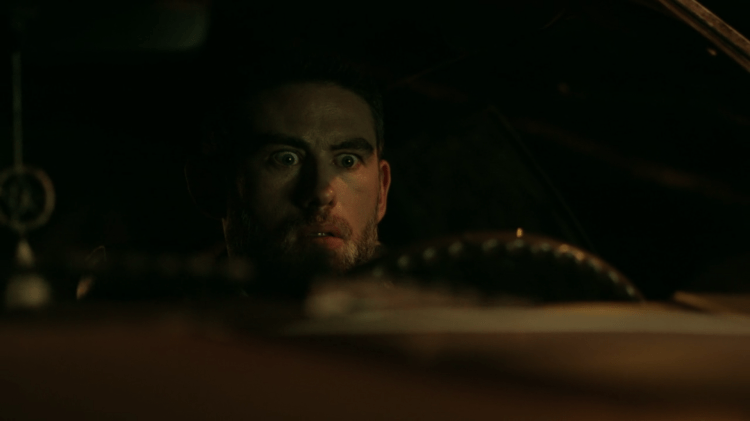
Miles is a man ruled by multiple phobias. His fear of dying leads him to place an ad stating that he will pay $30,000 for proof of life after death. After a disappointing series of fakes, he hits the jackpot and unwittingly opens the door to the afterlife–and a malicious ghost that wants to take him for a ride.
The film is about living with fear and uncertainty and learning to cope with adversity. According to one of Miles’s new acquaintances, the ability to see ghosts is ignited by fear and powerlessness, the kind experienced by children, and blocked by skepticism. Miles wants to believe, while his mother Charlotte is cynical and would rather there be nothing after death, because that means no judgment and no earthly tasks left incomplete. As she says, “We go out like lights. What else would we do?” Miles, always seeking safety, refuses to drive because of the potential for accidents and has the most boring job in the world: editing informercials. Because he spends so much time focused on both his traumatic past and his wariness of the afterlife, Miles takes his life for granted. It’s his encounter with the undead that gives him the motivation to do things that make him happy or that scare him.
The Empty Man
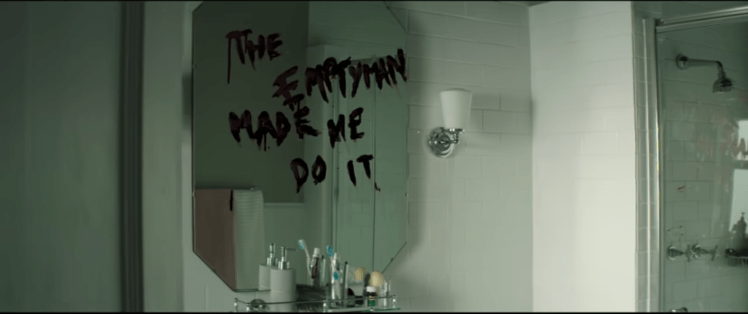
James is a former cop who now owns a security company. His neighbor Nora comes to him for help when her teenage daughter Amanda goes missing shortly after summoning the Empty Man, a creepy urban legend. James follows the clues to the Pontifex Institute, home to a cult also dedicated to communicating with the Empty Man.
The Pontifex Institute’s ideology is a more sinister version of that book The Secret: manifest your desires, and what you think about will be attracted to you. They live to “unleash the power of your mind.” Unfortunately, what their minds are unleashed to do is create a tulpa, a thought-person made real. They tend to the philosophy, as expounded by Amanda, that “Nothing can hurt you because nothing is real […] What’s real starts here [indicates her head] and ends up out here. I mean, what we think about with focus, and intention, and repetition, we manifest.” However, the Empty Man is able to influence people to do things they otherwise might not, such as stab themselves in the face with scissors or kill their beloved pet. The Pontifex people come across as desperate to believe in something, anything, even if it’s incredibly harmful.
I Saw the TV Glow
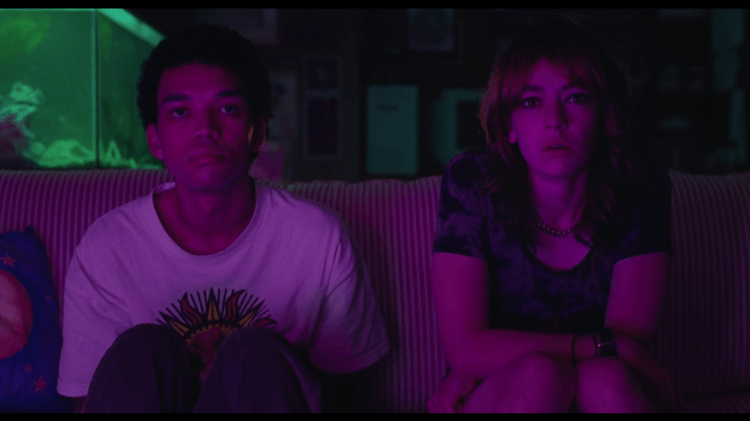
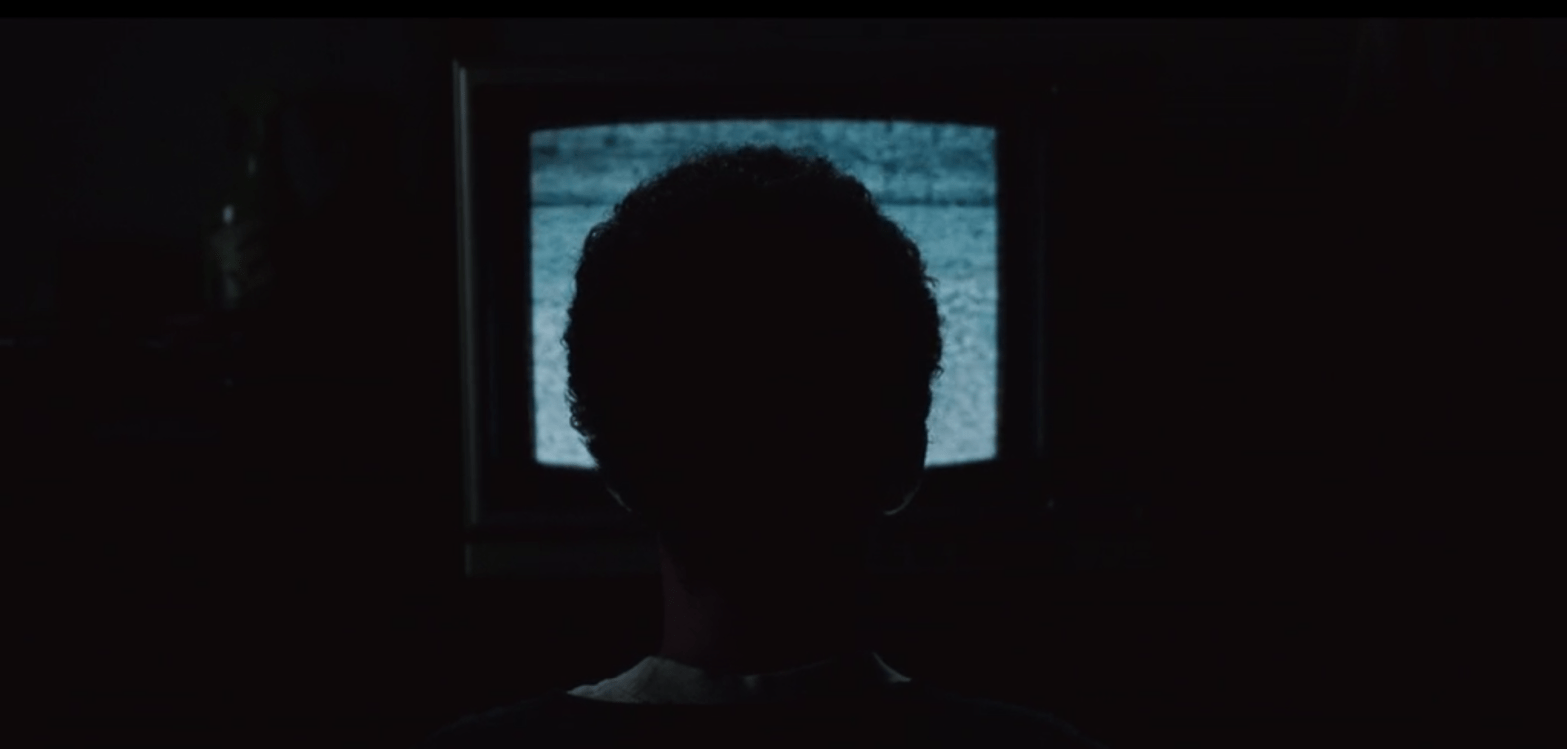
1996. Owen is an anxious 7th grader who’s smothered by his overbearing father and terminally ill mother. He befriends Maddy, an intense 9th grader who’s obsessed with the TV show The Pink Opaque, about two teenage girls named Tara and Isabel who have a psychic link and fight monsters (think the cheesy acting and special effects of The Mighty Morphin Power Rangers meets the badass female protagonists of Buffy the Vampire Slayer and the vintage creepiness of Are You Afraid of the Dark?). Maddy is being abused by her stepfather and takes a massive amount of comfort in her show, idolizing butch and powerful Tara. She disappears one day, and everyone assumes she’s dead. She returns eight years later, convinced that she left her boring life to enter The Pink Opaque. She tells Owen that she is really Tara and he is really Isabel, and that like on the show, they have been poisoned, buried alive, and brainwashed by the evil Mr. Melancholy to believe that they’re someone else. The only way to get back to their real selves is to recreate the burial. Owen has a difficult choice to make about whether to believe her, seeing as he’ll die a horrible death if she’s delusional.
It’s left unclear whether Maddy was right, but there are clues that she may be. As Owen muses, “Some nights, when I was working late at the movie theater, I found myself wondering, what if she was right? What if she had been telling the truth? What if I really was someone else? Someone beautiful and powerful. Someone buried alive and suffocating to death.” His real-world existence reflects that statement, as his asthma has him literally suffocating. His life choices are also suffocating: he grows up to become the restocker of the ball pit at the Fun Center, where despite his claim that he is now a man, he’s in a perpetual childlike state, surrounded by kids’ birthday parties all day. He regrets his choice not to do the seemingly crazy thing and join Maddy, but he’s still paralyzed by doubt. Owen and Maddy seem to have the tools in front of them to make transformation possible, but it requires sacrifice and unwavering belief.
 GhoulieJoe
Great piece Ghoulie Joe!
I’ve only seen two of these, Bug and Oculus. It’s been a long time since I’ve seen it but the way I saw Bug was maybe he was on meth and got her addicted too and then they got all paranoid and picked and picked at themselves? I’m probably wrong but that’s nothing new. didn’t the end kind go kind of apeshit?
I loved Oculus. I loved how they switched perspectives at the right moments and things kind of kept recurring. Mike Flanagan at his best!
Did you like The Haunting of Hill House?
LikeLiked by 1 person
Only two?! They were on lots of things lol. The end was pretty crazy indeed.
I did like The Haunting of Hill House! Though my friend and I did complain incessantly about Henry Thomas’s godawful blue contacts. We’re working our way through The Midnight Club, and now our beef is with the awful wigs.
LikeLiked by 1 person
I’ve only seen two of the movies on your list – but I also have seen plenty of bugs — I worked in New Jersey for a couple of years. Hey ho!
LikeLiked by 1 person
Eels 😦 😦
I really enjoyed “The Empty Man,” but it also kinda sucked. Like, it was creepy and looked great, but also that cult went through a whole hell of a lot of work to do a specific thing that probably could’ve been done in, like, twelve easier ways. And the whole thing was kind of pointless in the end, which might have been the entire point.
Anyway, awesome listicle! 🙂 I haven’t seen a couple of these, so I’ll need to check them out.
LikeLiked by 2 people
Agreed to all! Also maybe a bit longer than it needed to be; it kind of felt like a teen slasher mixed with something from A24. Also there are some plot holes to go along with the twist.
Thank you!
LikeLiked by 2 people
Awesome. I’ve seen… *counts*…four of these, and I think they were all worth watching in various ways. Oculus was probably my favorite of the bunch, and I Saw The TV Glow was…uh… Well, I can’t say that I really *liked* it all that much actually. But I did appreciate what it was trying to do and convey, so still an interesting film.
LikeLiked by 1 person
Thank you! Oculus is just fun. Glow is an acquired taste I think. The cinematography though is glorious! Which other two have you seen?
LikeLiked by 2 people
The other two were Skelton Key and Bug. Which I also liked, though I thought Bug would be a bit more, uh, you know, bug focused. But that’s on me.
LikeLiked by 1 person
What, you weren’t expecting imaginary bugs? Also maybe the other kind of bug, like the tracking kind?
LikeLiked by 1 person
Alas, I was not *skitter skitter skitter*
LikeLike
I’ve read countless paranormal accounts where people who weren’t necessarily religious invoked the name of Jesus, a loved one, or even Santa, beacuse in those moments it brought them comfort and strength. Both times I experienced what I assume was sleep paralysis, I mentally called out nonstop for my wife and dog, knowing they would protect me. I like the idea that sinister forces must not, for whatever reason, interfere with free will, only deceive us. That we have to invite evil into our lives and likewise possess the power to banish it. I also enjoy pondering tulpas. Have gods, spirits, aliens, etc. always existed, or did we create them through shared belief? Everyday, we get smarter, more people are born, and the universe grows. Is human consciousness driving this cosmic expansion? Just a few of the questions periodically crossing my mind. Anyway, your featured quote: “It doesn’t matter what’s true, it matters what you believe.” summarizes that nicely and resonates with me.
I rented “Bug” once hoping it would resemble William Friedkin’s “The Exorcist” or “The Guardian”, but it was more of a psychological thriller and I didn’t particularly care for it.
Doesn’t “God Told Me To” involve aliens? I can’t remember if I saw parts or just read about it.
That’s the plot of “I Saw The TV Glow”? Why did I think it was a documentary detailing 80s horror culture?
“The Empty Man” sounds exactly like “Tears of Kali”!
I agree with the others — great list!
LikeLiked by 2 people
Thank you! What an elegant way of putting your thoughts about free will! Oh my goodness I love that about your wife and dog protecting you.
I can see wanting Bug to be scarier based on Friedkin’s other work. Yes definitely aliens in God Told Me To–50-year-old spoilers! A documentary about ’80s horror culture sounds neat, I’d watch that!
LikeLiked by 1 person