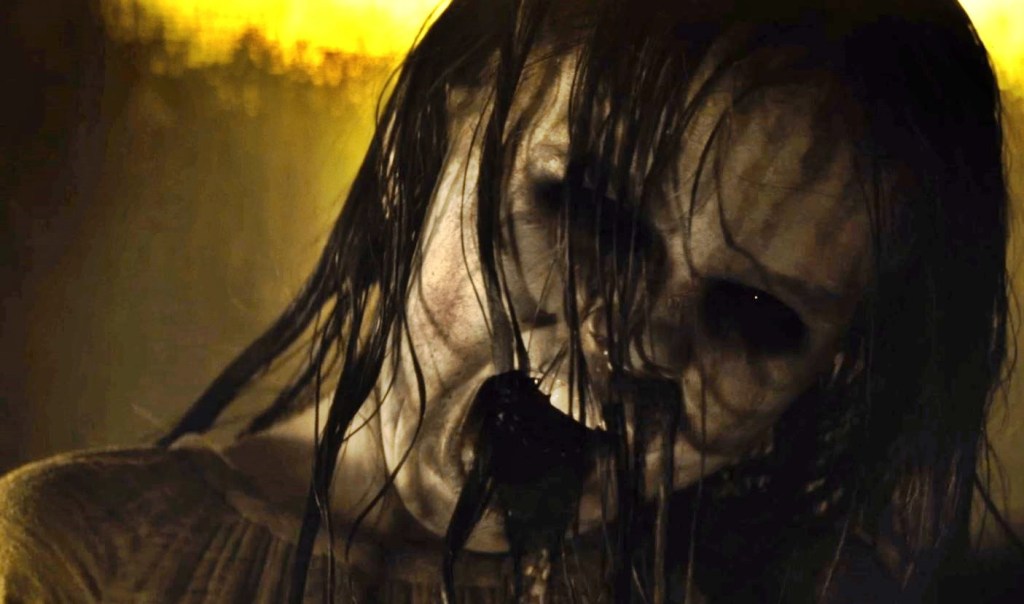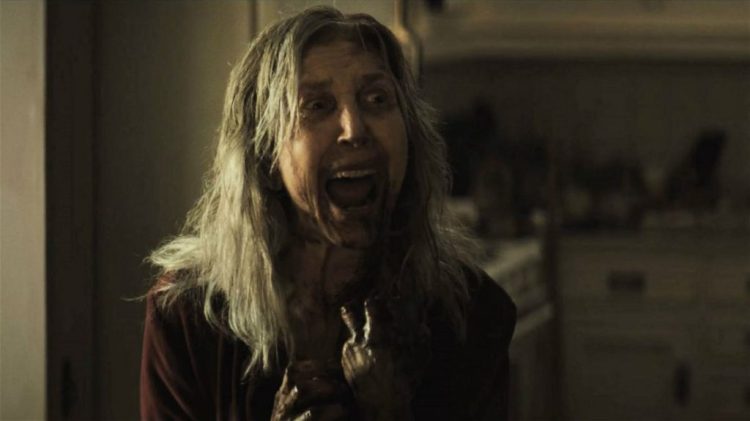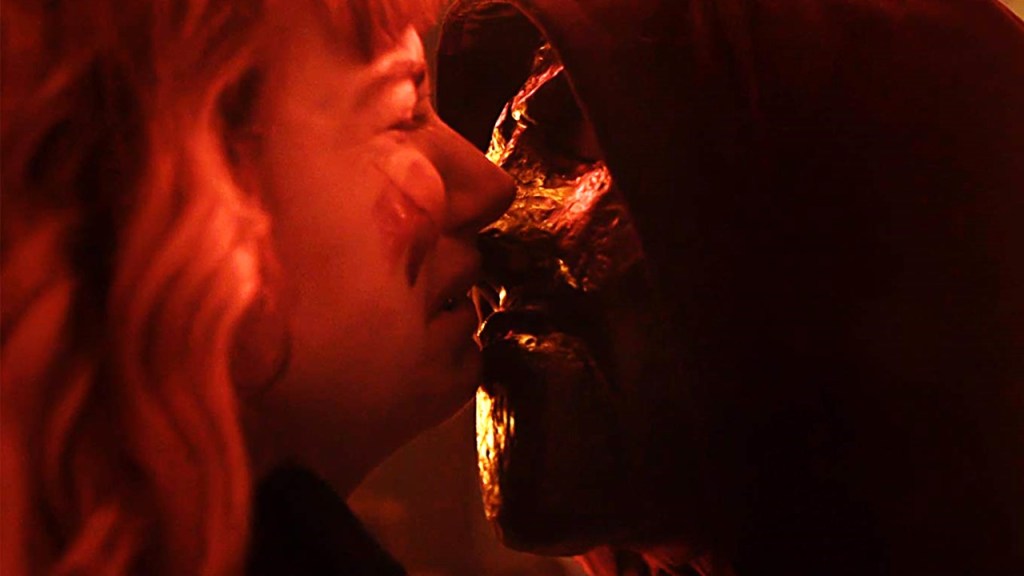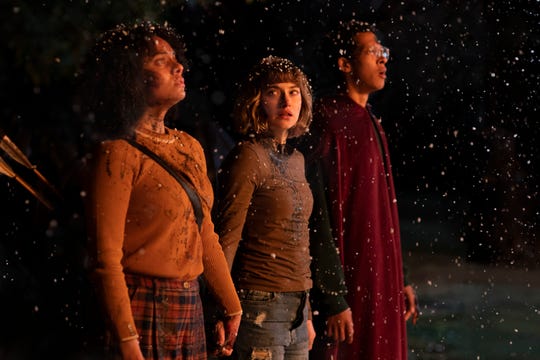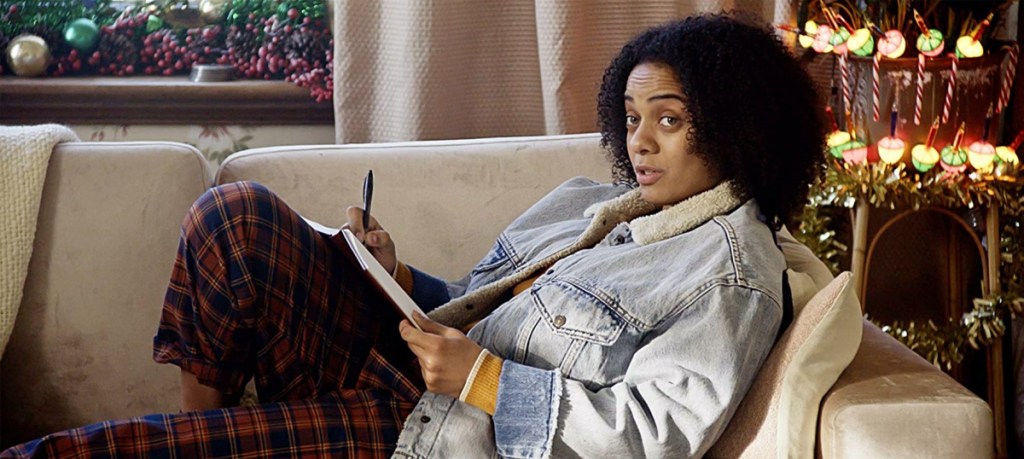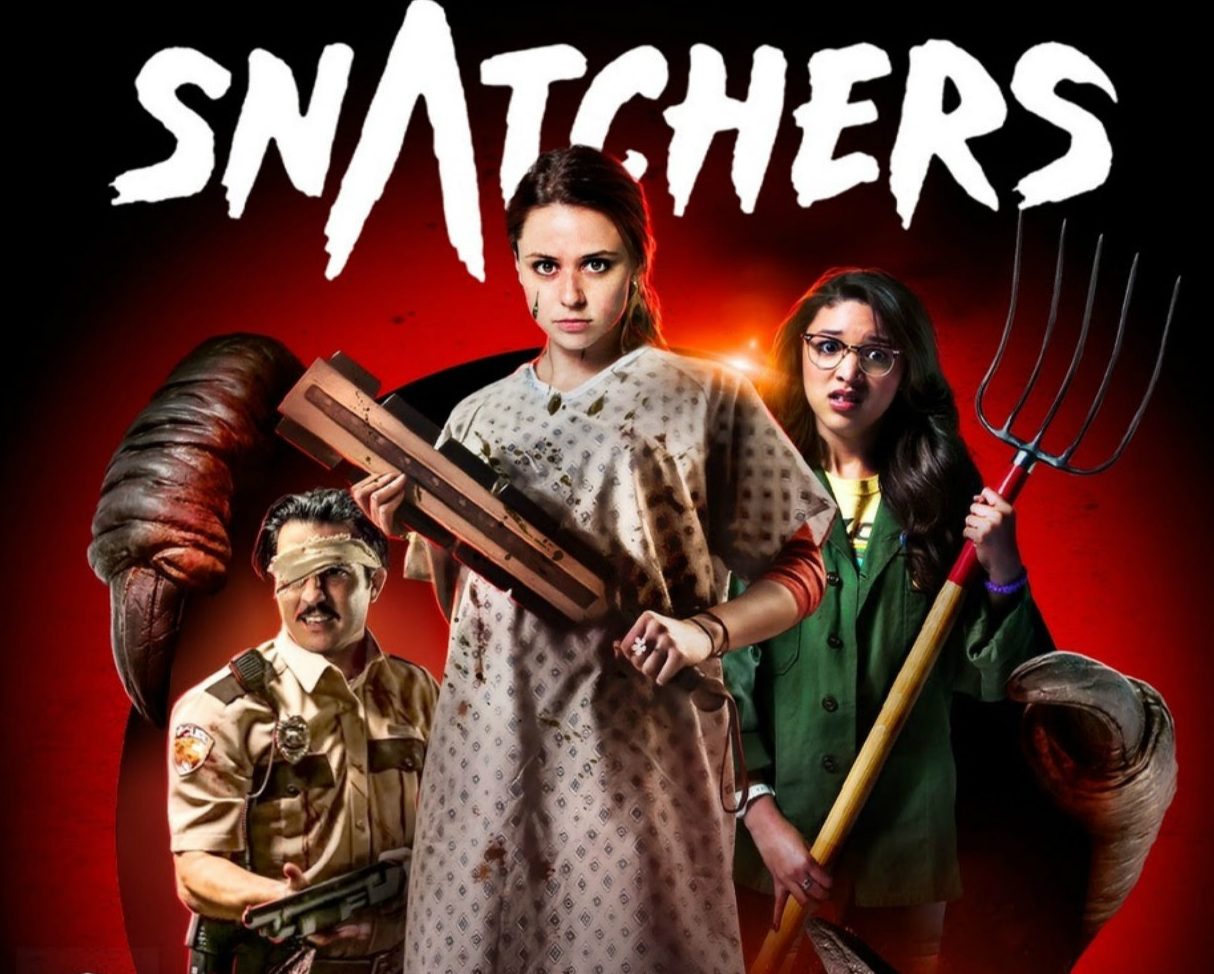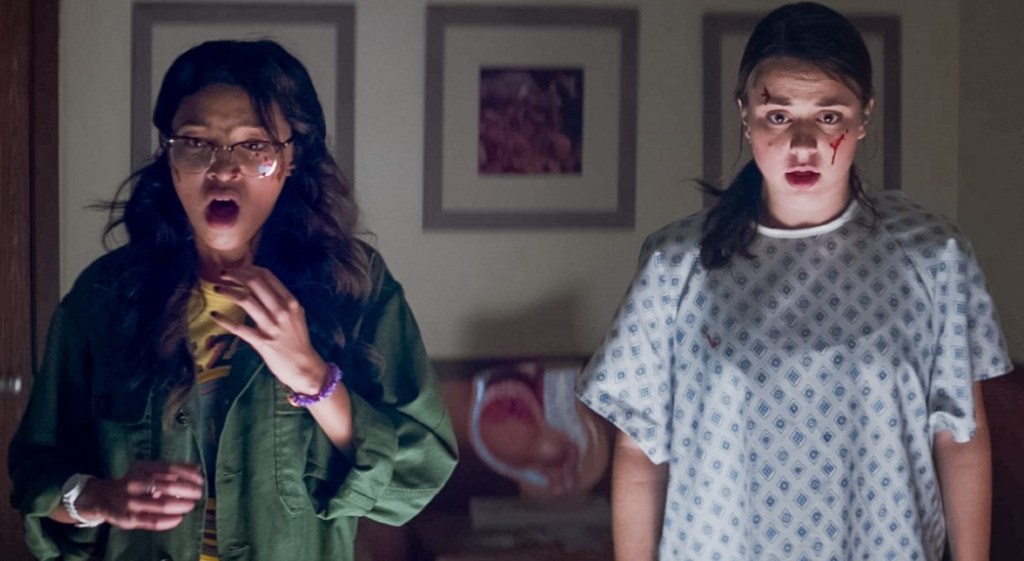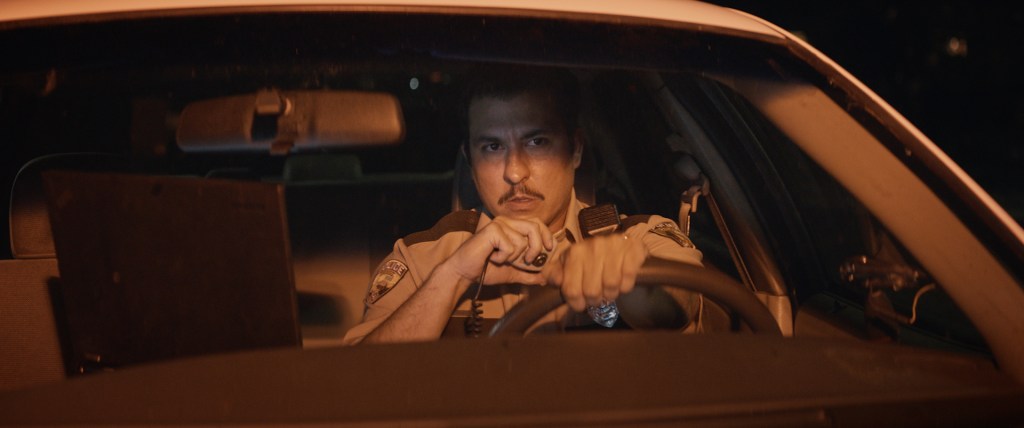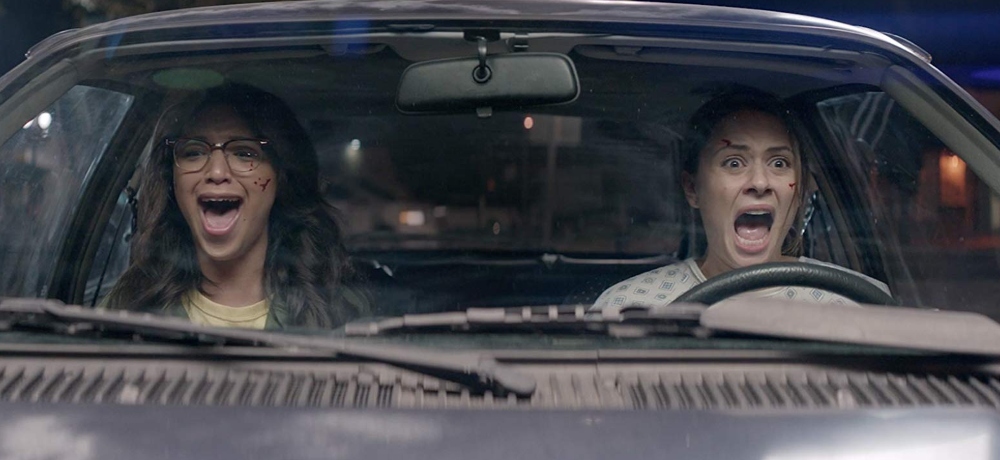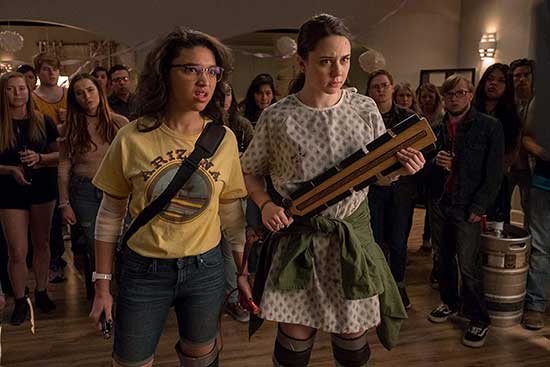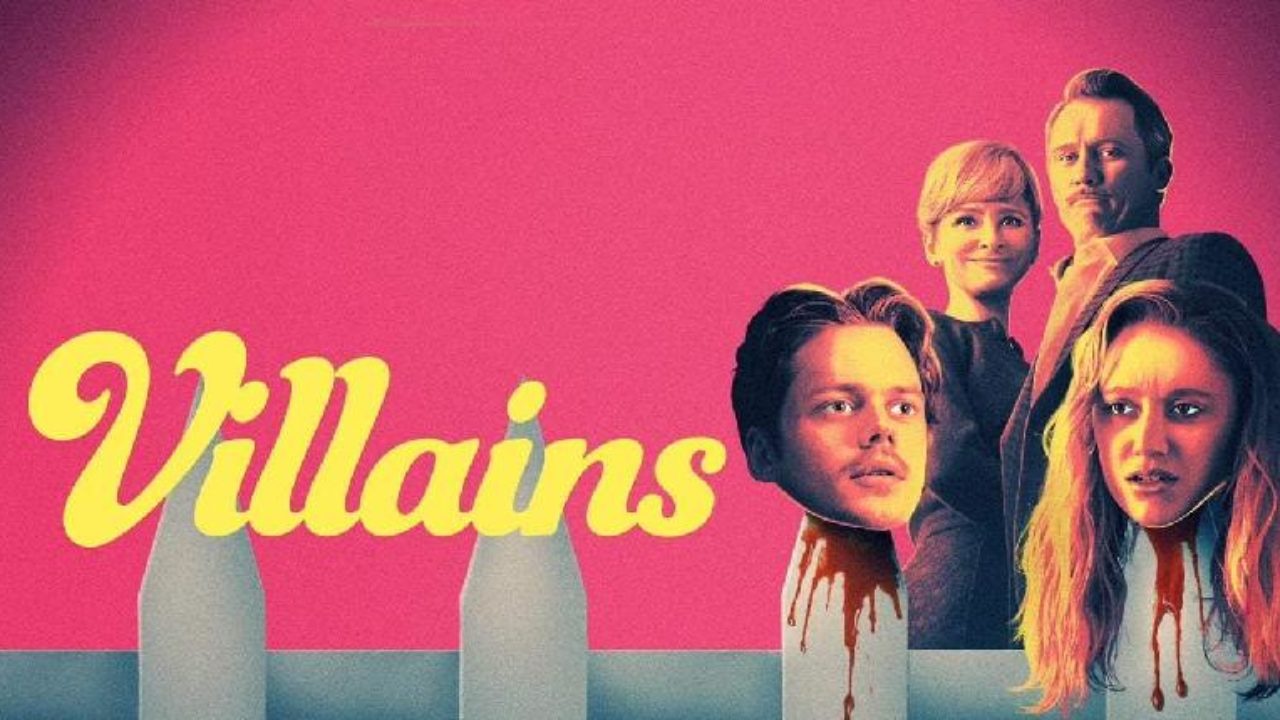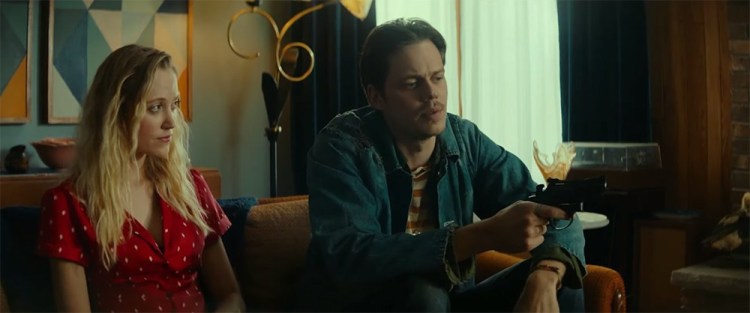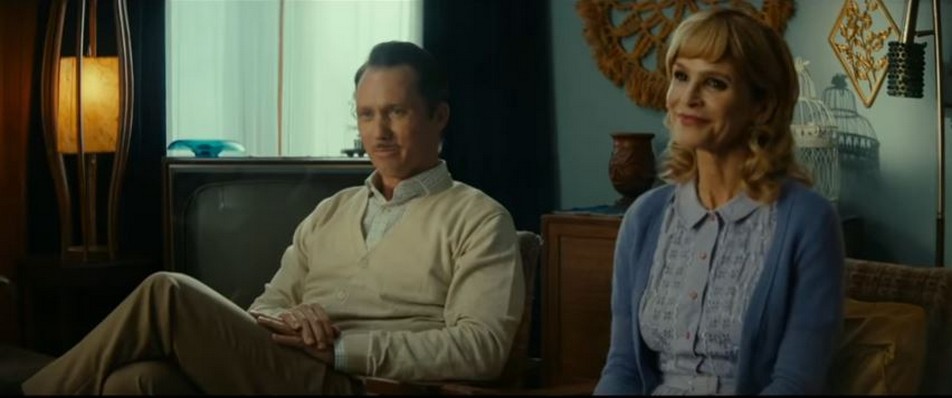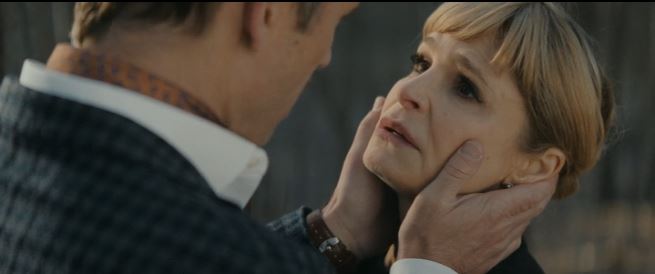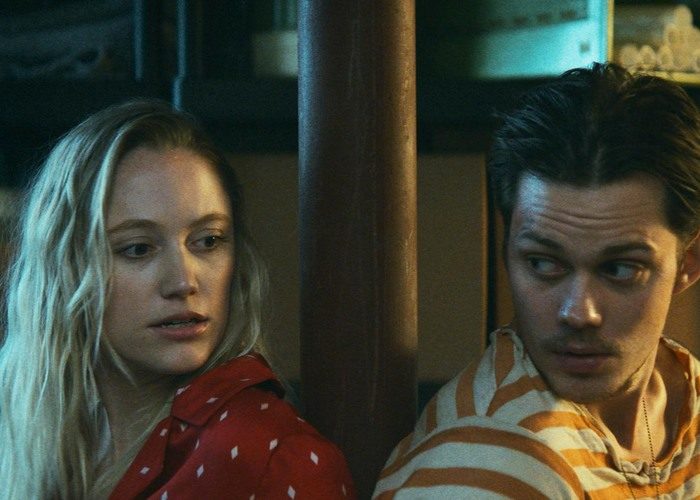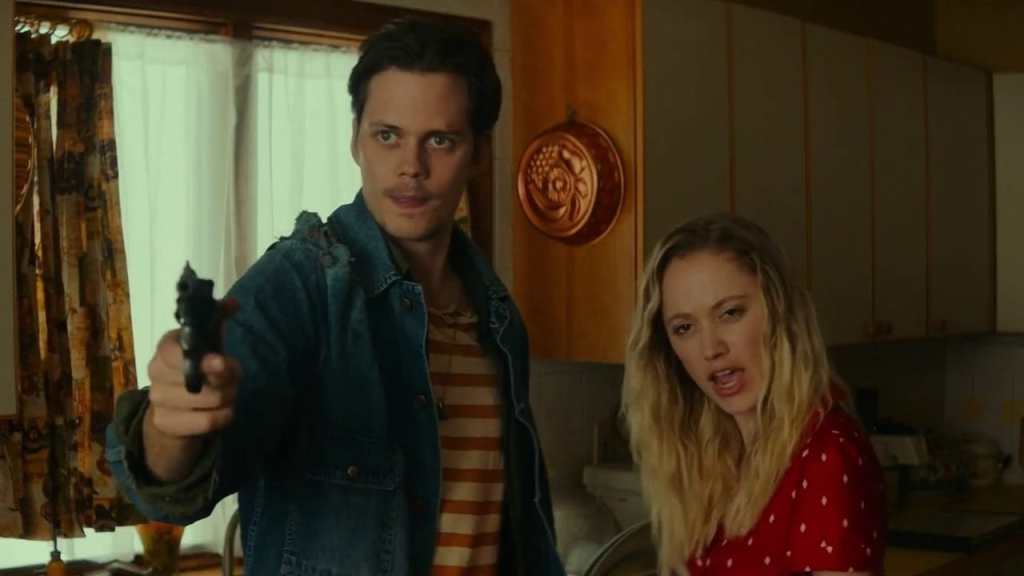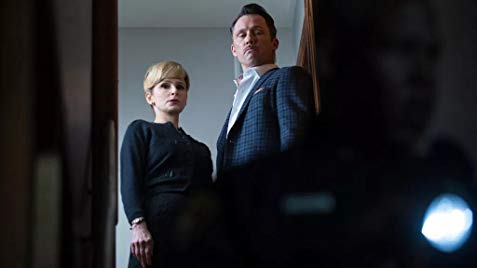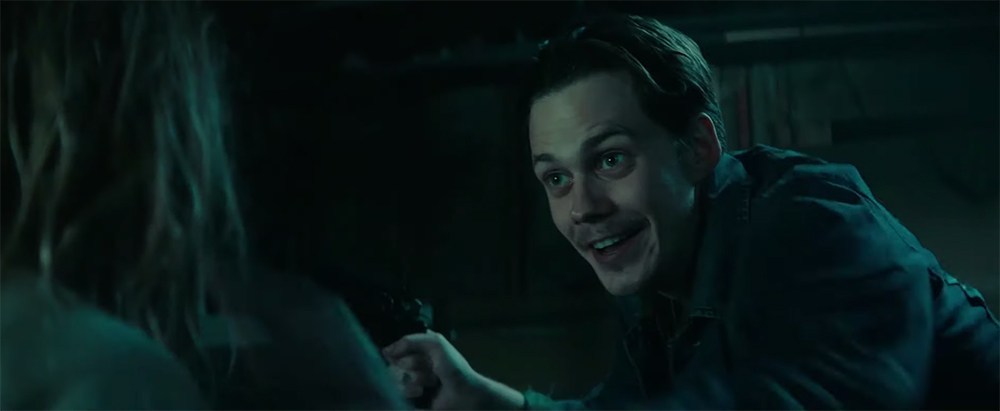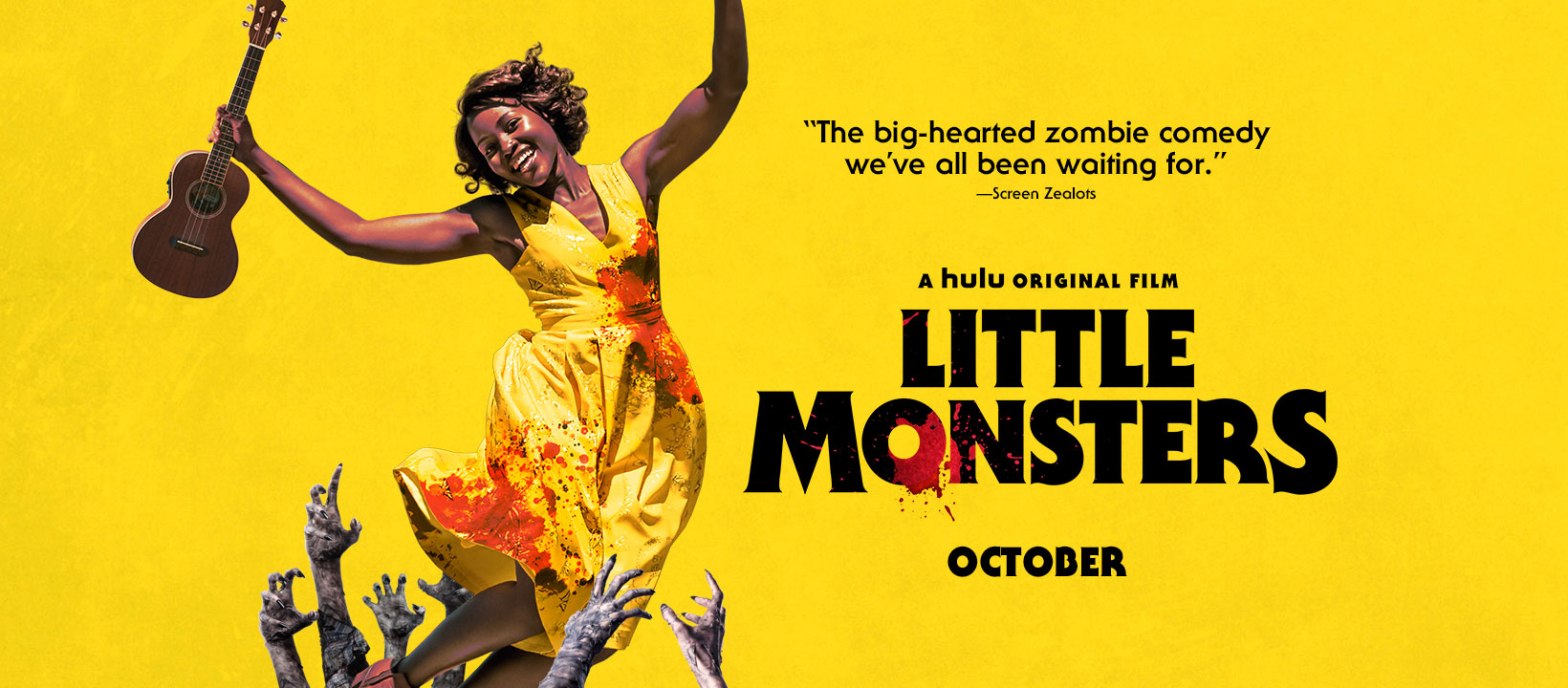
Jules (Maika Monroe) and Mickey (Bill Skarsgård) are inept but resourceful thieves who have just robbed a gas station. Ironically running out of fuel in the middle of nowhere, they break into an empty well-appointed home. All is well until they stumble onto a little girl chained up in the basement. As they scramble to free her, the owners Gloria (Kyra Sedgwick) and George (Jeffrey Donovan) come home and take the young couple hostage. Jules and Mickey are clever, but can they escape the seriously demented Gloria and George?
“We were just looking for some avocado toast! But you guys probably don’t have any.”
The movie is written and directed by two millennials, Robert Olsen and Dan Berk. The film draws a pretty clear young-versus-older, rich-versus-poor dynamic. Gloria and George, Generation X (born from 1965 to 1980) are well-to-do and dress conservatively and neatly. Meanwhile, Jules and Mickey are super millennials (born from 1981 to 1996), with their tatted-up fingers and informal clothes and lack of stable jobs. I am a little confused by Mickey’s outfit, though; minus the denim jacket, he looks like an eight-year-old from 1952.
It’s hard to find a full-body picture of Mickey–here’s a gif–but he’s dressed exactly like that boy in the middle
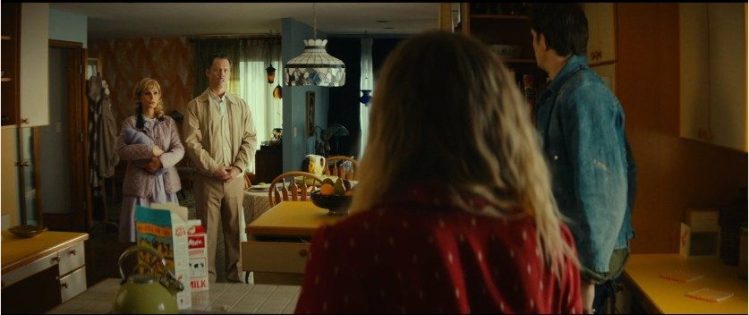
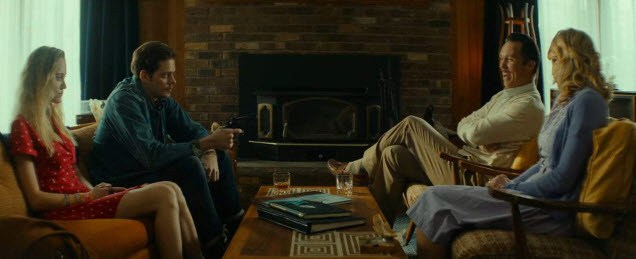
There’s a neat scene early in the film when the two couples are still feeling each other out: Jules and Mickey sit on the left side of the room while Gloria and George sit on the right, with their cardigans and their old-timey TV prominently in the background.
The characters are interesting. We find out in the first five minutes that Jules and Mickey are committing a robbery, but they’re convinced it’s the last one, and then they’re off to Florida. They’re really in love and so sweet. It’s easy to like and empathize with them right away. A lot of shots are from their point of view, my favorite being when they’re first exploring the house. They stand in the hallway and look left, and the camera pans left; they look right, and the camera pans right. In counterpoint, Gloria and George are pretty damn evil. But they’re not without their charms. They’re clearly off the rails in terms of sanity, but they come across as oddly rational and pleasant. Their syrupy southern drawls are soothing, and their devotion to each other is endearing.
Awwww, you could almost forget they kidnap and murder people
The movie’s not strictly horror–it’s a mix of comedy and action, too–but it does play with the conventions of the genre, like the scene when Jules and Mickey consider going into the dark basement. Mickey pleads with Jules to go with him, stating, “I’m not going to leave you all by yourself in this…scary upstairs.” Once down there, Mickey immediately says, “Alright. Let’s split up.”
And this is what happens! Every time! Tied to a damn pole!
While Jules and Mickey are obviously the protagonists and Gloria and George are the clear villains, the filmmakers don’t seem to be claiming one age range is better than the other, as the characters are extreme stereotypes: Gloria and George are wealthy, self-obsessed, and out of touch with modern times, while Jules and Mickey are lazy, out of touch with reality (their grand scheme is literally to sell seashells by the seashore), and self-congratulatory (they’re forever telling each other how “fucking awesome” they are, even when they’re doing dumb shit).
Jules: “So, are you guys gonna kill us, or what’s the deal?”–actual quoteGeorge: “There ain’t a sweeter sound in the world than a man trying not to scream.”–actual quote
Gloria and George’s captive Sweetiepie (Blake Baumgartner), representing Generation Z (born 1997 to now-ish), doesn’t say or do a whole lot (Jules and Mickey could have been caught by Gloria and George in any number of ways not involving a creepy chained-up kid), but she’s compelling in her own way.
“If you help us get out of this basement, I’ll give you a balloon! Do you want a balloon?”
Overall, I loved the shit out of it. It’s amusing, it’s moving, it’s suspenseful. And it’s majorly unpredictable. I totes recommend.
God I miss music videos! As an ’80s baby, I grew up in a time when if you wanted to hear the latest music you had to either turn on the radio or turn on the MTV. You had the songs you loved set to what basically amounted to short films. “Losing My Religion,” a little gem from 1991, was directed by Tarsem Singh, who did The Cell.
Except for J-Lo in whiteface, HOW AMAZING was ‘The Cell’?
Like the song playing over it, the video is gorgeous and haunting. If you’ve never seen it, you’re in for a treat.
The film documents the Poe family: father David (Adrian Pasdar), a pastor, mother Clare (Cady McClain), the chief resident of the child psychiatry unit at a hospital, and children, ten-year-old twins Emily (Amber Joy Williams) and Jack (Austin Williams). David and Clare have an inkling of how abnormal and cruel the kids are, but when they relocate the family to the country to start fresh, they have no idea what they’re in for.
Just look at these two charmers!
It’s shot found footage style. My main criteria for becoming immersed in films that use this technique is that the characters have a believable reason to consistently film what’s going on in their lives, even when dangerous shit is going down. This is the case for most of the movie, but sometimes it seems like the filmmakers forget that it’s supposed to be shot by amateurs, like the scene when Clare relates the detail that David was abused as a kid, which is voiced over footage of David drinking excessively. I can’t picture Clare hauling the camera out to spy on him, narrating the whole time. David is definitely believable as the compulsive documenter of every event.
“I’m not confident in my sermon-writing ability, so I use this as an excuse to avoid working!”
The characters are interesting. David is sometimes charming, sometimes petulant, sometimes childish and immature. Clare is the voice of reason. She can be occasionally goofy, and she’s totally winning. When the kids are out of range or ostensibly behaving, Clare and David are so cute and happy together. We get a glimpse of how they were before they had kids, and it’s heartbreaking.
The whole movie is a pretty graphic advertisement for birth control
In one scene, Clare and David are discussing their complex relationship with Jack and Emily; David bemoans the fact that he still loves them even after they reveal that they’re clearly budding serial killers. (Clare determines that they have conduct disorder, the childhood version of antisocial personality disorder, which can’t be officially diagnosed until the person in question is eighteen.) Clare says, “We can stop.” She means stop recording, but the ambiguity of the phrasing–you can also interpret it as Clare saying they can stop loving their kids–is telling. It’s a tired genre, but Emily and Jack are a pretty original depiction of evil kid characters. They’re not manipulative and mean, but instead lifeless and cold, and they have barely any dialogue.
Yeah, don’t get attached to the dog. Or pretty much anything in a two-foot radius of these kids.
Dragons are a clever image system in the movie, most notably a stuffed one that’s often in the background. In a chilling bit of foreshadowing, David reads Emily and Jack a bedtime story, The Dragon and the Paper Bag. It’s about a two-headed dragon that masquerades itself among schoolchildren and gains their trust, after which it eats them alive.
Totally a match for a two-headed dragon
Naturally, I have complaints. I got grumpy about how it’s unethical for Clare to diagnose her kids or prescribe them anything; in the field of psychology, an objective third person is best qualified to handle mental health issues, not someone the patient knows outside of treatment. (Though to be fair, by that point in the movie the kids’ behavior is totally off the rails, and Clare’s professional ethics are the least of her worries.) But really, my biggest gripe is that David, knowing his kids are assholes, teaches them lock-picking. Overall, I really enjoyed it. Give it a look if you’re in the mood for something gripping and creepy.
When I’m not reviewing horror movies, I am employed as library support staff (NOT everyone who works at the public library is a volunteer or a librarian). I recently wrote about some terrifying fairy tale and folklore books (which you can read here) when I was inspired at work, and I was recently motivated again when the above book, Zeralda’s Ogre, passed across my desk. It was so laughably inappropriate that I had to write about it. I easily came up with four more.
5. Zeralda’s Ogre, written and illustrated by Tomi Ungerer
Just sooooooo many issues with the title page alone
On the very first page, we’re introduced to the ogre:
Yes, this book is still in circulation.
In case you can’t make out the text, it describes his weaponry and “bad temper.” It also states, “Of all things, he liked little children for breakfast the best.” Subsequently the ogre kidnaps and eats the local children, and thus: “Terrified parents dug secret hideaways for their infants. They stuffed their little boy and girls into trunks and barrels in shadowy cellars, and in underground vaults.” This leads the giant to become increasingly cranky. Meanwhile, little Zeralda lives off the grid on a farm and has no idea the ogre exists.
If you guessed that this book was published in the 1960s, you would be correct.
Her big thing is cooking, even though she’s six, because childhood is a fairly recent sociological invention. She’s also capable of riding a mule-driven cart into town to sell her father’s wares when he’s sick. She meets the giant when his dumb ass is so excited to eat her that he falls down and gets a concussion.
That lizard’s concern for the ogre is touching.
Zeralda figures out that he’s hungry, and her first response is to cook all the stuff she was supposed to sell in order to feed her family–yes, that is the pig from the previous page.
Look at that mule, hoping it’s not next.
The ogre is so happy not to be starving that he invites Zeralda to cook him some more stuff. So Zeralda and her dad move in with him and Zeralda becomes the official ogre chef.
Ye gods, what’s the deal with that lute player?
And when Zeralda grows up, she marries the ogre. ‘Cause 1960s.
They lived happily ever after, at least until that one with its back to the reader ate its baby sibling
4. Minnie and Moo Go Dancing, written and illustrated by Denys Cazet
Don’t worry, this assault by pencil doesn’t go any further.
I became acquainted with this book while looking for age-appropriate reading material for my daughter Layla–this series was recommended. Let me assure you, we didn’t get farther than this one.
Minnie and Moo are two talking cows. When the book opens they’re rating the sunset with scorecards. Moo then discusses her wish for thumbs so that she could dance. Minnie assures her that cows have great lives, and that they don’t need thumbs to enjoy themselves. However, they apparently need to dress like humans, so they head into a barn for cast-off people clothes. Their bovine neighbors are suspiciously missing. That doesn’t stop Minnie and Moo from tarting up and heading to the farmer’s house party. The farmer’s wife Poopsie mistakes them for her sisters-in-law from California. “‘You look just like your pictures,’ Poopsie said.” She then wastes no time hooking them up with two single bumpkins standing by.
Ewwww…
After dancing and yelling “YA-HOO!” Moo eats some party fare: hamburgers.
“Moo…” Minnie said softly. “You’re going to hell.”
Minnie is horrified, and has to inform Moo that “Hamburgers are beef! Oh, Moo. Didn’t you know. We are beef! Moo…you’re eating someone!”
“Moo…” Minnie said softly. “How did she taste? Pretty good?”
The two run off before they’re next on the chopping block, taking the hamburgers and burying them. Luckily, they run into the Holsteins, whom they haven’t eaten after all. (What or whom they did eat is never addressed.) Poopsie and her buddies are searching for their missing party guests, and Poopsie finds their dresses. “‘They’re gone,’ she said. ‘Without clothes?’ said the farmer. ‘YA-HOO!’ cried Hank and Bobo.” ‘Cause hillbillies being thrilled their paramours have discarded their clothes totally belongs in a childrens’ book. They go home, and the cows dance under the stars, all the while Minnie giving Moo a creepy side-eye and possibly testing her meat content.
“Yes…good friends are such…delicious magic…”
3. The Saddest Toilet in the World, written by Sam Apple and illustrated by Sam Ricks
Toilet, I don’t even know where to start with what’s wrong with you…
This one was introduced to me while working a late shift with Ruthanne, a children’s librarian. She was browsing the new books, and for some reason decided to read this one aloud. I was dying trying not to make too much noise while laughing hysterically.
Do we want to question what the toilet’s tears are made of? We do not.
The book opens by introducing us to Danny, who loves to sit anywhere but the toilet. He claims he’s just not ready, despite his parents trying to bribe him. Danny’s mother has to console the toilet, who sobs, “I don’t understand. What does the couch have that I don’t?” (Well, Toilet, people don’t move their bowels on the couch, how about that? It’s more about what you have that the couch doesn’t: bacteria.)
Shit jokes and puns are inserted throughout the book–check out that bottle of “POO” in the background.
The toilet decides it can’t live that way, packs a suitcase, and leaves. Unfortunately, Danny had decided he was ready, and is distraught to find the toilet gone.
“Did he really have to take the plunger?” Shut up, Dad, you’re useless!
So they look and look.
In increasingly inappropriate ways…
Then, when all hope is lost, they find it.
Why does this look like one of those catch-up-with-the-fleeing-lover-at-the-last-second scenes from a romantic comedy?
Danny takes a jolly dump in it, and all is well. Time to celebrate!
Those kids behind them are stunned into silence.
2. The Grey Lady and the Strawberry Snatcher, written and illustrated by Molly Bang
I found this one on the internet when the focus of the listicle was going to be books published in the ’70s and ’80s.
The meat of the story (it has no words) is that a lady buys some strawberries and is then followed by the terrifying titular snatcher.
Look at it, trying to be all nonchalant!
It just silently follows her, getting gradually more bold.
And then the Buddhist goddess Kwan Yin shows up on a skateboard, for some reason.
Seems rude not to offer her a strawberry…
The illustrations are absolutely gorgeous, but horrifying.
Are we sure this thing wants to eat her strawberries, and not her face?
Fortunately, after following her for miles, the creature discovers blackberries, and the grey lady can eat her strawberries with her adorable family in peace.
Mudkin, written and illustrated by Stephen Gammell.
This one came to mind because of the author/illustrator. If the name Stephen Gammell doesn’t strike fear in your heart, you had a deprived childhood.
Bask in the grotesquerie!!!
Even when Gammell’s not trying for scary, it’s scary as fuck. Look at all these dribbles and the font that looks like a deranged ransom note.
I’ll do anything you say, Queen, just don’t hurt me!
Look at her beady eyes and that sentient purple thing!
Our unnamed protagonist comes across a mud creature that doesn’t speak except in spatters.
“A mask of human skin? For me to WEAR? Cool!”
Mudkin presents her with a mud crown, which hopefully is not constructed of other mudkins.
“Hey, this smells FUNNY! Are you sure this is MUD?”
This does not sound like dialogue from a delightful, whimsical story. It sounds like she’s being kidnapped to live with the tendril-y mud people for eternity.
Why does the word “FOREVER” look like it’s smeared in blood?
At least until the sun comes out and dries up all the rain. The girl then picks up her purple cat-fox, her crown, her bear, and her Beetlejuice doll and goes home, her blobular friend already forgotten.
Why…is the chair floating…?
Works Cited
Apple, Sam. The Saddest Toilet in the World. New York: Aladdin, 2016.
Bang, Molly. The Grey Lady and the Strawberry Snatcher. New York: Simon and Schuster, 1980.
Cazet, Denys. Minnie and Moo Go Dancing. New York: DK Publishing, 1998.
We open with a title card about a witch coming to steal kids at sea, and move on to Sarah (Emily Mortimer) being held by the police, who speculate “God only knows what happened out there.” Sarah is dehydrated and bruised, and her husband David (Gary Oldman) is conspicuously absent, though their daughters Lindsey (Stefanie Scott) and Mary (Chloe Perrin) are safe. She tells Detective Clarkson (Jennifer Esposito) her story: David, tired of giving fishing tours, wanted his own boat and his own business, so he bought a vessel with a history of not one, not two, but three unexplained cases of entire crews going completely missing. Once at sea, everyone on board: Sarah, David, Lindsey, Mary, Lindsey’s boyfriend Tommy (Owen Teague), and first mate Mike (Manuel Garcia-Rulfo) are all under the evil influence…of the cheap murder boat.
If you guessed that this scene leads to a cleaning-up-the-boat montage, you would be correct.
I was loath to see Mary, and kept putting it off. I’m not the biggest fan of Gary Oldman, and I have an irrational aversion to movies taking place outside. Plus I had difficulty taking it seriously, because the idea of an evil boat invariably brings to my mind the movie Cooties, in which Elijah Wood plays a hack writer transcribing his book: “Chapter one: The boat was evil. But he loved the boat…Chapter one: The boat was evil, but he didn’t know just how evil…The boat was evil, but it was an acceptable level of evil…Chapter one: The seafaring vessel–the schooner–was evil. [Sighs] It’s getting there.” When Sarah states, in all seriousness, “Evil needs a body to exist. The body was that boat,” all I hear is Elijah Wood. Sidebar: if you haven’t seen Cooties, get on that now. I’ll wait.
Why yes, that is Leigh Whannell on the far right. He wrote it.
I found it frequently boring and insufferably paint-by-the-numbers, particularly the characterization. David is the unstable patriarch who insists that “We’ve just had a run of bad luck”; Sarah is the shrill family bookkeeper screaming about the bills/worried mother (you could play a drinking game in which you imbibe every time she runs around the boat calling Mary for no particular reason); Lindsey is the teenage girl cliche, obsessed with wi-fi, her boyfriend, and making decisions that horrify her mother; Mary is the typical female-under-ten character–she’s supposed to be cute, and that’s the extent of her personality. Her job is to draw pictures explaining what’s happening with the ghost, and when it possesses her it’s supposed to be shocking because she’s supposed to be so damn cute.
Ugh, what a waste. I gripe about Oldman’s personality, but I have to admit he is an exceedingly talented actor. Mortimer could also be doing better.
There are multiple references to The Shining, because why not freely copy from something more famous while you’re at it: an impassioned speech about how they need to stay on course to keep the family going financially regardless of the insane shit that’s happening; a possessed character insisting the male lead kill his family, being locked up, a low-angle shot of him pounding on the door, and a ghost letting him out.
“Drown them! Also the boat-demon wants you to drown them!”
I fought the urge to just turn it off–which I have a strict policy of never doing, because with few exceptions (Seed II, Razor, and The Creepscome to mind) even the most unpalatable film has a hidden gem or two (or is at least so bad it’s funny). Making movies is hard, folks. I know this in my heart, even if I enjoy being snarky. The action does pick up after a while, once there’s more haunting and less whining, and a movie that I thought held no surprises showed me a thing or two. Owen Teague puts in a great performance for a brief but memorable role.
The ending is neat. I was glad that not all of the characters of color die, and it’s just so refreshing that the first death is of a white person–that’s one cliche they do manage to avoid. But overall, you can take it or leave it. Give it a look if you’re in the mood for something entertaining but no masterpiece.
Belgian movie, but in English. Lucas (Charley Palmer Rothwell) is a bored cashier whose ennui is interrupted by the sudden return of his ex, Chloé (Roxane Mesquida). She convinces him to enter the final round of Paranoia, a game of wits and riddle-solving, with a prize of a million Euros (roughly a million dollars U.S.). A few brainteasers later, they meet Maxine (Daphné Huynh), Ray (Hippolyte de Pocques), Naomi (Marie Zabukovec), and Jablowski (Thomas Mustin) at the final-est round, a psychiatric hospital. Split into teams of two, they’re forced to solve increasingly deadly puzzles.
Woo, Lucas and Chloé are on fire!
I came across this movie when I had a rent-one-get-one-free deal from Redbox. It was my third choice, and I wasn’t extremely enthused about it. As I checked the general info on IMDb, I saw it had extremely low user ratings, with one claiming it was boring. So I lowered my standards and got on with it.
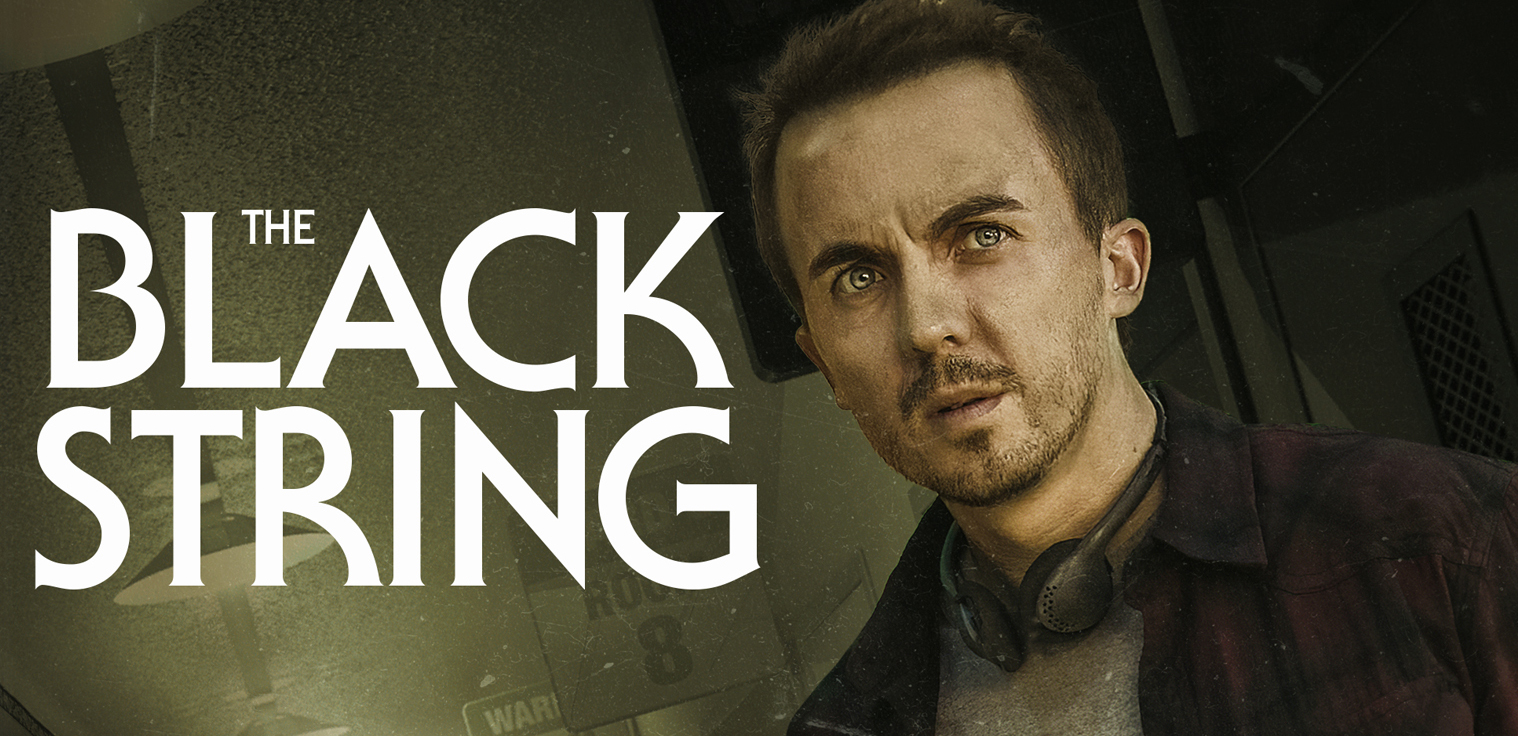
Nyeh, I wanted to watch The Black String!
And I was pleasantly surprised! I didn’t think it was boring at all. The opening is mysterious and quite beautifully shot. The pacing isn’t inordinately slow, and while the characters aren’t exactly likable, they’re interesting. I wasn’t actively rooting for any of them to disappear. The suspense is sustained admirably throughout. The gamers face pointy blades, fire, electric shocks, and a dentist chair complete with instruments. Watching Lucas’s sharp mind go to work is a lot of fun. (I can’t picture Americans doing well at Paranoia, ’cause ya have to know stuff, about other countries even.) Chloé meanwhile is not as savvy, but she’s twice as gutsy. She too is a pleasure to see in action.
‘Ho hum, just another day for Chloé.’
Of course there are torture scenes, but violence is used sparingly, and it doesn’t come across as cheap or exploitative. (Maybe that’s why some people thought it was boring–it’s not bloody enough.) Overall, I was glad I watched it. It’s not film of the year, but I wholeheartedly recommend.
“Come and solve puzzles with us. Forever and ever and ever…”
It’s a federal holiday, my children are with their abuelos, and I am sick with a disgusting cold. It’s the perfect storm for a movie day! I’ve had a growing pile of Takashi Miike must-sees, and today’s challenge is to discover whether I can stomach them all in one day: Ichi the Killer, The Happiness of the Katakuris, Visitor Q, and Over Your Dead Body.
If you’ve never had the joy of seeing anything by the distinguished Japanese director, his work is distinctly high-quality but terribly gory and often quite difficult to watch, for example Auditionand the “Imprint” episode of Masters of Horror.
Perhaps you remember his cameo in Hostel?
I’ll be documenting my experience with short video journals and written notes. This is my first foray into mixed media, so I’m wingin it. I hope you join me!
I read this film was banned in several countries, and that at some film festivals, barf bags were handed out. I also read that a scene in the opening featuring a large puddle of semen featured the real stuff. Oh boy.
Oh noes! Boiling oil to the back! “Just a little torture,” says Kakihara. No big deal. There’s some comic relief from the nauseated reactions of hardened criminals to Kakihara’s methods.
Ichi is an interesting character. He seems innocent and beaten down by life and manipulated by others, but he inflicts such violent deaths. He splits a dude in half! Meanwhile Kakihara is so cocky. And a snazzy dresser!
People are mean. The world is a cruel place.
It’s really a fascinating plotline, between the violence. And also during.
Aaaaand the first line is, “Have you ever done it with your dad?”
Rock attack number one…“Some things…are truly strange.”–actual quote. Yes indeed, like The Visitor sitting bemusedly under an umbrella while his hostess squirts out gallons of breast milk in sexual ecstasy.Reaction shot: this is bonkers!
Reportedly the Japanese title translates to Eater Woman. I much prefer that title. Sounds less westernized.
I read that the play the characters are performing is a super popular Japanese folktale; even Sadako in The Ring is an homage to it. You can learn more about it here.
Okay, there’s been a self-inflicted fork stabbing. The buildup of tension is quite impressive, as real life starts to mirror the play and reality and fantasy mix.
Yep yep, just a prop doll crying actual tearsYikes, this scene is heartbreaking
Okay, we’re pulling faces off and decapitating, now it’s Takashi Miike.
I doubt Miike was actually inspired by Alice Cooper, but here’s the song this movie makes me think of, “Only Women Bleed”, if you’re interested:
Wowza, what a day! I shan’t be doing that again any time soon. Though there will be a Jaume Balagueró challenge in my immediate future…
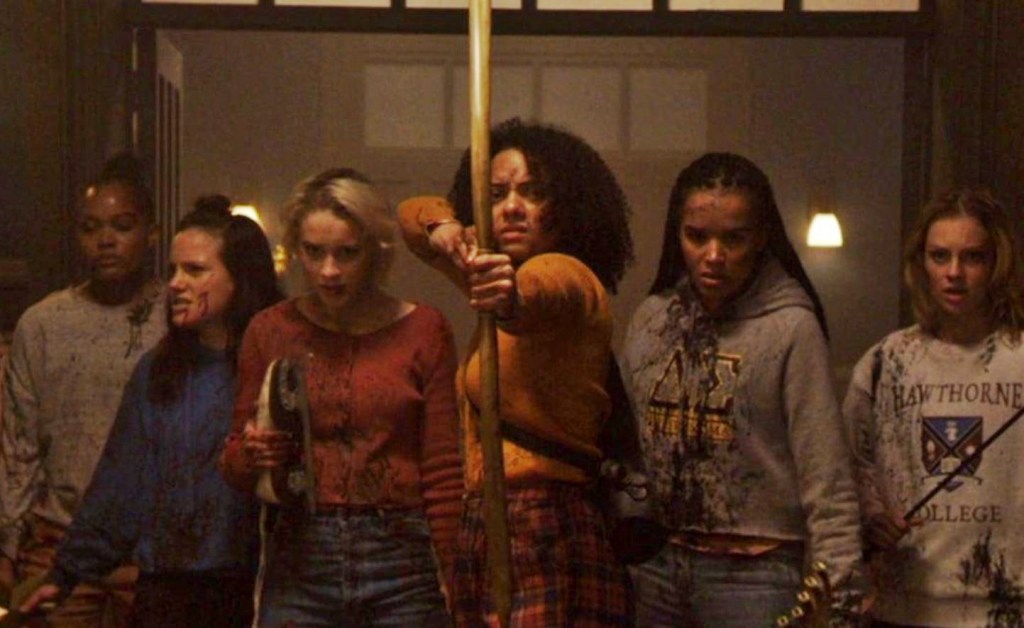
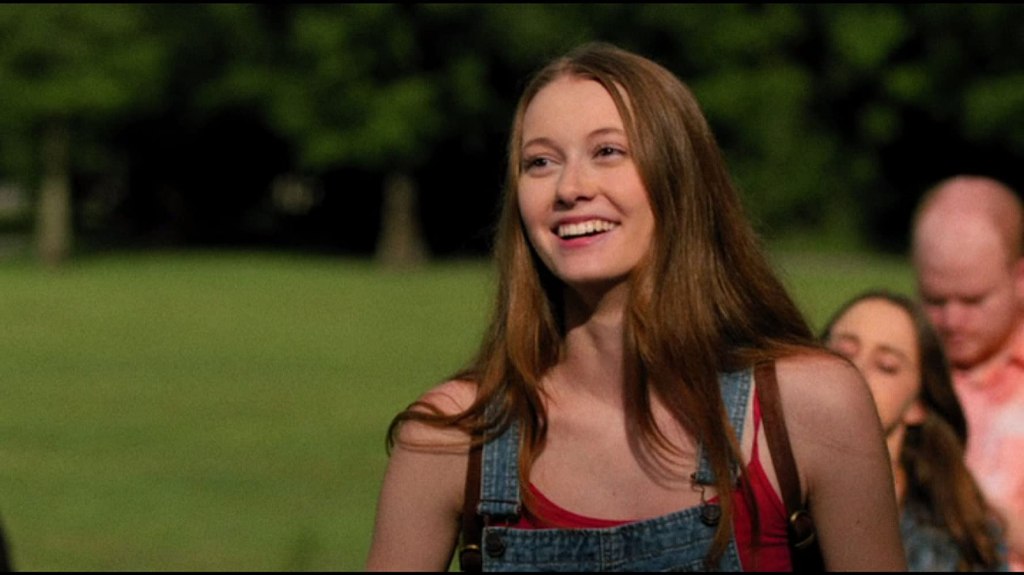
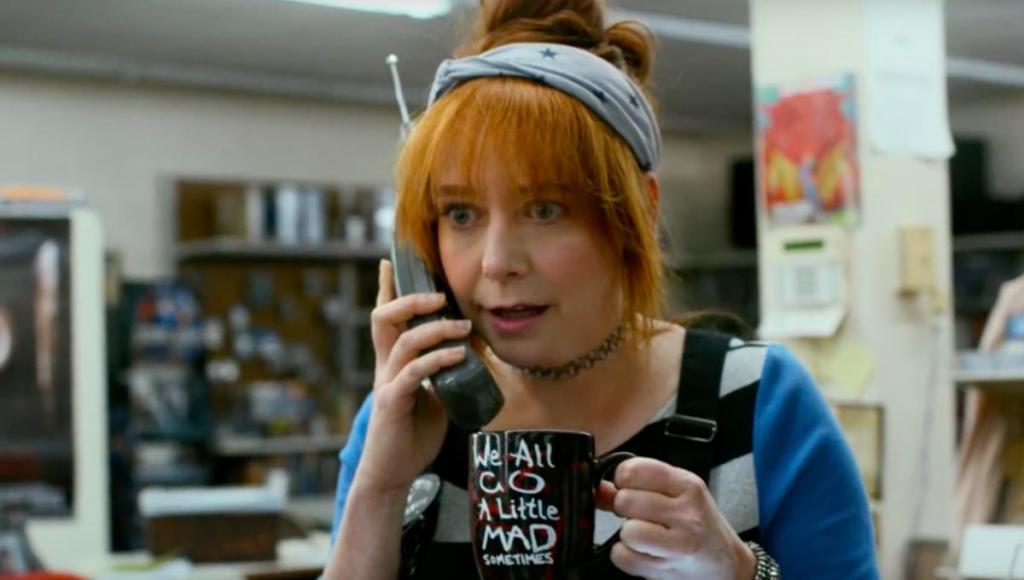
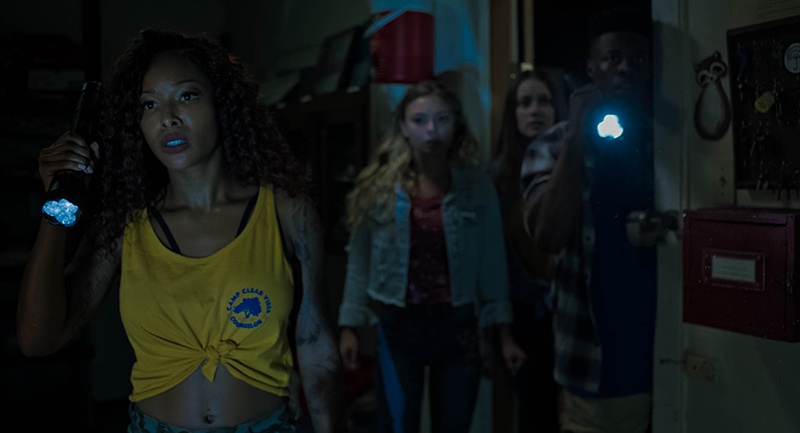
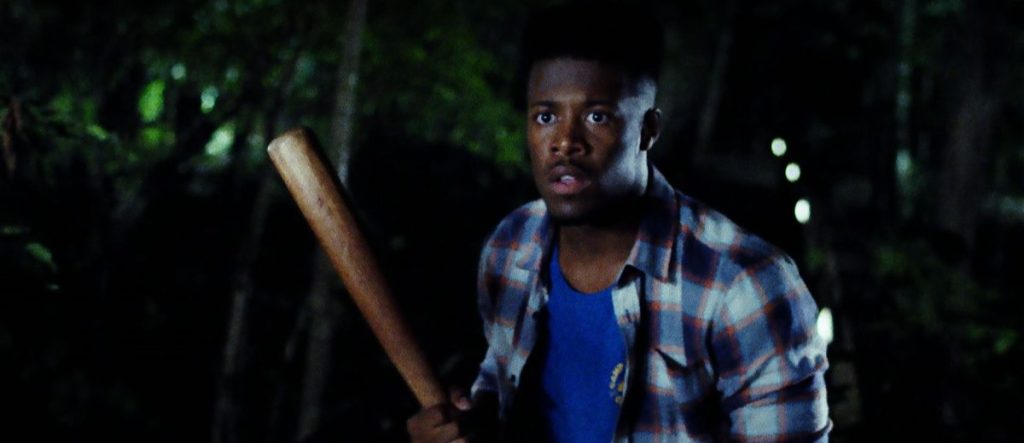
The film opens at a Halloween party in 2015. A group of teens, including Cheryl (Kristina Reyes), Nicky (Kya Brickhouse), Troy (Max Miller), and the eponymous (Pa)Trick (Thom Niemann) are playing spin the bottle. When Trick lands on a dude, he inexplicably starts murdering people. Detective Denver (Omar Epps) and Sheriff Jayne (Ellen Adair) shoot him multiple times, but no body ever surfaces. Subsequently, each year on Halloween a massacre with a similar MO takes place. It looks like Trick is alive and stabbing.
“FUCK this kid likes pumpkins!”–actual quote
The movie starts out weird and snowballs into ever-increasing weird. Now I don’t mean weird like avant garde or experimental. I mean all of the characters making absolute batshit decisions, like Cheryl and Nicky fleeing from Trick to the hospital, where Cheryl abandons the injured Nicky to have a heart to heart with her father. Characters are hastily introduced, like Nicky’s…siblings? Niece and nephew? The dialogue referring to them is so vague that the relationship is never fully explained. Then they disappear without any impact on the plot.
Here’s Jamie Kennedy as the crappiest doctor ever!
Speaking of which, the dialogue is often exceptionally bad. One of my favorite quotes: Denver– “He murdered [name redacted] with a gravestone of a fed I got killed. Who does that?” Then there’s this exchange between Denver and Jayne: Denver– “And yet he’s the poisonous fog that rolls in and kills everyone without rhyme, reason, or remorse.” Jayne– “You’re confusing evil with crazy.” “Denver– “I know crazy. Cops are crazy.” Jayne–“You’re right. Cops are crazy. I play Tuesday-night hearts with cops. I eat with cops. I bowl with cops. I fuck cops. We may be crazy, but we’re not alone. But Trick is. His crazy is alone and methodical. He can join a Nazi group on Facebook, even build his rep in the feeds, but not as himself. No, the only ones he shows himself to are those hunting him.” Okay, one more random quote: “Enjoy the fun in this piece of shit.”
Remember Tom Atkins from Halloween III? Silver shamrock!
Because the film has no logic, reason, or much in the way of themes (it tries to convey something about how people blindly follow social media), it’s pretty unpredictable. Most of the characters are still somehow quite likable. I love that the main protagonists are a Black detective, a tough female sheriff, a Latina woman, and a Black woman. Also, Jayne’s second-in-command is played by Dani Shay, a nonbinary actor. Deputy Green is a small but memorable role.
They’re so adorbs!
I recommend Trick wholeheartedly; gawk at the wondrous diversity coupled with questionable writing!
Ken (Chaz Bono) is a sexy but deranged diener (the technical term for an employee at a morgue–not a lazy pun, I googled it) who inadvertently reanimates a baby that died in the womb. He decides to take the infant home and raise her as his sister, naming her Tess. (Don’t expect logic here, just go with it.) Cut to Tess (Kayleigh Gilbert) turning sixteen, fleeing her creepy, abusive keeper and his mummified mom, and seeking out her birth mother. Meanwhile, said mother Lena (scream queen Barbara Crampton) is an actress teaching acting to others and trying to reanimate her career. When Tess finds her, Lena takes her for a student, and they bond. However, Tess is pretty cavalier about electro-killing anyone who crosses Lena, and Detective Marc (Michael Paré) has keen eyes on the case.
Lena just has keen eyes
I came across this movie while browsing new additions on Hoopla, a streaming service through my library. I decided to watch it after discovering the double whammy of Crampton and Rae Dawn Chong, one of my faves–I had just been wondering where she went. I figured it would be a stinky dumpster fire, going by the synopsis: “A stillborn baby girl is abducted by a morgue attendant and brought back to life by electro-kinetic power.” Indeed, the film has its weak points in addition to the ludicrous premise: bad special effects, random theft from more powerful movies like Psycho and Carrie, not enough Rae Dawn Chong. The characters aside from Tess and Lena are flatly one-dimensional, especially the ones who piss them off.
There aren’t even enough stills of her from the movie! This is the only one I could find!
However, I found a lot to like. Aside from the obligatory horror movie body count, there’s a lot of character development for Tess and Lena. Tess is played skillfully by Gilbert–she’s a delightful mix of campy and creepy. Given the abuse that Tess suffered, her yearning to be loved and accepted (and her adorable, winning smile) make it possible to empathize with her. Lena is the real focus of the movie. A major theme (yes, it has themes!) is rebirth, and Lena is fighting to prove herself. She’s overcoming the lifelong habit of repressing her emotions and guilt from her past to move on with her life.
This movie could totally have been a groundbreaking genre-bender. One of my great film loves after horror is the dramedy about a quirky family getting its shit together, like This is Where I Leave You, The Hollars, and The Family Fang. (It is a very white genre, I’m afraid.) Imagine Ken as less horrifying and an actual big brother to Tess; he’s the lone wolf who still lives at home with their mother. Let’s say she’s played by Margo Martindale and not a dummy. She passes away, and Tess and Ken go on a journey to find her birth mother. Cut to Lena and her agent/wife Dory (Rae Dawn Chong). Lena is forced to confront the guilt she feels about her past mistakes, and the comedy/horror aspect comes in when Tess’s whole family comes together to teach her to control her temper. I’d watch it.
Teen angst!!!
Anywho, I enjoyed it much more than I expected to. Give it a look if you’re in the mood for a chick flick with poorly executed electricity-related deaths. Or just watch the trailer, it spoils literally the entire movie.
Bird (Kathryn Prescott) is your typical vanilla final girl whose friend Tyler (Davi Santos) gives her an old Polaroid camera from a yard sale. Unfortunately it’s a haunted camera–that’s bad. But it comes with film–that’s good! It also dooms everyone who has their picture taken–that’s bad. Can Bird solve the riddle of why the camera is so pissed off before she and her friends die?
Based on the teens in this video, they’re all done for!
Polaroid is a movie of few surprises. Basically, if you’ve seen one PG-13 movie about a group of cursed friends dying off, you’ve seen them all. We have tropes like the victim wandering slowly around her house, calling, “Hello?” and “This isn’t funny!” and “I’m all by myself and hearing suspicious noises, so let me go investigate my pitch-dark attic without so much as a flashlight!” (Okay, she actually says only two of those.) We have the love interest Connor (Tyler Young), the sassy best friend of color Kasey (Samantha Logan), the adventurous friend Mina (Priscilla Quintana), and her boyfriend Devin (Keenan Tracey), plus popular girl Avery (Katie Stevens). We have the obligatory old newspaper search (as well as a phone search), the visit to the character who knows it all, and Javier Botet.
Even the taglines leave something to be desired
The characters aren’t especially likable–even the SBFOC, who’s usually much more interesting and enjoyable than the final girl. The majority of Kasey’s lines involve some slight variation of “This is so messed up,” and “This is crazy” and “Yo.” (At least she doesn’t say “wack.”) The dialogue in general came across as inauthentic to me. And with each death, the kids get more blasé about the situation, until they practically let one sacrifice him/herself and take advantage of it. (Though he/she is the most obnoxious one anyway.)
“No cap, this photy is totes lit! YOLO!”
It does pick up around the end, once the mystery starts unraveling and Grace Zabriskie shows up. She can outcreep Javier Botet any day. Overall, it was entertaining enough. I wouldn’t say skip it, but you definitely don’t need to give it your full attention.
Hell no, I’m outta here!
If you’re in the mood for a serious haunted photograph movie, check out Camera Obscura too.