Five Things I Have to Grudgingly Concede About the 1997 Remake of ‘The Shining’

Of course it’s blasphemy to say that the remake of The Shining is superior to Stanley Kubrick’s original, but there are still some things to like about it. I’m working on a writing project about horror movies and parenting, and I’m writing a sub-section about psychotic parents. I tried to use the original, but Jack Nicholson’s Jack Torrance evokes no modicum of sympathy on my part; I’m trying to discuss how good parents can go bad, but Nicholson’s Jack is a terrible man with a terrified wife and a deeply traumatized son. I found the remake much easier to work with.

Plus there are these features:

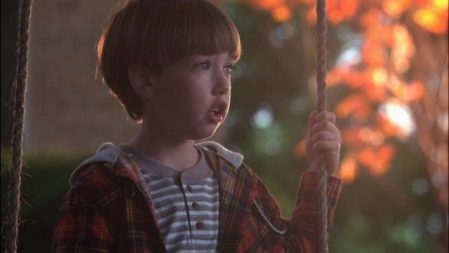
1. Courtland Mead is a hell of an actor. I grew up watching him on some sitcom, I think it had Kirk Cameron, and I used to think of him as “that kid who can’t close his mouth.” But Danny Torrance is a demanding role, and Mead kills it. He’s likable and skillfully gets across the angst and disappointment and fear Danny feels.

shin3

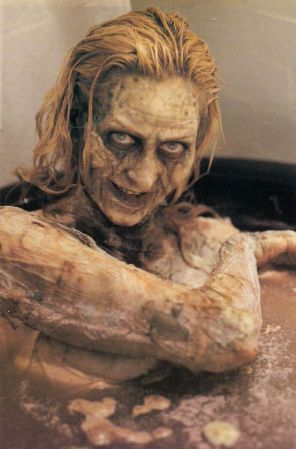
2. Cynthia Garris can be creepy when she wants to. I bear a grudge against directors who cast the same actors over and over, especially when said actor is a spouse. Mick Garris almost always puts his wife in his movies, which irks me. However, Cynthia is actually pretty scary as the lady in Room 217.

shin4

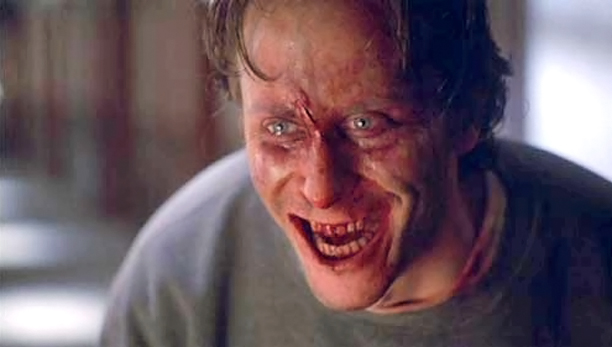
3. The character development is handled much more gracefully than in the original. As I said, and many others have said, Jack Nicholson’s Jack Torrance starts out crazy and horrible and just gets more so. Steven Weber’s Jack is a bit more sympathetic, and Weber conveys much better a flawed but overall decent man who suffered abuse and can’t get past it.

shin5

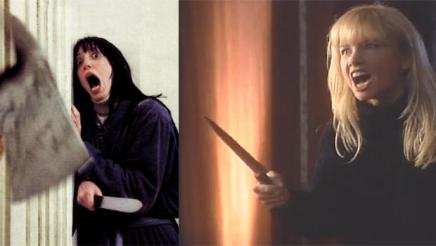
4. Wendy is much more compelling than in the original. Rebecca DeMornay’s Wendy is a fighter, a woman who always puts her son first. Shelley Duvall’s Wendy is a broken woman who has barely anything going on in the personality department.

shin7

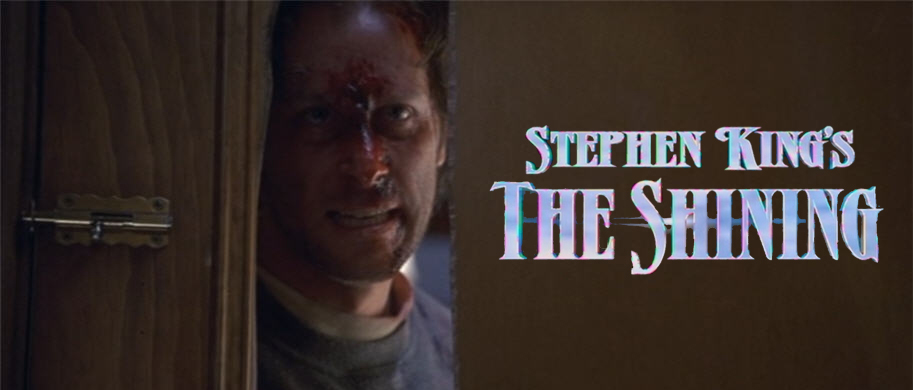
5. The cameos are a little over the top, but still pretty cool. There’s Stephen King himself, Sam Raimi, Shawnee Smith, Frank Darabont, Richard Christian Matheson, and David J. Schow.

shin8

The ending, though…the ending makes me wanna slap somebody.

Five Songs That Make Me Shake My Head at the Narrators

This is a piece I wrote a while back and finally got around to doing my final polish.

Many songs involve an unreliable or unlikable narrator whom the listener isn’t supposed to trust or like. For example Dave Matthews Band’s “Don’t Drink the Water,” which describes the horrors of colonialism through the eyes of someone who thinks the land is his to take. Some songs, however, feature narrators who believe they’re right, and the song is meant to elicit sympathy or corroboration on the part of the listener—and they shouldn’t.

1. Magic!—“Rude.”
The song: “Rude” concerns a young man confronting his beloved’s father, who straight up hates him. The narrator asks the man for his daughter’s hand in marriage, and he is cruelly rebuffed: “You say I’ll never get your blessings ‘till the day I die/Tough luck my friend, but the answer is no.”
I empathize: The narrator makes a good case for himself: “Why you gotta be so rude/Don’t you know I’m human, too.” On that basis, it’s easy to feel sorry for the guy. He tried to take the polite route, and was mocked for his trouble. Also, the music video implies that Dad’s distaste is based on class or race (or likely both), given that the narrator is neither wealthy nor white.
However: As a teenager I would have eaten this song up, seeing it as romantic and sweet. Yet as a mother (of a daughter, no less), I am affronted by the narrator’s opening gambit: “Can I have your daughter for the rest of my life/Say yes, say yes, ‘cause I need to know.” Not only is he asking to take and keep the man’s daughter, he’s damn bossy, too. After Dad’s “no” he threatens to “marry her anyway.” Then comes his next sally, which is decidedly more hostile: “I hate to do this/You leave me no choice […] We will run away/To another galaxy you know/You know she’s in love with me/She will go anywhere I go.” Not only is he manipulating her love for him, he’s saying if Dad doesn’t play ball, they’ll just disappear and he’ll never see her again. With a threat like that, he might even be able to get Dad to pay for the wedding.

2. “Love’s the Only House”—Martina McBride
The song: The narrator discusses the many problems in the world today and how love can fix said problems.
I empathize: I’m a Buddhist, and I heartily endorse the sentiment that “Love’s the only house big enough for all the pain in the world.”
However: There are so many places where the narrator comes across as smug, condescending, and even racist: “Senorita can’t quit crying, baby’s due now any day/Don Juan left, got sick of tryin’, no one there to show him the way.” As if this weren’t enough, the “senorita” goes to the store to beg for milk, and who should buy the milk but our humble narrator. One can only hope she goes home with the lass to teach her how to act right. Or maybe she’ll go home secure in her knowledge that her wonderful gesture helped save the world.

3. “How Do You Like Me Now?!”—Toby Keith
The song: This song describes an up-and-coming singer so excited about his success that he wants to contact a high school acquaintance he had an unrequited crush on and point out how well he’s doing.
I empathize: Everyone loves a good revenge story. And apparently she was snobby and vain: “You overlooked me somehow/Besides you had too many boyfriends to mention/And I played my guitar too loud.”
However: Again, as a teenager (and outcast) I would have loved the idea of the spoiled girl getting her comeuppance. But as an adult who has left her teenage years far behind, I don’t blame people for how they acted when they were young and stupid. Not to mention that he sounds like he was a jerk to her: “You were always the perfect one and the valedictorian so/Under your number I wrote, ‘Call for a good time.’” True, he heard a rumor that she made fun of him for pursuing his dream of being a performer, but the narrator takes his butt-hurt a little too far when he gloats about the mean guy she ended up marrying: “He took your dreams and tore them apart/He never comes home and you’re always alone/And your kids hear you cryin’ down the hall” (this last is followed by an upbeat musical break). The narrator sounds a little like he’s not all there in the mental health department; it’s probably a good thing she stayed away from him.

4. “Breakin’ Dishes”—Rihanna
The song: “Breakin’ Dishes” is a catchy little tune about a spurned woman getting revenge by making a mess.
I empathize: Being cheated on is a devastating betrayal. Who doesn’t enjoy the scene in Waiting to Exhale when Angela Bassett’s character torches her philandering husband’s car?
However: The narrator sounds pretty unhinged. “I’m breaking dishes up in here, all night/I ain’t gon’ stop until I see police lights/I’ma fight a man tonight.” She also amuses herself by burning his clothes. Infidelity is nothing to trivialize, and since he’s “been coming home lately at 3:30” he probably is cheating, but the narrator doesn’t actually have concrete evidence: “Is he cheating/Man, I don’t know.” Yet that doesn’t stop her from “looking ‘round for something else to throw.” So instead of confronting her boyfriend, she’s instigating a fight, and based on what we know about her he’s probably going to get the crap beaten out of him. And possibly set on fire.

5. “The Saga of Jesse Jane”—Alice Cooper
The song: Jesse is a man who enjoys wearing women’s clothing, in this instance a wedding dress. He is currently serving time for killing a man who accosted him in a McDonald’s.
I empathize: I’ve listened to the song many times, and I was always on Jesse’s side. Again, teenager, outcast, etc. I’m no fan of homophobia or attacking people who look different. I hate bullying.
However: Here’s Jesse’s description of the event: “His face was red, his fist was clenched/He threw his Coke and he got me drenched.” That is the entirety of the altercation. Jesse retaliates: “I killed him dead, I killed ‘em all.” Not only does Jesse murder a man for throwing a soda at him, he wastes everyone in the restaurant for looking at him funny. Hate crimes are no joke, but shooting people is not the answer.

When my writin’ friends who helped me edit this piece asked me how I found these songs, I had to admit I own all these albums (except Magic!). Despite the songs irking me, I still enjoy the majority of their body of work (except Magic!).
1977’s ‘Audrey Rose’ is Thought-Provoking and Groovy

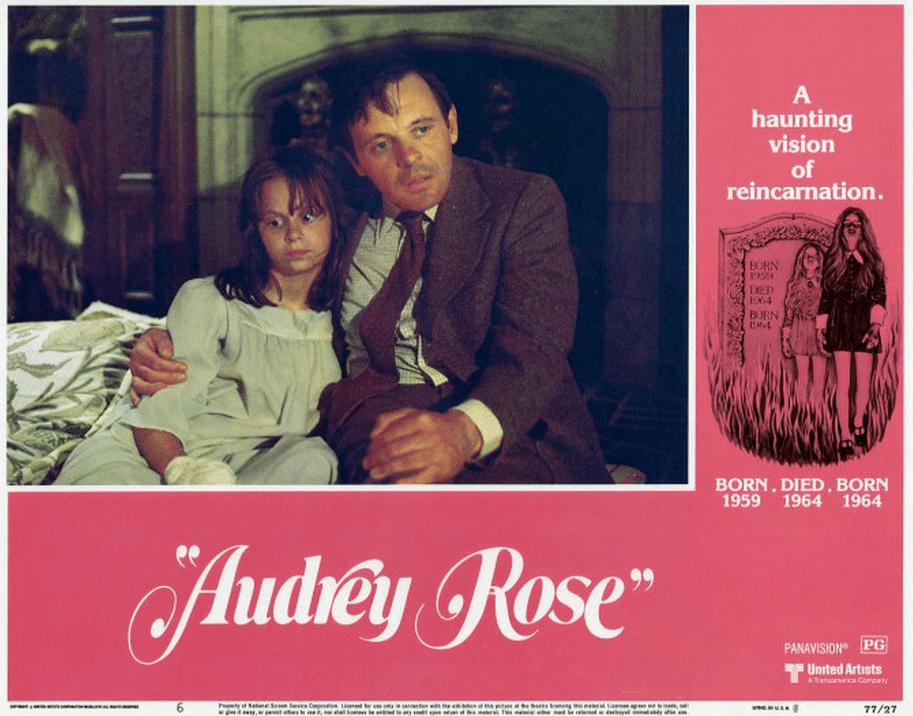
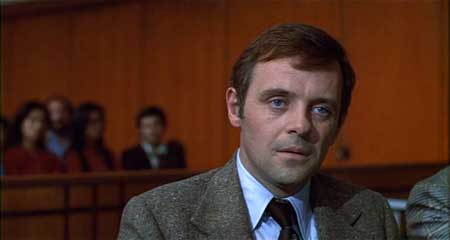
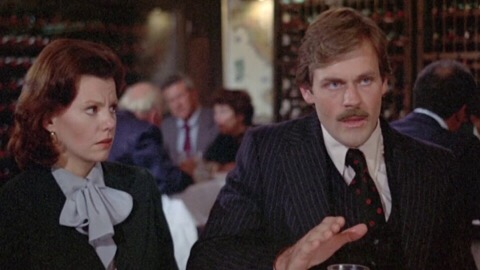
Janice (Marsha Mason) and Bill Templeton (John Beck) have a simple and happy life with their young daughter Ivy (Susan Swift). Suddenly a stranger (Anthony Hopkins) begins following them around, focusing particularly on Ivy. When they confront him, Elliot reveals that he believes Ivy is the reincarnation of his daughter, Audrey Rose, who burned to death in a car accident. Janice takes him seriously after Ivy has an episode of terrible nightmares—which occur every year around her birthday—that cause her to leap out of bed and pound the windows, all the while screaming for her daddy. Janice allows Elliot to comfort her while acting as Audrey Rose’s father, and the dreams become manageable in his presence. Bill continues to scoff, wanting Elliot out of their lives, which prompts Elliot, who believes she’s in danger, to take them to court for custody of Ivy.
ar3
You guys don’t wanna test me; a census taker tried to test me once…

I first watched this with my sister Leslie; when we were teenagers, we decided to review every horror movie at the now-defunct Hollywood video, in alphabetical order (alas, we started and ended with A).

ar4
Those were the days

So there’s a pretty heavy nostalgia factor for me. But aside from that, there’s still a lot to like. I enjoy the courtroom scenes, when an exotic troupe of people come forth to testify for the existence of reincarnation. The performances are great, with special kudos to Susan Swift. The characters are fairly likable; Bill gets on my nerves after a while for his stubbornness, but I’d be up in arms too if a creepy rando was hounding my family and calling to say: “I didn’t see Ivy at school this morning. Is she all right?”

My only gripe is that I hate the aesthetics of the ‘70s; I like brown, but not mixed with orange and plaid. The Templetons’ apartment, with its wacky color scheme, epitomizes the decade (the only thing missing is a fondue pot), and is the most disturbing aspect of the film for me—though it may be evocative for others.

ar6
Don’t forget the giant ascots and porno ‘staches

Despite the somber subject matter, the film has a message of hope: death is not the end, and that with death, “The soul is free.” Boogie on down and give it a look if you’re in a philosophical mood (or want to see a young and tasty Anthony Hopkins).

‘The Astronaut’s Wife’ is a Creepy Thriller

Jillian (Charlize Theron) is, as the title suggests, married to an astronaut, Spencer (Johnny Depp). While on a trip to space, he and his colleague Alex (Nick Cassavetes) are repairing their shuttle and there’s an explosion, causing them to lose contact with NASA. Upon returning home, both men begin acting strangely. Shortly after, Jillian discovers she’s pregnant with twins. Her suspicions about Spencer are compounded by NASA employee Reese (Joe Morton), who tells her Spencer is now an alien that basically erased her husband like a cassette (or some other technical device invented after 1999, if you like). Jillian is left to wonder who the father of the babies is.

aw2
Depp’s face when someone told him blonde wasn’t his color

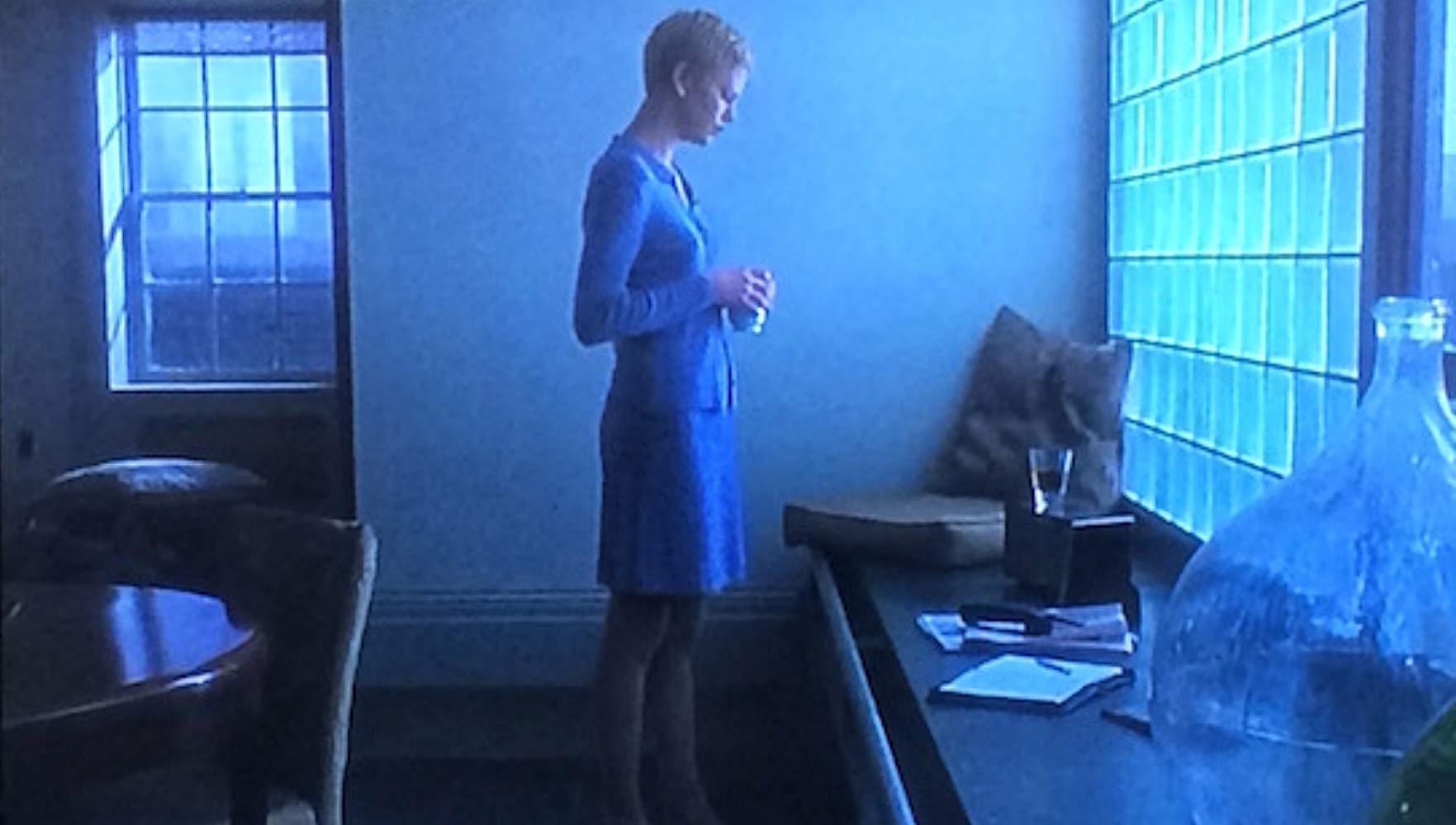
Something interesting in the film is the settings and minor characters, which symbolize the deterioration of Spencer and Jillian’s relationship. When Jillian and Spencer live in Florida, their house is big but homey, with lots of natural lighting. The co-workers at their going-away party seem friendly and likable. Jillian, a second grade teacher, works in an informal setting, sitting among her students. In contrast, the new house is overly big, sterile, and when it’s not dark, it’s lit with an ominous bluish light. (Actually, all of the settings are dark after Spencer comes home, even the going-away party.) The welcoming party she and Spencer attend is full of phony, snobby people; even the kindly woman Jillian befriends is spoiled, pointing out the bracelet her husband bought her when she had a miscarriage. Jillian’s new teaching atmosphere is now a formal private school, where the children wear uniforms and sit in neat rows.

aw5
Bars, bars everywhere
aw1

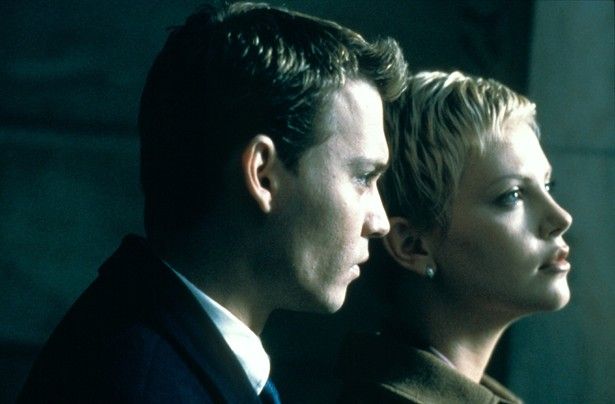
Jillian sports a haircut very similar to that of Rosemary in Rosemary’s Baby, reflecting the similar themes of paranoia, supernatural babies, and untrustworthy husbands. Though the movie is a bit science fiction-y, I’d say it’s more classifiable as a horror movie. There are a few creepy moments, like when Alex starts displaying signs something is amiss—the viewer has no idea what will happen next. It reminds me of the Black Oil episodes of The X-Files, which are profoundly disturbing. Or Reese confronting Jillian about Spencer: “Can you swear to me that he’s still your husband?” The filmmakers do a marvelous job of building tension, and it’s unpredictable. Give it a look if you’re in the mood for a serious tale of alien activity.

aw4
Or maybe the haircut is just a family tradition

‘The Abominable Dr. Phibes’ is an Utter Classic

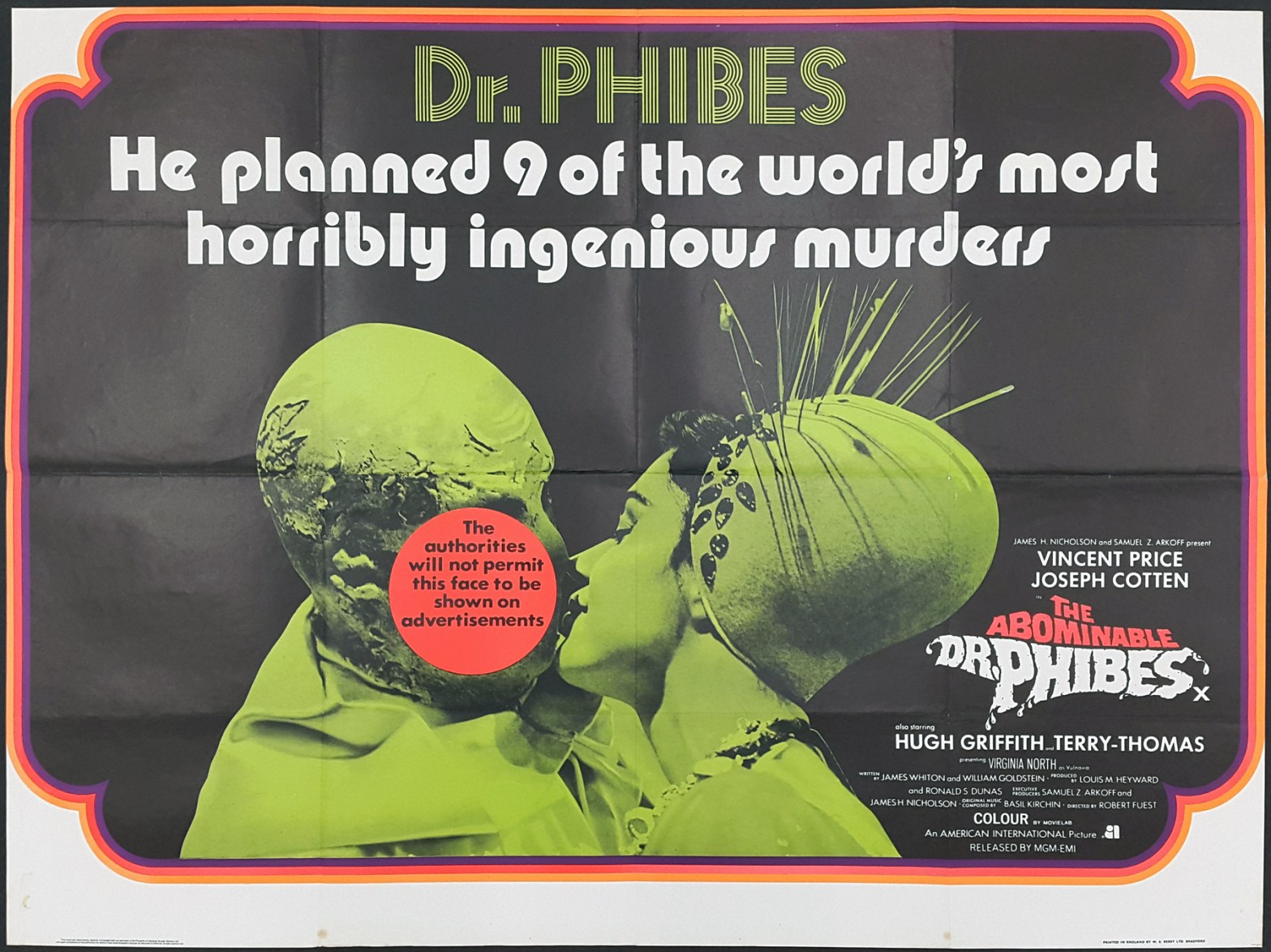
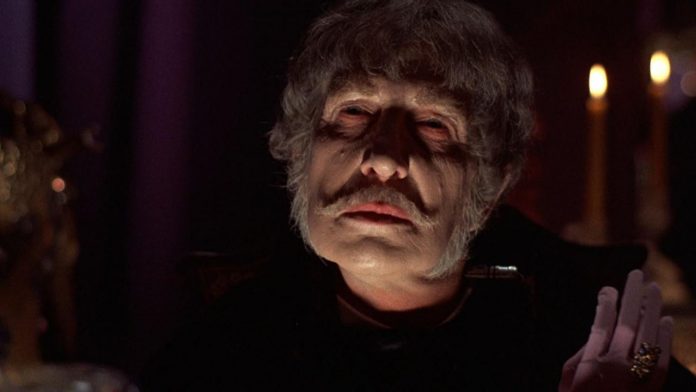
Anton Phibes (Vincent Price) is a man so rocked by his wife passing away on the operating table (being horribly disfigured in a car wreck doesn’t help matters) he decides to kill the eight doctors and one nurse who couldn’t save her, with nine of the ten Biblical plagues: boils, bats, frogs, blood, hail, rats, beasts, locusts, and death of the first-born. Scotland Yard’s Inspector Trout (Peter Jeffrey) is on his heels, and the race is on to stop Phibes before all nine plagues are reenacted.

ad2
Goofiest corpse ever

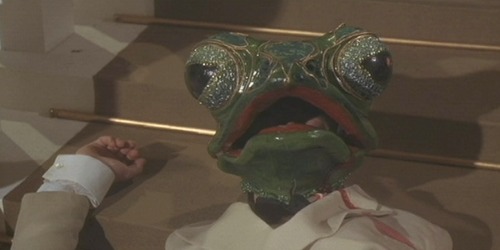
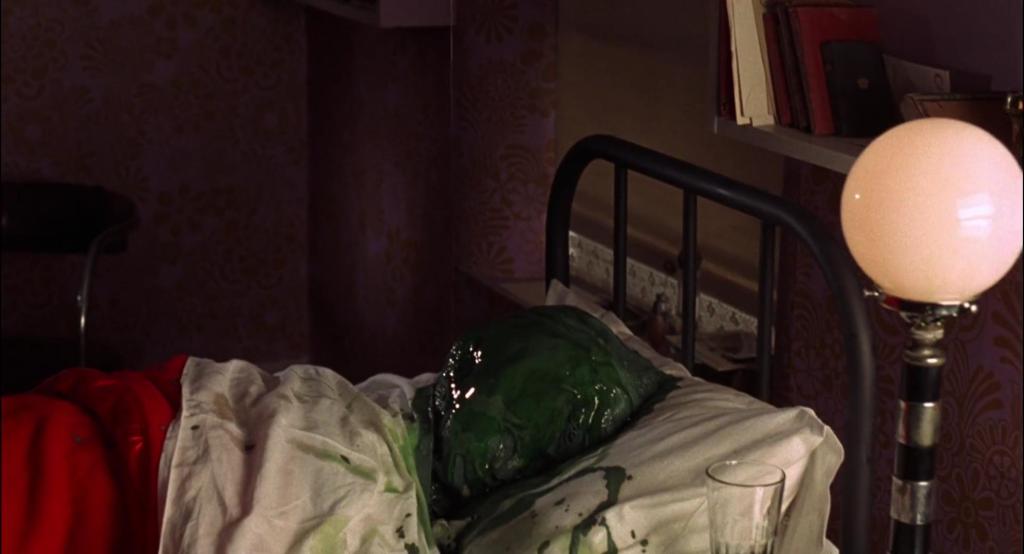
This film is just a delight. It’s terribly corny and riddled with plot holes (most of which spring from trying to create deaths from plagues that are more bothersome than deadly), but it’s darn entertaining and funny, too. One of my favorite scenes is when Dr. Longstreet (Terry-Thomas) is watching what appears to be an ancient porno. His maid comes in and scolds him—for missing his dinner. I was also amused by the unlikeliness of the scene when Nurse Allen (Susan Travers) meets her doom. While she sleeps, Phibes covers her face completely with a viscous green goo (which she sleeps through), then releases locusts in her room. When the detectives find her, sans face, she’s lying in the exact same position we saw her in last, which leaves us to assume that she also slept while the bugs ate her—I guess she pulled a double shift that day. (Though to be fair, a reader did point out to me she remembered Allen saying something about taking a tranquilizer before bed.)

Nurse Allen was tired…dead tired

It has creepy moments on occasion, for example the scene when a doctor is sleeping soundly while Phibes lowers a mysterious cage into his room. But then the cage is revealed to be full of fruit bats. Fruit bats? Really? What are they going to do, lick him to death? Never mind the technical aspects of their anatomy, fruit bats are the cutest breed of bats—they look like little foxes.

A long-haired rousette (Rousettus lanosus) at the Lincoln Children's Zoo.
They said I did whaaaat?

Vampire bats at least have sparse fur, puggy upturned noses, and visible fangs, making them suitable as horror movie villains. Thus, even the eerie moments are upstaged by cheese.

There are some heartstrings-tugging moments, like when Phibes holds up a necklace to his wife’s portrait; in silhouette, it looks like she’s wearing it, emphasizing his inability to be with her. Those few seconds are more effective than his multiple speeches to her promising revenge, that all seem to start with, “My love, my queen…”

ad1

Price gives his usual hammy but stellar performance. My brother Jeremy, who watched this with me, said, “There was only one Vincent Price.” Indeed, and I miss him. Check it out if you’re in the mood for something lighthearted but gory.

1997’s ‘Aberration’ is Ridiculous but Occasionally Entertaining

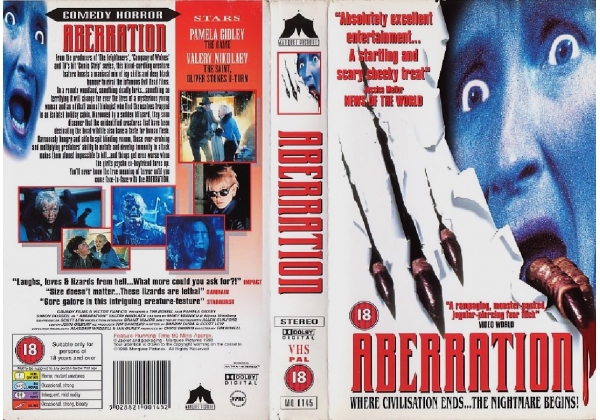
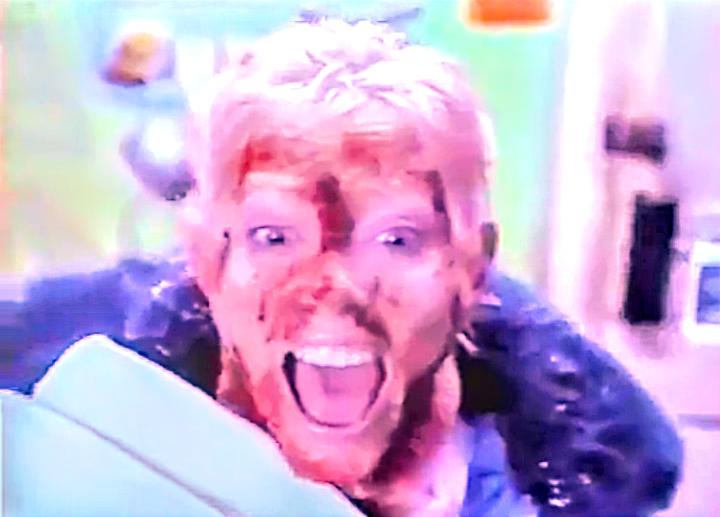
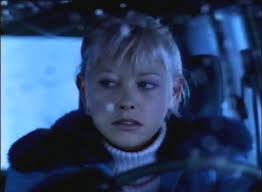
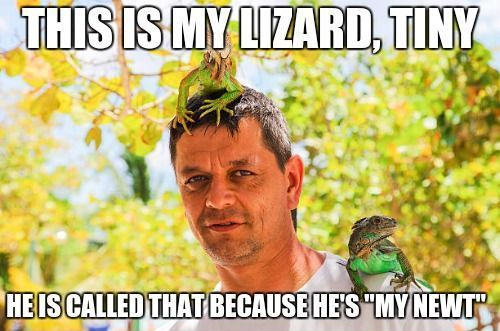
Amy (Pamela Gidley) has just stolen fifty thousand dollars from her ex-boyfriend Uri (Valeriy Nikolaev) and needs to hole up for a while, so she heads to a secluded cabin. Unfortunately there’s a bunch of green goo around, which spawns lizards that are “evolving into a more efficient predator.” They have teeth, spit poison, grow gills, and quickly become immune to pesticides. Amy teams up with Marshall (Simon Bossell), a biologist investigating the disappearance of wildlife in the area. When a blizzard and a lizard-chewed car strand them in the cabin, their only hope is a shotgun and their wits.

You may be surprised to learn there aren’t a lot of stills from this movie

I first watched Aberration as a teenager with my sister Leslie; our plan was to review every horror movie from the (now defunct) Hollywood Video. We didn’t make it past the A’s, probably because we watched stuff like Aberration.

abe1
In case you’ve never experienced the magic of going into a store to pay an outlandish price to borrow a hard copy of a movie for which you needed a player. And God help you if that shit was late!

At that time, I hated the movie, and I’m still not crazy about it. The characters are often annoying, the lizards are painfully unrealistic, and it feels much longer than its 92-minute running time. It starts out slow, and though the action eventually picks up, I was still bored and didn’t really care if the characters made it or not. In addition, there’s a lot of reveling in the blood of dead animals, mostly the creatures, but there are also dog and cat corpses. In addition, for the last twenty minutes or so, Marshall starts manically shooting his gun and spouting one-liners. They’re not even particularly good ones, for example when the lizards kill shopkeeper Mrs. Miller: “She…was a nice…lady!”

abe2
Iguana eat your face! See, puns are where it’s at, comedy-wise.

To be fair, I didn’t hate it as much this time. There’s even a brief period in the movie when I enjoyed it: Amy and Marshall work together to find and kill the lizards in her cabin (contrasting with the rest of the movie—you’d be surprised at how much screen time is spent on them getting into a car, driving a ways away, discovering lizards have damaged the car, then having to walk. You‘d think after the first time it happens, they‘d check under the hood).

aberration2
Hmm, should I check for lizards? Nah, they couldn’t possibly disable a second car.

Although Aberration owes a lot to action movies (particularly since its budget seems to be spent entirely on explosions), and those films tend to focus on a powerful male and his arm candy, Amy and Marshall are equals. They’re both clever and resourceful, and while he’s the scientist, she’s far better with a gun. (Until the aforementioned last segment, when Amy is unconscious and Marshall becomes Rambo.) While I don’t always like Amy and Marshall, I appreciate that they don’t bemoan their situation—they crack jokes and take care of business. And unlike typical horror movie heroines, Amy doesn’t cry once; she’s tough, assertive, and though she has a short hissy fit, it’s angry rather than whiny. And finally, it’s a pretty clever premise; the lizards aren’t scary, but they’re menacing because they’re small and hard to catch.

If you’re in the mood for watching critters get blowed up and lots of purty fires, this one’s for you.

‘Arachnophobia’ Stands up to the Test of Time


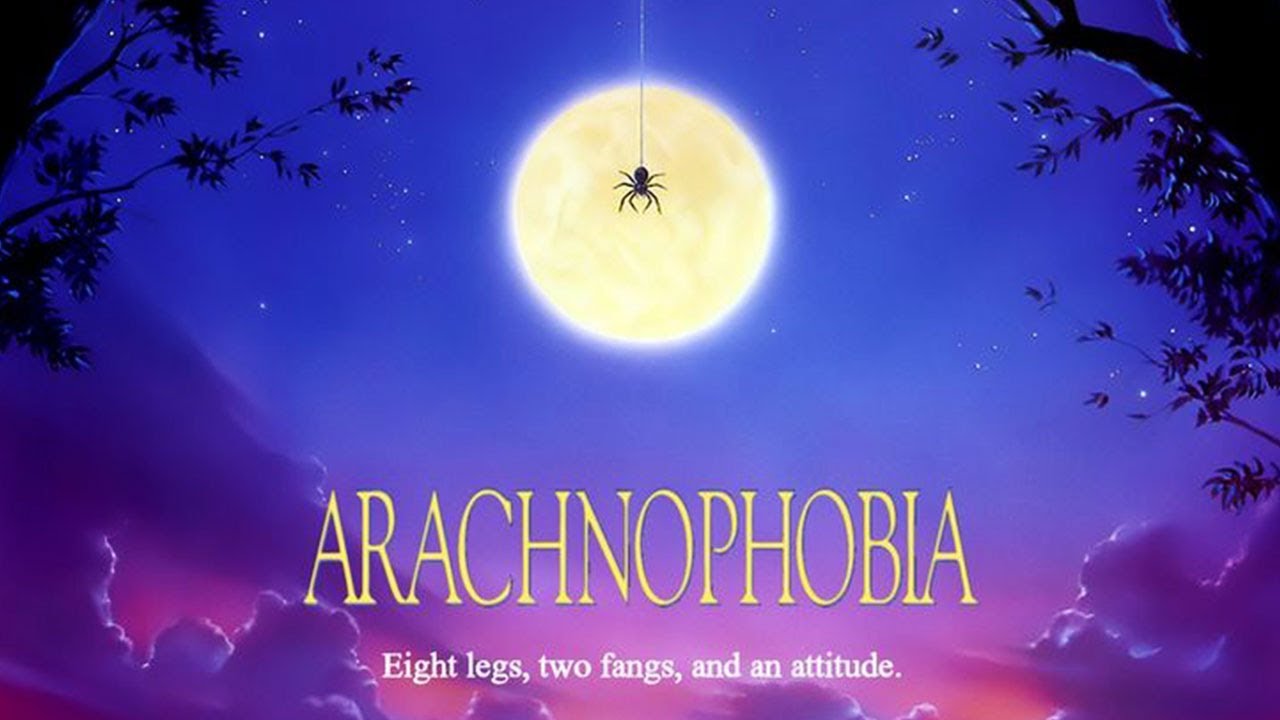
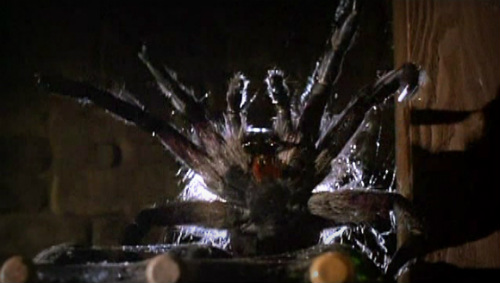
While on a job in Venezuela, a photographer is killed by a very poisonous and very bitey new breed of spider. The little bugger happily rides home with the corpse to a small town in America. Ross (Jeff Daniels), the town’s new doctor, is unfortunately quite afraid of spiders, but now has to deal with an army of deadly hybrids that are every bit as aggressive as their father. With the help of spider experts Dr. Atherton (Julian Sands) and Chris (Brian McNamara), as well as exterminator Delbert (John Goodman), he has to kill the queen and big bad Dad.

arach6
I want a huggie!

I saw Arachnophobia as a child with my uncle (who also introduced me to the Poltergeist movies, bless him). I found it more entertaining than scary. Despite the serious subject matter, there’s a goodish amount of jokes too, for example wacky Delbert, who loves his job just a little too much. It’s PG-13, so there’s not a tremendous amount of gore (though there are a few painful close-ups of fangs piercing skin). However, I wouldn’t recommend it to people who have arachnophobia, despite the major plot point of Ross overcoming his; I think it would only inspire paranoia. The movie makes spiders scarier. It emphasizes their aggression, ruthlessness, and also their ability to lay hundreds of eggs at a time. Not to mention disgusting scenes such as Delbert savoring the crunch of a spider under his boot, a pulsating egg sac, and an exploding spider.

arach3
If this is your reaction to seeing a spider, maybe give this one a miss

Aside from being gross and sometimes creepy, the film has other good qualities. It builds suspense while still utilizing the humor used throughout the movie, like when town residents narrowly avoid being bitten without even realizing it. In addition, the characters are likable, my favorite being Ross’s wife Molly (Harley Jane Kozak). I find it amusing that she’s the spider-killer for the house, defying gender stereotypes. She’s completely fearless, and tries to encourage Ross to enjoy the beauty of spiders. She’s an interesting character—it’s too bad she gets phased out in the last half of the movie.

arach5
“Sure honey, you have lots more scenes coming up. Now off you go.”

In addition, the spiders look real; there are only a few scenes (like when a spider is on fire) that it’s obviously a fake. Maybe it’s the childhood nostalgia talking, but to me the film is charming and amusing; it’s the kind of movie I can watch repeatedly. Give it a look if you’re neutral about spiders or will enjoy being freaked out by them.

arach2
A movie that watches you back

‘April Fool’s Day’ is Fun and Delightfully Dated

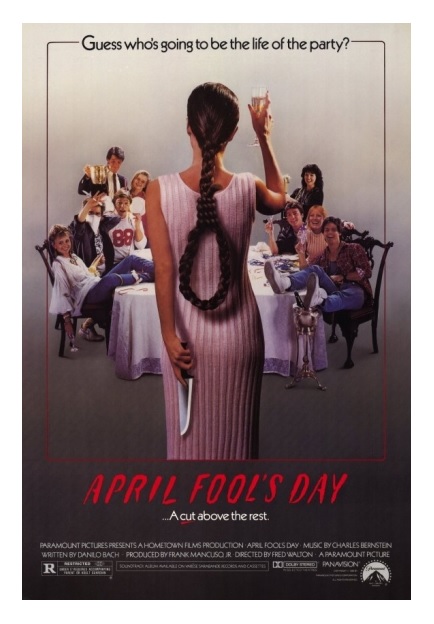
A group of twenty-something friends and acquaintances are heading to an island to celebrate their friend Muffy’s (Deborah Foreman) birthday. Once there, they run into trouble when they discover there’s a killer among them and no way off the island. Meanwhile Muffy’s behavior is becoming increasingly erratic. It seems everyone present has “little secrets” they’d like to stay hidden but are revealed with his or her death. Could it be that Muffy has gathered them all for some elaborate revenge scheme? Or is it an April Fool’s Day prank they’ll never forget?

afd4
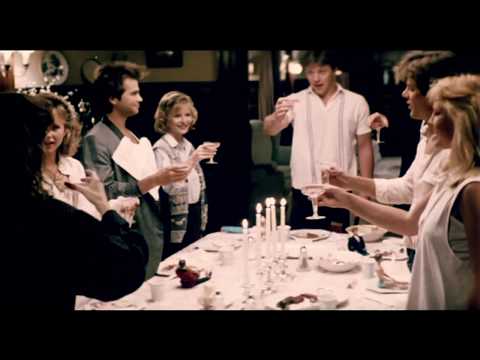
Those wacky ’80s hairstyles! Look at these assholes with their feet on the table–they’re just asking to get stabbed.

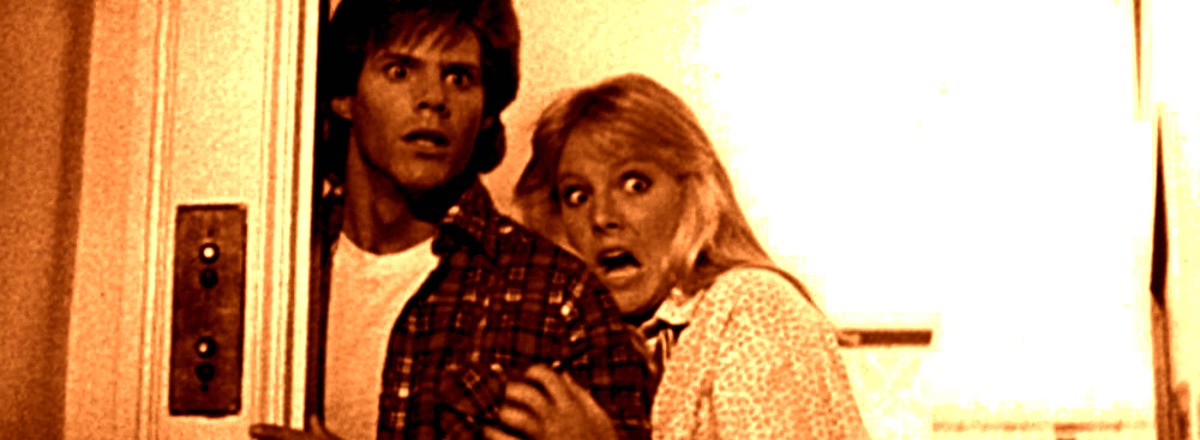
It’s your basic slasher movie: a large cast getting killed off one by one in an increasingly predictable fashion. Except that the characters, rather than being naughty teens, are naughty college students, so in between having sex and drinking they’re reading Paradise Lost and reciting poetry. But higher education doesn’t save them from having dumb moments, my favorite being when Rob (Ken Olandt) tells Kit (Amy Steel) shortly after she finds one of their friends dead in a well, “You gotta look at the bright side of things.”

afd3
Or the horrifying side of things

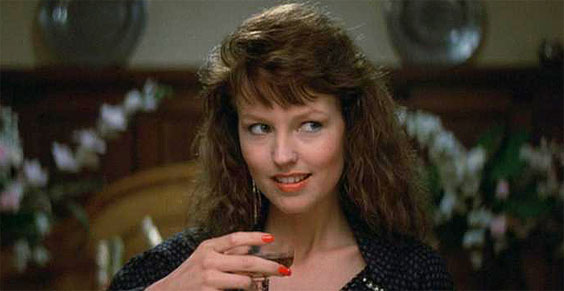
Slasher movies generally have all-white casts, give or take a token Black guy or couple, and the characters are somewhat hard to distinguish between at first. Usually types are established: the practical joker, the nerd, the athletic guy, the final girl, etc. In this movie there were only four women, so I could classify them as the bookworm, the sex kitten, the unremarkable blond girl, and Muffy. But there were five guys, who all seemed to be the athletic practical joker. They eventually became the guy with the southern accent, the guy who might be gay (wait, which one was he?), and the other blond guys. Even by the end of the movie I was still confused. In addition to my befuddlement at the many many blonds, I spent most of the movie waiting for Muffy to reveal herself as a guy. Apparently I got my endings mixed up.

april fools day
Each as forgettable as the last

Overall, it’s decent for a slasher; the acting is acceptable and there’s a nifty twist ending. It’s directed by Fred Walton of When a Stranger Calls and When a Stranger Calls Back fame. I enjoyed it. Give it a look if you’re in the mood for something that’s a little bit—but not too much—out of the ordinary.

afd2
Hey Muffy, hahaha!

‘An American Haunting’ is…Definitely Less Ridiculous than the Book it’s Based On


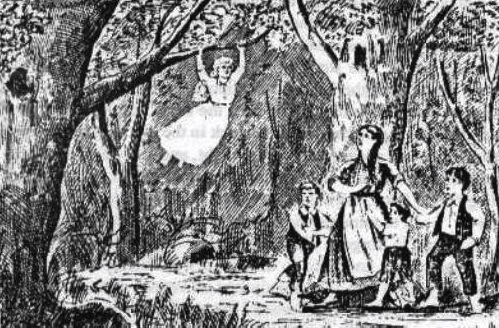
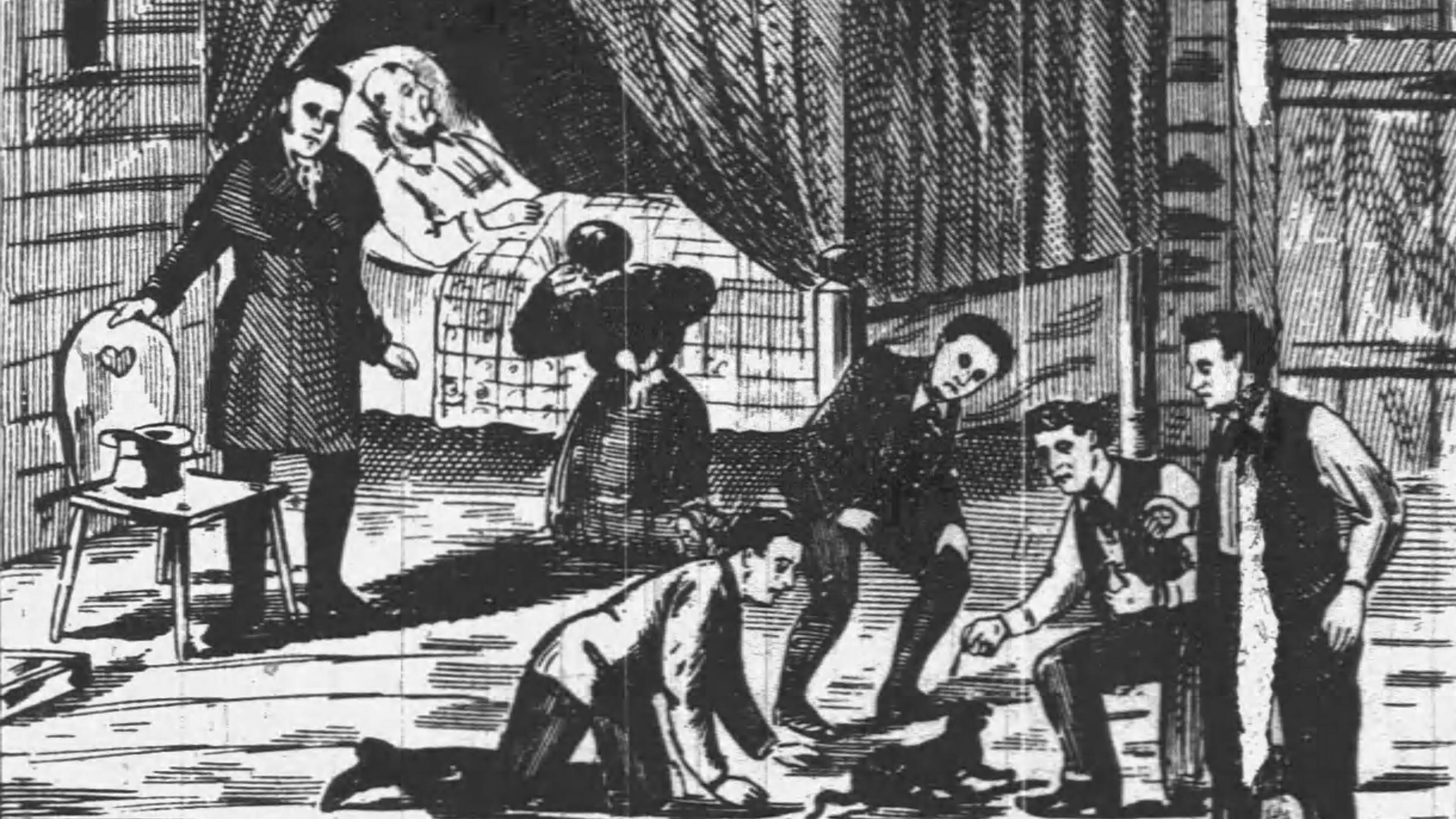
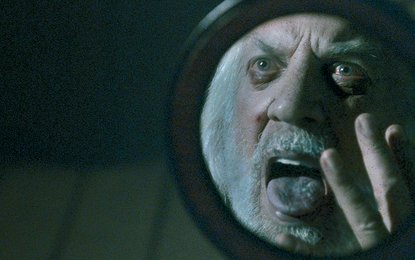
It’s 1817, and Betsy Bell (Rachel Hurd-Wood) is a teenage girl who appears to be either possessed or haunted by an angry ghost who slaps her and pulls the blankets off of her bed, among other things. There are also weird noises and otherworldly animals skulking about the family property. Betsy’s father John (Donald Sutherland) has angered Kate Batts (Gaye Brown), a woman rumored to be a witch—is it possible she’s the one behind the phenomenon? John is also being affected—what is his role in the haunting?

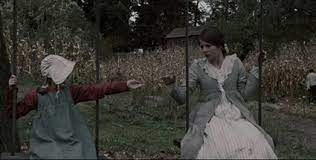
Nooooo, it’s the children of the corn!

The movie is based on a book written by Betsy’s future husband Richard (James D’Arcy), which is supposedly a true story, but some say it’s a hoax. I read the book, and have difficulty buying that all that stuff actually happened. There are far more demonic happenings the filmmakers wisely left out, for example characters’ long conversations with the ghost about their personal lives. The spirit is basically a slightly friendlier version of Pazuzu in The Exorcist. Thankfully the movie pares down the creature’s dialogue, but the shots from the its point of view get old after a while. Wow, people really were easier to scare back then:  

The plot point of the family owning slaves is just as hard to take seriously. In the interest of retaining sympathy for the white protagonists, the slave characters are treated extremely politely by the Bells; Betsy’s mother Lucy (Sissy Spacek) says, “Anky, could you answer the door, please?” At the same time, they’re superstitious and fearful stereotypes straight out of a 1930s zombie movie.

ah2
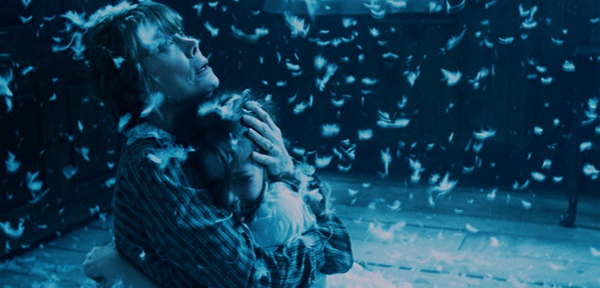
Then again, the white folks are terrified of feathers

One aspect of the film I appreciate is that because Betsy is portrayed as a childlike and innocent girl, she’s not parading around in her frilly underthings like most teenage girls in horror movies. And because I don’t agree with Hollywood that romances have to be shoehorned into every single movie, I am also thankful that while the romantic subplot is an important part of the story, it is muted to a bearable amount (probably because the girl in question is a teenager, and her love interest is in his thirties).

ah3
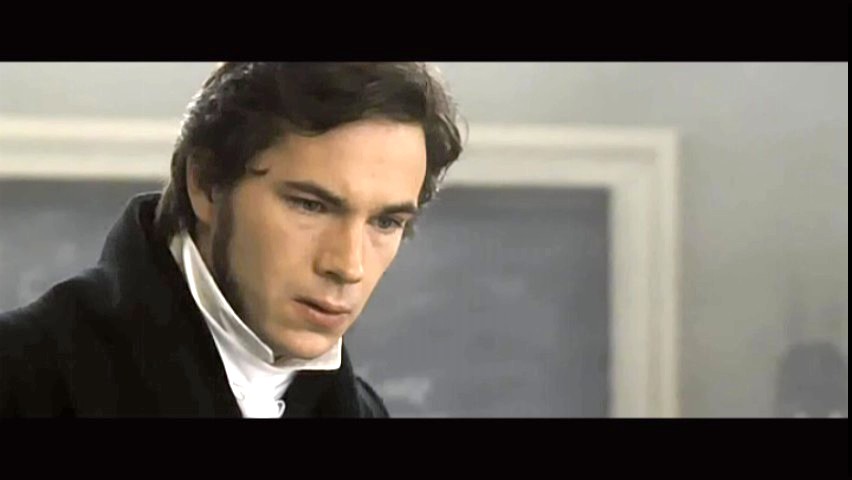
Check out those sweet mutton chops!

The filmmakers decided to throw in a wraparound story of a teenage girl facing the same predicament as Betsy, which leads to a truly creepy ending. The rest of the film is hardly scary, but the shocking twist (for both girls) is grotesque and disturbing.

american 1
This was my reaction, too

Check it out if you want a sincere tale with actors you’ve probably heard of.

Park Ky-hyeong’s ‘Acacia’ is Gorgeous and Melancholy

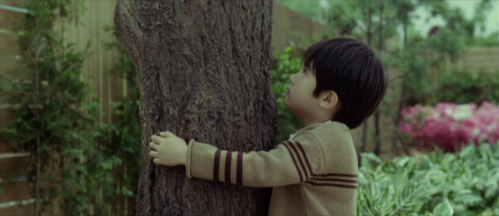
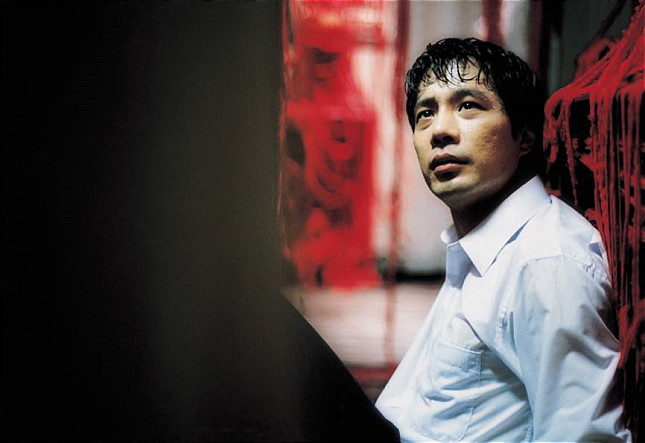
Korean movie. Mi-sook (Shim Hye-jin) and Do-il (Jin-geun Kim) are a married couple who are having trouble conceiving a child. They adopt an artistic loner named Jin-sung (Oh-bin Mun). He adjusts fairly well, with the help of his adopted parents, Do-il’s father, and new friend Min-jee (Na-yoon Jeong)—though he seems to think the acacia tree in the backyard is his deceased mother.

acacia4
                                                               Don’t cry, don’t cry, it’s only a movie…

Suddenly Mi-sook finds she’s pregnant, and though everyone still tries to pay attention to Jin-sung, things aren’t the same. Jin-sung is mean to baby Hae-sung, which exacerbates the situation. Mi-sook plans to send Jin-sung back, and he runs away. The family begins violently falling apart.

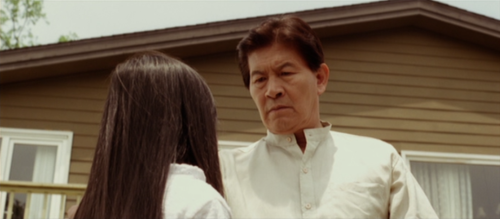
I hadn’t seen this film in six years or so, and was happy to finally get to review it. I still loved it, but my perception of the characters has definitely changed. On my first two viewings, I saw the family as basically loving, good people who had tragedy destined for them. On my most recent viewing (after becoming a parent), I feel a lot less sorry for them. Mi-sook flips out when Do-il even brings up the possibility of adopting a child. After she calms down and accepts the possibility, she picks a kid after a cursory introduction because he paints well. While they both make a valiant effort to welcome Jin-sung, they’re not the best parents. For example, Mi-sook has a hissy fit when Jin-sung has trouble adjusting to his new family name. Mi-sook and Do-il want to be parents mostly because they feel cultural pressure to do so, not because of any readiness or skill. They’re a bit cold and distant—the most endearing character is Do-il’s father, the kindly voice of reason.

acacia3

In addition to all the sad-making, there are lots of creepy moments, too. The viewer is unsure of what horrible things await, but the tension builds from the beginning, when Jin-sung recreates Munch’s eerie painting The Scream. Jin-sung has an unnerving blank-eyed stare much of the time, and Mi-sook is a ticking time bomb, so even the happy moments feel uneasy. One of the most brutal scenes is when Do-il finds a needle in his bowl of rice, cutting his mouth. He blames Mi-sook, and turns on her. Compared to the previously stable man he was at the beginning, this Do-il is terrifying and unpredictable.

acacia2
                                              “Clean that up before I kill you.” –actual quote

Overall, the film is thought-provoking and a bit depressing—check it out if you’re in a serious mood.