‘Alice, Darling’ is Indeed a Horror Movie

*Content warning: The film depicts an emotionally abusive relationship. While I like to keep my reviews lighthearted, I am in no way trivializing the subject.

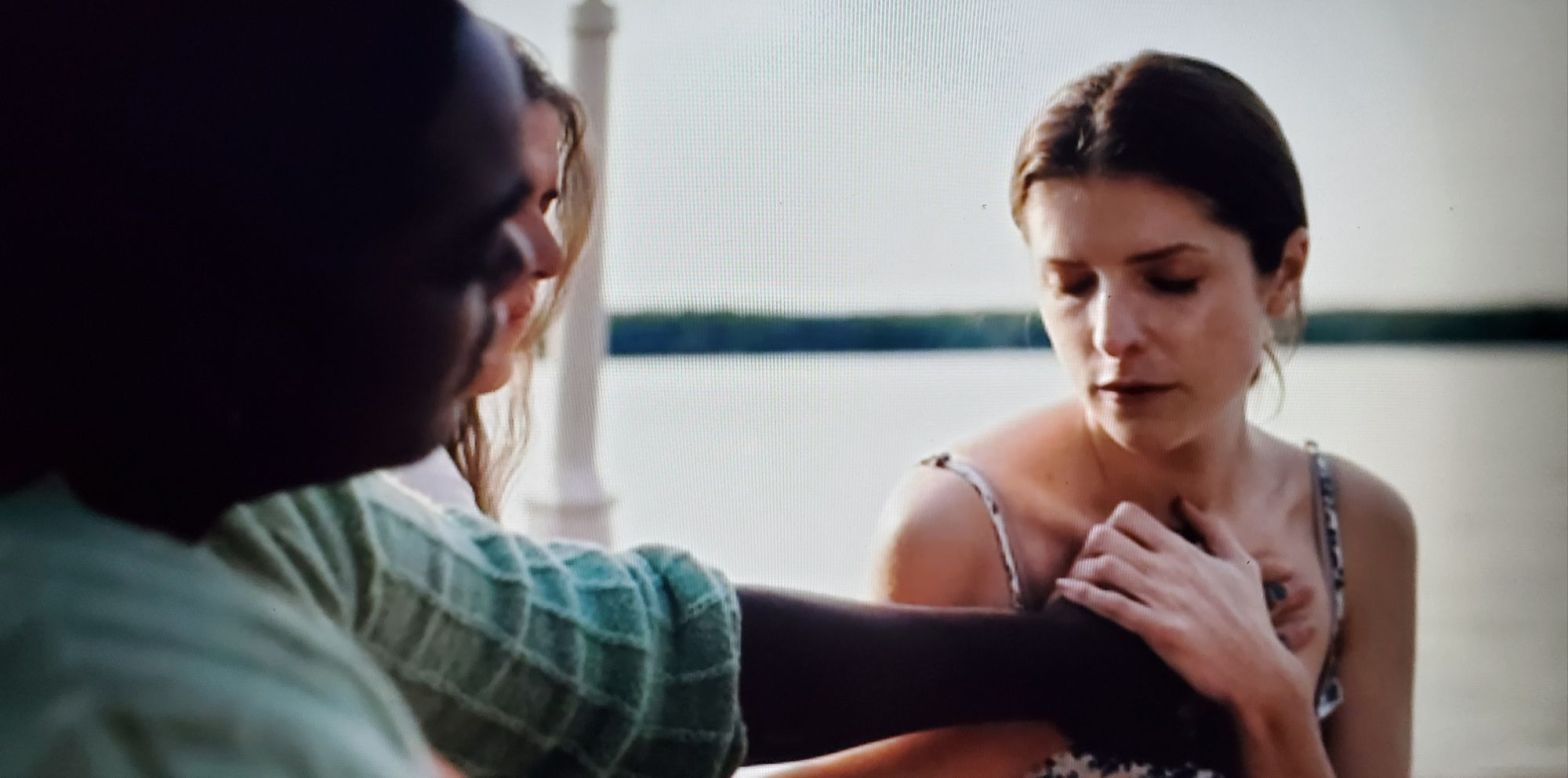
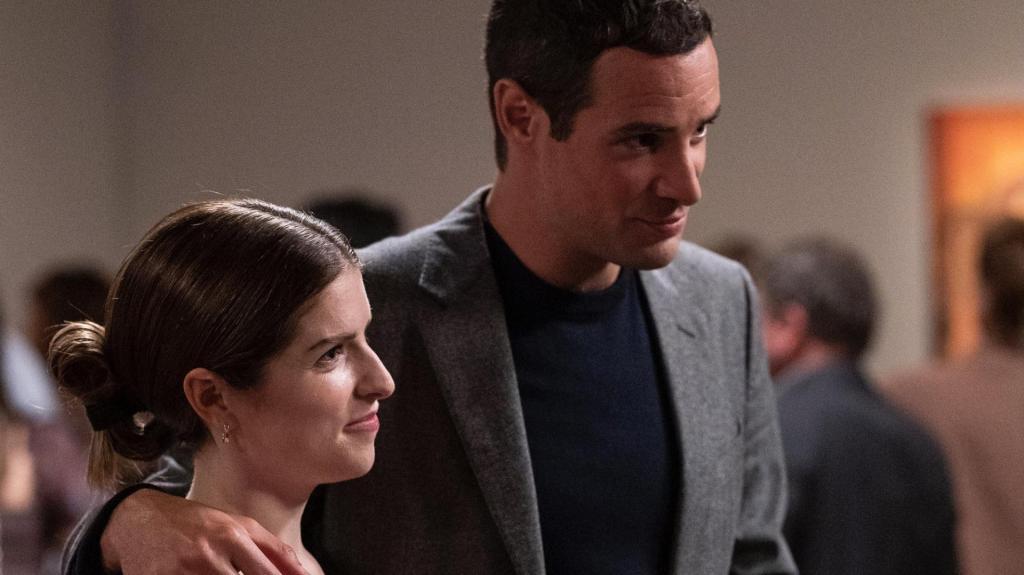
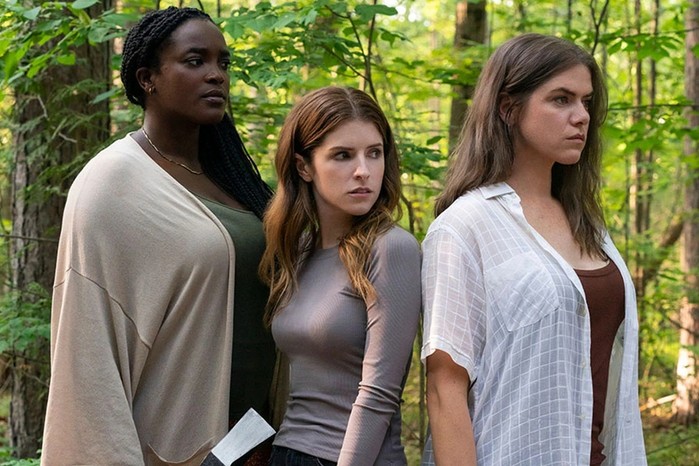
Alice (Anna Kendrick) is saddled with an emotionally abusive boyfriend, Simon (Charlie Carrick), who controls every aspect of her life. When she lies to him in order to get away for a week with her childhood friends Sophie (Wunmi Mosaku) and Tess (Kaniehtiio Horn), Simon tracks her down, with explosive results.

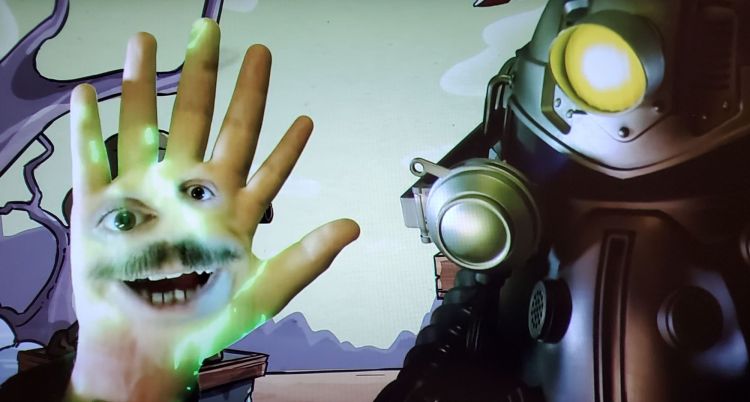
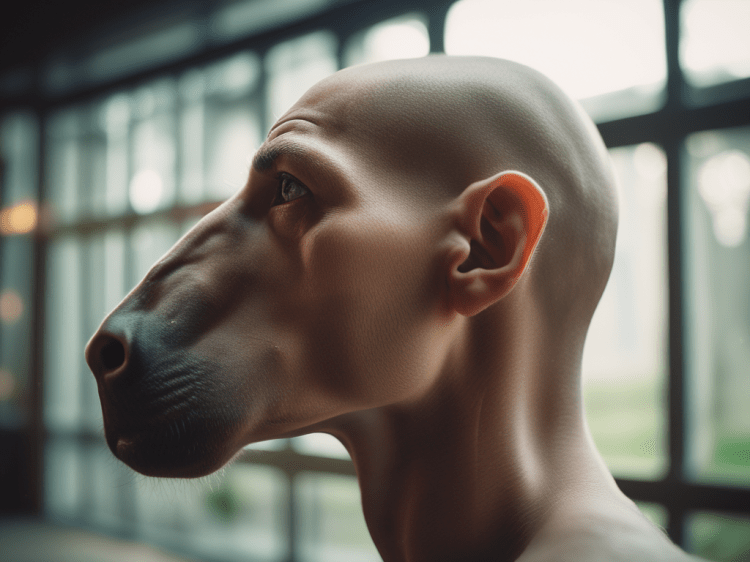
A big image system in the movie is eyes. We see tight closeups of Anna’s worry-face, watching Simon to gauge how he reacts and modifying her behavior accordingly. When Anna goes to the cottage with Sophie and Tess, we get more wide shots of beautiful countryside and the ladies having fun and Alice gradually (but not completely) letting her guard down. Bodies as a whole are emphasized, as in Simon’s dominance over Alice’s body. He decides what they eat; he always has his arm around her, reigning her in. He’s fiercely in charge of her sexuality. When they’re apart, he prompts her to send him pictures of her breasts, even when she’s out to dinner or on the supposed work trip. He won’t even let her shower by herself. The lake Anna swims in with her friends is heavily counterpointed by the shower, where she’s his prisoner. Seemingly the only thing Anna controls is her hair, which she pulls out when she’s overwhelmed by stress. Which is often. Really, her thick, gorgeous hair is a bit unrealistic–she should probably look more like this:

Maybe a little less lopsided. Aren’t AI-generated images as fun as they are terrifying?Okay, last one, promise:

It’s not a sensational movie, as in wildly violent or axe-murdery. There’s quite a low body count, in fact. The horror is built up from just how far Simon will go to keep his sway over Alice, and how much power she yields to him, and the realism makes it all the more disturbing. Simon is a quintessentially human monster, and his ordinariness underscores how much this really is happening in real life.

Sophie and Tess are a welcome contrast to Simon. A major theme is the magic of friendship. Yes, this kind.

Just imagine it with three ponies. Who have a deadly weapon.

I don’t have any major gripes. I would have liked more character development for Sophie, the voice of reason, and less about Tess’s angst over her stalled career. Check it out if you’re in the mood for something serious but ultimately uplifting. I lied, here’s the worst AI image yet, I found it in my media library and couldn’t resist.

And I’ll be having NONE of this! What the FUCK, AI?

Book Quote of the Day

“[…] Anna dreamed of letting go and getting lost. She could do it, slide into the scene and vanish. Her family had always been terrible at Where’s Waldo? But she […] rode back with Mom and Dad so she wouldn’t have to listen to Christopher’s ‘check in with work’ call the whole way. Mm-hmming while Mom fretted about neighbor Miriam’s latest health issues, none of which were even close to life-threatening, was torture of a different and therefore refreshing variety.”

–Jennifer Thorne, Diavola.

The Horrors of Adulting: Beatrix Potter

When I was a wee lass, I loved me some Beatrix Potter. I wanted to pass on that love to my eldest when she was a toddler, but I had apparently blocked out the more disturbing aspects of the stories. I didn’t get farther than “The Tale of Tom Kitten”, which concerns a clowder of feline siblings whose mum sends them out to play in their best clothes while she gets the house ready for company. When inevitably the clothes are ruined, “She pulled them off the wall, smacked them, and took them back to the house.”

Yet somehow, the phrase “I am affronted,” has worked its way into my daily vocabulary

I realized that my love of the books probably had less to do with the admittedly adorable illustrations and more to do with my growing fascination with things that were scary. A goodish amount of the tales have to do with anthropomorphic animal children behaving dangerously and risking getting in trouble with authority figures, a fear which haunts me to this day.

This is me

Consider “The Tale of Benjamin Bunny”, in which Benjamin and his famous cousin Peter run afoul of a cat. Benjamin’s father saves them, and then hits them with a switch. Beneath the threat of life and limb, there’s the threat of a violently miffed authority figure.

The switch is bad enough, but does he have to yank their ears, too? And what’s with shoving Peter’s face in his crotch?

In “The Tale of Peter Rabbit”, Peter’s mother warns Peter and his sisters not to go into Mr. McGregor’s garden: “Your Father had an accident there; he was put in a pie by Mrs. McGregor.” Forget the switch; disobey your mother, and you get made into a pastry!

Look at that baby that can’t wait to eat bunny pie!

In “The Tale of The Flopsy Bunnies” Benjamin Bunny grows up and has so many children with his cousin Flopsy that not even Potter knows their names, hence the title. The family is hungry, so the children head to Mr. McGregor’s garden to find some cabbages. Mr. McGregor throws them in a sack and has a lively debate with the missus about what to do with his catch. ” ‘Not fit to eat; but the skins will do fine to line my old cloak.’ ‘Line your old cloak?’ shouted Mr. McGregor–‘I shall sell them and buy myself baccy!’ ‘Rabbit tobacco! I shall skin them and cut off their heads.’ ” I don’t even know what the moral of this one is! Don’t be hungry?

Luckily they escape, and the story doesn’t end with a sack of pulverized baby bunnies

Or there’s always “The Tale of Samuel Whiskers”. In this one, poor Tom Kitten gets himself hopelessly lost in the chimney of his house.

The funny smell is actually two scheming rats, one of whom wastes no time tying him up, while the other demands a “kitten dumpling roly-poly pudding”. Nightmare fuel!

This is Tom trying to call for help, but his mouth is full of spiderwebs!

The two rats proceed to wrap Tom Kitten in dough and tenderize him with a rolling pin. And then from there I guess they plan to cook him alive? Or eat him alive? I’m not sure which is worse.

Emoji is my addition

Tom Kitten escapes, his mother bathes him (no description of corporal punishment this time), and the story ends on the cheerful note of Tom’s sisters becoming master rat catchers and keeping dozens and dozens of their tails as trophies.

Here’s a random picture of a dog with a gun. I forget which story this is from, maybe “The Tale of the Dog with Opposable Thumbs”.

And then there’s “The Story of A Fierce Bad Rabbit”. A good rabbit is eating a carrot and minding its own business when a bad rabbit snatches its carrot and roughs it up for good measure. The good rabbit hides in fear.

Good thing, too, because a hunter sees the bad rabbit and shoots at it, which somehow blows off its tail and whiskers but leaves it otherwise unscathed. The good rabbit sees it scampering by. The end.

And don’t get me started on the story about Jemima Puddleduck, who survives being outwitted by a fox who wants to eat her eggs, but then a troop of puppies gobble down her offspring instead, and she goes home crying. The end. As a palate cleanser, here’s a drawing from one of Potter’s more wholesome stories.

Alex Garland’s ‘Men’: Stylish and Thought-Provoking

Harper (Jessie Buckley) is a woman recovering from the shock of seeing her husband James (Paapa Essiedu) fall off the roof of their flat, maybe or maybe not on purpose. She takes a trip to a quiet English countryside only to find that her man troubles are just beginning.

When a church has pagan imagery on display, it’s time to run fast and far

It’s easy to read the film as man-hating. Literally every male Harper sees, including her husband, is trying to control her, manipulate her, hurt her, fuck her. Even the friendly Geoffrey (Rory Kinnear) trips over himself in his insistence to be her knight in shining armor, to carry her bags, pay for her drinks, save her from randos in the yard. Her only allies are her gal pal Riley (Gayle Rankin) and a sympathetic female police officer (Sarah Twomey) who shows up once, never to return.

Really Harper has nothing to worry about, these men are just big babies

Buuuut you can also interpret the film as misogynistic. A lot of the buildup of tension in the film is based on the concept of widdle Harper alone in the big, sprawling wilderness, being menaced by a disturbing parade of male psychopaths, including a naked guy. Imagine a horror movie with those gender roles reversed, a man being stalked by a naked woman:

You don’t have to imagine it, because I made a poster!

Okay, not every man would react that way.

Most of the gripes about sexism come from towards the end, when Harper goes from refusing to be a victim, saying things like, “I will fucking cut you!”

Hers is bigger, pal.

to damsel in distress, lying in the road and trembling when somone she trusted turns out to be her enemy.

Whether or not you think it’s sexist, you can’t deny it’s beautifully shot

Honestly though, I don’t know how to parse the image system throughout that is, shall we say, distinctly feminine:

Vagina!
Vagina!
Vaaaaagina!

However, while I can see the movie from both perspectives, ultimately Harper’s dilemma seems very personal. She’s dealing with her particular grief and guilt, and her surroundings and interactions reflect that. There’s a dreamlike quality throughout, especially toward the climax. While I might have liked to see her turn into a stabby, badass action hero, that’s not her character arc.

The movie flitted in and out of my radar for a couple of years. I think I put it on my watchlist after seeing it was written and directed by Alex Garland, of whom I am a fan. When I told my sister Leslie I enjoyed it, she asked, “Was it scary or just weird?” I responded, “Well it’s A24 lol.” Which means that it’s a bit of both, but mostly the latter. Give it a look if you’re in the mood for something challenging but easy on the eyes.

Book Quote of the Day

“The Gentleman Scientist was fooling with something dangerous and knew it but either wasn’t willing to stop or couldn’t and in the end those things come to the same. I could stop which made me a fool to go on, but there was another factor. Something had happened to me. I had grown curious. It was welcome and dreadful in equal measure. It was a feeling and in my world those had been in short supply. You see a man with his legs gone and his face sliding off even as he screams in agony, you see his teeth on his shirt like a barbaric necklace and know you were standing where he got it only seconds before and it stuns your feelings […] and when those feelings start to return you see the possibility that your humanity isn’t as gone as you thought it was.”

–Stephen King, “The Dreamers”, You Like It Darker, 2024.

Steve’s still got it!

‘The Exorcist Believer’: You’ve Seen Worse, You Know You Have!

Victor (Leslie Odom Jr.) is a widower raising his teenage daughter, Angela (Lidya Jewett). After performing a seance with her friend Katherine (Olivia O’Neill), the two girls disappear in the woods for three days and come back decidedly more evil than they had been previously. It’s up to Victor, Katherine’s parents Tony (Norbert Leo Butz) and Miranda (Jennifer Nettles), Chris, the mother of the possessed girl from the very first film (Ellen Burstyn reprises her role), and a spunky coalition of religious leaders to save the day.

I didn’t go looking for other opinions, but the hatred for the movie is pretty loudly broadcast. I didn’t see what all the hubbub is about, though. Well, William Friedkin was pretty pissed off, but he hated all the other sequels too, even the arguably quite watchable Legion. I thought the first hour was really solid. I had a cup of coffee in the kitchen I very much wanted to drink, but I was too enthralled to either pause or make a quick run for it. After the first hour, it turns to poo for a bit, then comes back strong for the close. A lot of mainstream horror movies have that uneven feel of a team of writers that can’t agree on what they want to say, and a lot of them can’t even deliver a good ending.

People were also griping that it’s just a cheap remake, but the filmmakers put forth an effort to make this its own movie while skillfully tying it to the original. There aren’t a barrage of look-alike shots, no spider-walk, no peeing on the floor, no one in a fedora standing in front of the house. They do copy the quick, subliminal shots from the director’s cut released in the early aughts, there’s a distraught teen shrieking obscenities, and you bet your ass there’s a spinning head, but overall it’s pretty creative.

Personally, I’m a sucker for the cast. Leslie Odom Jr. is always phenomenal–I’m a major Hamilton nerd. Ann Dowd–the consummate creepy lady–in this one the creepy lady makes good! Ellen Burstyn is a national treasure–have you seen Requiem for a Dream? If you haven’t, I’ll wait. Speaking of Burstyn, this is my approximation of how she got involved: Studio exec [Let’s picture him as Ryan George]: “Be in my movie. Here’s money.” Burstyn: “Nah.” Studio exec: “Here’s a metric fuckton of money.” Burstyn: “Okay. But I’m giving it to charity. Also, I don’t want to have to do a lot of stuff.” Who cares if it’s stunt casting? She delivers her horrendous dialogue like a badass! And I honestly got choked up when Linda Blair pops in at the end.

I had a feeling throughout of grudgingly liking the unintentionally silly parts. There’s just something that tickles me about two snarky teenage demons mocking a grouchy nurse for having an abortion: Possessed Katherine [pouting]: “You were to honor your mother with a child in her name.” [fake cries] Possessed Angela: “Did the power of Christ compel you?” And the scene with all the religious folks coming together for a big group exorcism! A Baptist, a Pentecostal, a Catholic, and a Rootwork healer…it sounds like a “walk into a bar” joke. It’s just too precious. The filmmakers try to put forth a theme of “The power of Christ speaks through all of us,” but during the exorcism when the Catholic priest shows up belatedly, everyone looks relieved.

Singalong time!

It was a weird coincidence at twenty-one minutes to the end when my ten-year-old came back from visiting friends saying his stomach hurt, and then he promptly projectile vomited all over the floor. Thankfully, he’s not possessed. Unless you count being obsessed with Fortnite as possession. Anywho, check it out if you’re in the mood for something competently made and even trying to approach diversity.

Top 25 Movie Quotes: Part XXII

Ever seen the American Film Institute’s list of movie quotes? Let me sum up: of the hundred, about 25 are Casablanca and Gone with the Wind. Most of the rest are from the other golden oldies that are revered by the writers of film studies textbooks; they may be well-made, but they’re also very much a reminder of how discriminatory Hollywood was in terms of race, gender, and sexual orientation. Though I give big ups for including Jaws, Psycho, and The Sixth Sense, the AFI’s selections just don’t speak to me, and if you’re on this site, perhaps they don’t speak to you, either. Though many of the movies I quote from aren’t horror, they are all delightful (the quotes, not necessarily the movies). After trying and failing to narrow down my own list to a slim ten squared, here is part twenty-two. (And no, I had no idea how many of these I would write when I started in with the Roman numerals–I keep watching movies!) In no particular order:

25.) George (Shea Whigham) has just watched his teenage daughter, who recently revealed to him that she’s a superhero, step into a portal to another universe: “Parenting stuff is a big-ass mystery.” (Spider-Man: Across the Spider-Verse, 2023)

24.) Possessed Daniel (Otis Dhanji), to his girlfriend: “He hates when you touch him. You make him soft.” Hayley (Zoe Terakes): “Yo, this spirit’s a cunt.” (Talk to Me, 2022)

23.) [Max (Adam Sandler) has a magic sewing machine that allows him to impersonate the owner of shoes that he repairs, and one such owner is a corpse, making him look like a zombie] Kid: “Hey, Mister, you okay?” Max: “Huh?” Kid: “Don’t eat me! Please don’t eat me!” Max: “All right. All right. [Takes off a shoe, which returns him to his normal appearance] I’m not! I’m not gonna eat you! [Kid faints] Kid! Kid, wake up! I’m not gonna eat you!” (The Cobbler, 2014)

22.) Reggie (Marque Richardson): “Tell me, man, what’s harder? Being Black enough for the Black kids or Black enough for the white ones?” Lionel (Tyler James Williams): “Being neither.” (Dear White People, 2014)

21.) Charlie (Joel Edgerton), doing maths in order to start producing shoes durable enough for men dressed as women: “How much do you weigh?” Lola (Chiwetel Ejiofor), aghast: “The right amount!” (Kinky Boots, 2005)

20.) Jones (Jason Schwartzman) is auditioning for a role with playwright Conrad (Edward Norton): “It’s a fact, we’re not alone. The alien stole the asteroid. Long thought to be a lunar splinter fragmented from the lesser moon of the hypothetical planet Magnavox-27, now considered a rogue pygmy cometette, according to the encyclopedia. Obviously, she would’ve said something to him. I’m certain of it. Your mother, I mean. She would’ve gotten him to tell us the secrets of the universe or yelled at him or made him laugh. She would’ve had a hypothesis. You remind me of her more than ever. She wasn’t shy. You’ll grow out of that. I think your sisters might be aliens, too, by the way. When I met your mother, she was only 19. She was smoking a cigarette, reading a paperback, taking a bath in a swimsuit on a rusty fire escape a flight and a half below my camera position. Sometimes, I sometimes still think I still hear her here [points to temple] breathing in the dark. Who knows, Woodrow? Maybe she is in the stars.” [Conrad stares silently for a moment] “You’re perfect.” Jones: “Okay?” Conrad: “Okay.” [They kiss.] (Asteroid City, 2023)

19.) Chris (Sinclair Daniel), to her possessed friend: “Dalton, I know you’re in there. But if you touch me again, I’m gonna fuck you up.” (Insidious: The Red Door, 2023)

Somehow this is the best I could do while looking for an image or clip of her

18.) [Talk show host Katherine (Emma Thompson) is debating with her boss]  Caroline (Amy Ryan): “Do you want to know who Jimmy Fallon had on last Tuesday when you had Doris Kearns Goodwin? Robert Downey Jr. They washed a sheepdog together. It was fucking glorious.” Katherine: “I’m sorry, Caroline. Should I have played giant Connect Four with her or perhaps sung a karaoke song on the back of a tandem bicycle? It’s Doris Kearns Goodwin. She’s a national treasure.” Caroline: “Agreed. I only wish she’d been an Avenger instead of writing books about Abraham Lincoln.” Katherine: “She could be an Avenger if she tried!” (Late Night, 2019)

17.) Amos (Blair Underwood), to his niece, who has scoffed at the study of Black folklore: “How does one group of people subjugate another?” Maxine (Michelle Hurd): “Uh, Amos…” Amos: “No, no, no. I’m just educating the girl. You subjugate a people by telling them their science is superstition, their faith is heresy, and their wisdom is make-believe.” (Bad Hair, 2020)

16.) Héctor (Gael García Bernal): “We really need to borrow your guitar.” Chicharrón (Edward James Olmos): “My guitar?” Héctor: “Yes.” Chicharrón: “My prized, beloved guitar?” Héctor: “I promise we’ll bring it right back.” Chicharrón: “Like the time you promised to bring back my van?” Héctor: “Uh…” Chicharrón: “Or my mini-fridge?” Héctor: “Ah, you see–” Chicharrón: “Or my good napkins? My lasso? My femur?!” (Coco, 2017)

15.) Voice on answering machine: “Miss Johnson, I hate to be the one to tell you this on an answering machine, but your fathers, they were killed by a pack of ninjas. But I just want you to know that they died as they lived. Gay and proud and defending your fair city. I hope this news doesn’t bring you to a life full of skateboarding and drinking and going down a path of evil.” (Black Holler, 2017)

This movie’s low-budget, but it won me over with its random-ass humor

14.) [Brad (Ben Stiller) has been rambling about his upper-middle-class-white-guy problems to Ananya (Shazi Raja)] Brad: “What…what is that look?” Ananya: “What?” Brad: “That…No, what are you thinking?” Ananya: “What am I thinking?” Brad: “Yeah, please, tell me.” Ananya: “Honestly, I’m thinking you’re really lucky. You’re 50 years old, and you still think that the world was made for you.” Brad: “Uh, I’m 47.” Ananya: “Do you even know poor people?” Brad: “Of course.” Ananya: “Okay, well, when I visit my mother’s family in Delhi, a lot of people out there only live on two dollars a day. They’re not complaining about being ignored at a dinner party. They’re happy they get dinner.”(Brad’s Status, 2017)

Yet again, no clip or image from that scene

13.) Nick (Adam Sandler): “And, Inspector, we tried to start your car up, but, uh, couldn’t get it done, so we left it there.” Inspector Delacroix (Dany Boon): “What?” Nick: “We stole a Lamborghini. You can have that when we’re done with it.” Delacroix, content: “Okay.” (Murder Mystery 2, 2023)

Brutally unfair that you can easily find like ten stills from this movie of Jennifer Aniston and Sandler pointing at each other

12.) Sergio (Laia Costa): “Nima. Look at me. Look. You are so beautiful. You are so, so, so beautiful. Say it. Shout it. Shout it to the fucking moon.” Naima (Alia Shawkat): “I can’t!” Sergio: “Yeah, you can. Say it to her.” Naima: “And you have to say it with me.” Sergio: “Yeah.” [In unison] Naima: “I am so beautiful!” Sergio: “She is so beautiful! [Sergio, to the moon] Stop being jealous! Stop it!” (Duck Butter, 2018)

11.) Sadie (Maude Apatow), hitting puberty hard: “Mom, why can’t I get new clothes? What the fuck?! Nothing fits me! God damn it!” (This is 40, 2012)

10.) Curtis (Craig Robinson): “I know you don’t want to hear this right now, but one day, when you lighting the hip-hop world on fire, it’ll be because you have a unique perspective. And when you collecting all your Source Awards, you’ll thank me.” Morris (Markees Christmas): “Source Awards?” Curtis: “Mm-hmm.” Morris: “Is that as far as I get in your dreams?” Curtis: “All right. All right. You right.” Morris: “Can I get a Grammy or something?” Curtis: “Nobel Prize! How bout that? Thank me in that speech.” (Morris from America), 2016

9.) Sonia (Salma Hayek): “If you don’t help me, I am gonna put my strap-on on and I am gonna fuck your dreams until they wish they were your nightmares. [Shooting at attackers] Motherfuckers!” Bryce (Ryan Reynolds): “First of all, your mouth needs an exorcism.” (Hitman’s Wife’s Bodyguard, 2021)

8.) Young Woman (Jessie Buckley): “Everything has to die. That’s the truth. One likes to think that there is always hope. That you can live above death. And it’s a uniquely human fantasy that things will get better, born perhaps of the uniquely human understanding that things will not.” (I’m Thinking of Ending Things, 2020)

7.) [A group of high school students have been targeted by a killer] Scuba (Gabriel Davenport): “If it makes you feel better, you’ll be killed before you get suspended for plagiarism.” Gabby (Addison Rae): “Scuba. Don’t joke about that.” Scuba: “My bad, you’re right. Plagiarism’s serious.” (Thanksgiving, 2023)

My second favorite quote: “Now is that any way to thank Kathleen? She’s been cooking all day.”

6.) Valentine (Samuel L. Jackson): “You know what this is like? It’s like those old movies we both love. Now, I’m going to tell you my whole convoluted plan, and then I’m going to come up with some absurd and convoluted way to kill you, and you’ll find an equally convoluted way to escape.” Harry (Colin Firth): “Sounds good to me.” Valentine: “Well, this ain’t that kind of movie.” (Kingsman: The Secret Service, 2014)

5.) [It’s the rural South in the aftermath of WWII, and veteran Ronsel (Jason Mitchell) is being confronted by white dudes for using the front door of a general store] Pappy (Jonathan Banks): “You must be confused as to your whereabouts. Well, that explains why you’re tryin to leave by the front door.” Ronsel: “No, sir, I’m not confused at all.” Pappy: “Oh, I think you are, boy. I don’t know what they let you do over there, but you’re in Mississippi now, n*****. You use the back door.” Henry (Jason Clarke): “Go on, son. Son, we don’t want no trouble here. Go on.” Ronsel: “You know what? You’re absolutely right. When we was overseas, they didn’t make us use the back door. General Patton put us on the front line. Yes, sir. You know what we did? We kicked the hell out of Hitler and them Jerries. While ya’ll at home safe and sound.” (Mudbound, 2017)

4.) [It’s 1968, and a group of gay friends have gathered for a birthday party; they’re playing a game that involves calling the man they love and saying so] Hank (Tuc Watkins): “I’d like to leave a message.” Michael (Jim Parsons): “Oh, not in. One point.” Hank: “Would you say that Hank called? Yes, it is. Oh, good evening. How are you?” [Hank’s boyfriend] Larry (Andrew Rannells): “Who the hell is that?” Hank: “Yes, that’s right. The message is for my roommate, Larry. Just say that I called…” Larry: “It’s our answering service.” Hank: “…and said I love you.” Alan, Michael’s heterosexual roommate who wasn’t invited (Brian Hutchison): “Hank, are you crazy?” Hank: “You heard me correctly. That’s what I said. The message is for Larry. It’s from me, Hank, and it is just as I said. I love you.” (The Boys in the Band, 2020)

3.) Rei (Kiko Mizuhara), to her unrequited high school crush Nanae (Honami Satô): “You smile when you lie. And you look really cute when you do it. My entire life crumbles with just a single smile of yours!” (Kanojo, AKA Ride or Die, 2021)

2.) [Cassie (Carey Mulligan) has tricked and bound the man who sexually assaulted her best friend] Al (Christopher Lowell) “You know, I was affected by it too, okay? I mean, it’s every guy’s worst nightmare, getting accused like that.” Cassie: “Can you guess what every woman’s worst nightmare is?” (Promising Young Woman, 2020)

1.) Gabbie (Rosario Dawson), to her son Travis (Chase Dillon): “Pumpkin? What’s wrong?” Travis: “This place is haunted!” Gabbie: “All right, now hang on. Now, I know this place isn’t as warm as I had hoped. [A ghost, which Travis sees but Gabbie doesn’t, is creeping up] But, you know, I think we get some daylight in here, it’s gonna feel better. Hey, I’m gonna light a vanilla candle and it’s gonna be a game changer.” Travis: “Will it, though?” Gabbie: “Sweetie, I need you to give this place a chance. This is our home now. [Sees the ghost] Nah. We’re out.” (Haunted Mansion, 2023)

My second favorite scene: describing a ghost to a police sketch artist

Author’s note: I have extensively relied on IMDb for help, both with dates and with some of the quotes.

Real Fear Part Three: Evil Children

*Author’s note: In the process of analyzing films, I let loose major spoilers.*

The horror genre is loaded with movies about evil children. From a sociological standpoint, you can interpret this as reflecting worries about the next generation (those dad-ratted millennials and their trophy-hunting, nostalgia-obsessing, avocado-toast-making!) or just a gimmick to make something that’s supposed to be harmless creepy instead, like that urban legend about John Denver being a sniper in the Vietnam war. The children are evil for varying reasons, be it supernatural, genetic, environmental, or sometimes even for no reason, but a prevailing theme is either guilt on the part of the childrens’ guardians for their misdeeds or fear of losing control over them.

Supernatural corrupt youngsters abound in films like Pet Sematary (a zombie), ‘Salem’s Lot (a vampire), The Ring (an angry ghost), and The Omen (the antichrist). They’re often born to mortal people who are horrified by their behavior. From a real-world perspective, there is some scientific study regarding body chemistry as a cause of psychopathy–though obviously the real-life issues don’t stem from curses, possession, or coming back from the dead; they involve deficiencies in serotonin and an overage of dopamine (Fallon, 82-84). Some theorists even posit that for some people, being a psychopath is natural: “As far as ‘will’ is concerned, I want someone to say with a straight face that Oprah, with her constant losing battles against obesity, lacks will. That woman had more will than 99.9 percent of people. But it is not the ‘will’ that society, her friends, her family want. They want her to be wonderful and to do great works, and be famous, and be thin. Well, folks, unless she gives up everything else and stays focused solely on her weight for the rest of her life, she is going to keep coming back home. All behaviors can be modified in the face of a genetic and epigenetic makeup that says otherwise. But to stay changed in the face of those genetic imperatives usually means you have to give up nearly everything else you hold most dear. Our genes and how their effects are modified by stressful experiences early in life don’t necessarily predict categorically who we are and what our deep character is about, but they create constant pressures to be and act a certain way. Psychopathic tendencies are particularly hard to fight, and attempted cures may make only small differences. Drugs that influence the monoamine neurotransmitter systems can partially reduce impulsivity and aggression, and early interventions involving diet and meditation can decrease behavioral problems, but the core neuropsychological deficits leading to lack of empathy and remorse remain. There are no magic bullets” (Fallon, 206) (unless it’s a werewolf movie). This reflects an underlying fear for parents that we have no control over our children: can we influence our kids enough to polish them into moral, upstanding citizens? Or will we fail?

An adult nightmare indeed…

In Children of the Corn, the juveniles of a small Nebraska town are being influenced by tween Isaac, who educates them about the awesomeness of He Who Walks Behind the Rows, a corn-based god.

Clearly there’s not much to do in this town

As Job, a good Christian boy, narrates, “They were acting real creepy.” He and his sister Sarah are the only children in Gatlin who don’t suddenly embark on a killing spree, murdering every adult around. The others are driven by religious fervor, and seem to really enjoy poisoning, maiming, and dismembering people. Later they graduate to crucifying their victims.

They’ve completely lost their fear and respect for authority, at least the secular kind. Isaac claims that adults are “unbelievers and profaners of the holy,” and once a corn child turns nineteen, off they go to be sacrificed. The children of the corn are the penultimate two-year-olds who won’t listen or behave. “Children, particularly young children, control precious little in their lives. Parents control everything. This lopsided power dynamic doesn’t sit well with those on the losing end. Kids sometimes challenge parents just because they can” (Pearlman, 15). The film asks the question of what would happen if children (who often outnumber their parents) realized that their elders are only humans, with a limited amount of real power.

Just look at how powerful this low-angle shot makes them look!

It’s easy to get wrapped up in guilt and anxiety about how heredity will affect our children. My husband’s family has a sizable amount of alcoholism, dementia, and cancer, while mine has depression, OCD, and heart problems. My daughter Layla, even when she was a preteen, was strikingly like me as a teen; we share the same traits of low self-esteem, shyness, and gender dysphoria. My son Orion, at age nine, is also a mini-me at that age: sensitive and quick to tears, but kind. According to some reasearchers, genetics are exceedingly important influencing factors in a child’s life, possibly more so than environment: “Parents matter, but they don’t make a difference. Parents obviously matter tremendously in their children’s lives. They provide the essential physical and psychological ingredients for children’s development. But if genetics provides most of the systematic variance and environmental events are unsystematic and unstable, this implies that parents don’t make much of a difference in their children’s outcomes beyond the genes they provide at conception […] shared environmental influence hardly affects personality, mental health or cognitive abilities after adolescence. This even includes personality traits that seem especially susceptible to parental influence such as altruism, kindness and conscientiousness” (Plomin, 107.) Once again, parents are left worrying about things we can’t control. How much influence do we really have, and what’s predestined in our genes?


The Bad Seed (I went with the 1985 remake that’s much less wishy-washy1) regards Christine, the daughter of serial killer Bessie Denker. Bessie’s murderous ways have skipped a generation and been passed on to Christine’s young daughter Rachel. Bessie, in pursuit of an inheritance, killed 13 members of her own family, starting with the attempted murder of her brother as a child. She was caught while hunting down toddler Christine, who was taken in by Richard, the reporter covering the case. In the movie, sociopathy is regarded as almost wholly a genetic condition. Christine’s neighbor, Emory, is a true crime writer who states: “I’m not saying that environment is irrelevant, but your hardcore murderer has to have something very basic missing in his genetic makeup.” Christine responds, “So what you’re saying is that a lack of morality can be inherited.” Rachel, though possessing a shallow charm and cutesiness, has no sense of empathy, only acquisitiveness.

Rachel putting on a show

Christine aptly recognizes that “She just seems so greedy.” To which her neighbor Monica replies, “Everybody’s greedy, children just don’t hide it as well, sweetie.” People are constantly giving Rachel presents, but she’s still prone to theft, stealing from her classmates and Monica’s purse. The opening shows Rachel pushing Mrs. Post, a sweet lady trying to feed a cat, down the stairs, because the woman promised her a Christmas ornament when she died. When classmate Mark wins a penmanship medal instead of her, she beats him to death with her shoes and steals it. Then she comes home and goes roller skating. The only person to immediately see through her facade is the maintenance worker Leroy (look, it’s David Carradine!).

Leroy: “Pretty smart, ain’t ya? You’re almost as smart as me.” Rachel: “I’m smarter than you.”

Rachel strikes fear into the hearts of her enemies. She has to chase Mark down; he runs away from her. She even scares Leroy, after he figures out that she killed Mark. He insinuates that he took her shoes out of the incinerator, and she threatens, “I want those shoes back. You give them back to me, or you’ll be sorry […] I want them back as soon as I get home from school. Do you hear me?” Leroy, panicking, tries to find the shoes (which actually had burned) and hides from her when he can’t find them. Not to be deterred, Rachel merrily burns him alive. Meanwhile, Christine has also figured out that Rachel is a bit murder-y, and Rachel is happy to use Christine’s guilt over Rachel’s dead father to her advantage: “Ever since Daddy got killed, I’ve been scared. I miss him so much, Mommy!” She also exploits Christine’s motherly love when she admits to killing Mark: “Please, Mommy. It wasn’t my fault. You’re not gonna tell on me, are you?” Christine replies, “No, Rachel. No, darling, I’m not gonna tell on you, no. It isn’t your fault, sweetheart, you’re right. It’s my fault.” Christine, after telling Rachel to burn her shoes and throwing Mark’s medal out to sea, snaps after Leroy’s death. She gives Rachel a massive dose of sleeping pills, saying, “Sleep well, darling. Sweet dreams. Oh God forgive me! I love you so much.” Before waiting to make sure Rachel actually dies, she shoots herself. In the end, Rachel survives and goes to live with Richard. But she asks, “Can I come back and visit Aunt Monica sometimes?” A recurring motif in this subgenre is the child who is not a child–they have adult tendencies and at the very least instincts towards–if not outright expertise for–manipulation and harmful behavior.

Christine, asking about the death of Mrs. Post, trying to believe Rachel’s story that she fell down the stairs on her own: “Is that really all that happened?” Rachel: “Except that she was screaming all the way down.”

Young children and babies are, obviously, not born knowing how to behave like reasonable people (or the facsimile that most of us manage eventually), and have a disconcerting resemblance to an adult with antisocial personality disorder—a condition that involves “a pervasive disregard for the rights of others […] failure to conform with social norms and standards of lawful behavior, deceit, impulsiveness or failure to plan ahead, irritability and aggressiveness, reckless disregard for the safety of oneself and others, consistent irresponsibility, and lack of remorse” (Black, 52-53). Any parent can recognize their own offspring in that description, having seen them hit another over a toy or make a dangerous jump. I have to admit to feeling a twinge of nervousness about Layla as a baby, when she loved pulling my hair and slapping me. Orion had a biting problem and repeatedly tormented Layla by snatching her toys and throwing them either in the litter box or the toilet. (I won’t bore you with the lengthy description of conduct disorder, the under-age-eighteen version of ASP, but if you’re interested, I included the full list of criteria as a footnote.) The flip side of nature in child-rearing is nurture; of course we’ll make mistakes, but will our own flaws cause us to do things we can’t take back?

The Butcher Boy is not strictly a horror movie, but it does portray graphic and upsetting subject matter: Francie, a troubled preteen, acts out in cruel ways until finally he murders a woman.

Francie experiences multiple environmental causes for conduct disorder, mainly his sympathetic but deeply flawed parents: “Many children who become antisocial endure poverty, substandard housing, bad neighborhoods, parental abuse and neglect, and inadequate nutrition and medical care” (Black, 154). He grows up poor with his alcoholic, abusive father Benny and mentally ill mother Annie. In one scene, Benny chases Francie with a belt in an attempt to beat him, while Annie frantically takes a handful of pills. At one point, Francie gently stops her from hanging herself. Annie is then sent to a mental hospital, and Francie is left to clean and do the shopping when they run out of food. When Annie comes back, she’s no longer depressed but instead manic, obsessed with baking at all hours. When Francie runs away after his parents have a fight that culminates in Benny slapping Annie and calling her a bitch (also a criteria for conduct disorder: “Has run away from home overnight at least twice […] or once without returning for a lengthy period”), Annie throws herself in the ocean and drowns. Benny blames Francie, and soon succeeds in drinking himself to death, leaving his corpse to draw flies in the living room, while Francie does his best to deny that Benny is dead. Francie, true to form for conduct disorder, charms many of the adults in his life; he’s well-liked by the town priest and the ladies at the grocery store, who call him a “rare character.” As one of them says later, “What chance did he ever have, the poor creature.”

Look at him! He’s adorable!

Francie meets the criteria for conduct disorder: “A repetitive and persistent pattern of behavior in which the basic rights of others or major age-appropriate societal norms or rules are violated.” He “Often bullies, threatens, or intimidates others,” taking a special interest in his peer Phillip and Phillip’s mother Mrs. Nugent. He “has stolen while confronting a victim.” In fact, Francie himself acknowledges that stealing apples from the Nugents’ tree is his first bad deed, which he quickly follows up with by stealing Phillip’s comic books. He has “deliberately destroyed others’ property.” He has “broken into someone’s house, building, or car”–he breaks into the Nugents’ house, vandalizes it, and then takes a dump on the floor.

Mrs. Nugent is less than pleased

Mrs. Nugent is so scared of Francie that twice in the movie she sends her brothers to rough him up; the second time it happens, Francie gets the better of them and hits them with a rock. Francie sees the Nugent family as the source of all of his problems: “If she hadn’t poked her nose in between me and Joe, everything would have been all right.” Francie’s friend Joe is the most stable influence in Francie’s life. At first, he joins Francie in taunting Phillip, but then he has a crisis of conscience, convincing Francie to leave him alone and then disowning Francie as a friend completely. Despite getting psychiatric care, Francie escapes, begins drinking, and in a poorly timed series of events, finds out his parents’ sweet honeymoon story was a lie and is turned away for a final time by Joe. Francie attacks Mrs. Nugent, dehumanizing her by calling her an alien. He murders her, dismembers her, buries her, then tries to burn down his house. 

Here’s grown-up Francie after years and years of therapy, greeting his old pal the Virgin Mary, played by Sinéad O’Connor

In some cases, psychopathy seems to be something almost inevitable, not preventable. Dr. Kent A. Kiehl, a leader in the field, describes the multiple letters he receives from worried parents: “One of the most telling aspects of the letters is that none of the children are described as normal from birth. Parents say they noticed something different, odd, or abnormal about the child from the very beginning. The letters never describe a normal child, followed by a sharp transition in behavior precipitated by something like a head injury or stressful event (i.e., divorce or death of a parent or sibling). They never describe a period of time where the child went from a normal state into a slow decline. Such a pattern is seen in a number of mental illnesses and is commonly referred to as a prodromal period–a slow, progressive change in normal functioning until a real mental break occurs. These children’s histories are presented as qualitatively different from other siblings or children from a very early age; if anything, the behavior has been disappointingly consistent, if not worsening, since birth” (127). What can we do with a child we can’t change?

In We Need to Talk About Kevin, a sixteen-year-old boy massacres a group of his classmates by locking them in the school gym and picking them off with a crossbow. The movie is from the point of view of his mother Eva, who is baffled by his lifelong cruel behavior. From the time he’s a baby, Kevin hates her, crying nonstop unless his father Franklin is holding him. (In one scene, Eva is so desperate for an end to the squalling that she stands with his stroller by a construction worker using a jackhammer.) As a toddler, Kevin mocks Eva and purposely goads her. He refuses to talk and glares at her. He throws his food at the wall (prompting Eva to say, “Mommy was happy before widdle Kevin came along”).

As Kevin gets older he shows evidence of conduct disorder but without the kind of environmental predictors that Francie has. Like most of the parents in this subgenre, who love their horrible children unconditionally, Eva keeps trying to mother Kevin even though she’s not fooled by him. Eva is sometimes impatient but always loving, and we’re meant to empathize with her. It’s well established that she was reluctant to become a mother and misses her freedom as a travel writer to just pack up and leave when she wants. In one scene, pre-pregnancy, she and Franklin frolic in the rain. But even Franklin wants to tie her down, saying, “Promise you’ll never go away again.” In a flashback she’s juxtaposed with the happy pregnant women in her class, standing alone and unsmiling. While giving birth, the nurse has to chide her, “Stop resisting, Eva.” Afterwards, she stares dazedly into space while Franklin plays with the new baby. She also has to give up her busy New York life to move to the suburbs. When Kevin is a few years older, he shows an actively destructive side, in one scene purposely destroying Eva’s decoration of her study with maps of places she’s been. However, he convinces Franklin that he was only trying to make Eva’s room more special and that he is sorry, and Franklin, who continues to view him as a “sweet little boy,” buys it. Kevin also refuses to be potty-trained for years, taunting Eva with having to change his diapers. In her most flawed moment, she loses her temper with him, and he ends up breaking his arm. Unexpectedly, she wins a small amount of his respect, as he lies to the doctor and Franklin about how it happened. (He tells her later, “It was the most honest thing you ever did.”) That night, he finally uses the toilet and continues to do so. However, he does use the event as a way to manipulate Eva, as in a scene when he guilt-trips her into skipping the grocery store and going straight home instead.

As a teenager, Kevin amuses himself by torturing his younger sister Celie, who adores him nevertheless. He puts her guinea pig in the garbage disposal and tricks her into getting drain cleaner in her eye. In marked contrast to Kevin, Celie is kind and happy. When Eva cleans her wounded eye, which is clearly painful to Celie, she still thanks Eva afterwards. Meanwhile, Franklin is increasingly frustrated with what he still sees as Eva being hysterical, and the couple is planning to get divorced. This information is used to hide one of Kevin’s most horrific acts: shooting Franklin and Celie and leaving their bodies in the backyard. Kevin is immediately caught, which seems to be part of his plan; he tells Eva he “might be tied up” on his upcoming birthday and calmly lies down to get arrested. Eva is blamed for his behavior, with strangers yelling “You stole my baby! You’re so evil!” and “I hope you rot in hell, you fucking bitch!” One woman even slaps her in the face. Eva visits Kevin in jail, so regularly that she’s on a first-name basis with the correctional officer. At the end, Kevin admits to Eva that he’s not sure why he did it anymore. Scared about going to “big-boy jail” after he turns eighteen, he hugs her.

Parenting is scary. But take heart. According to neuroscientist James Fallon (not the comedian), parents are putting too much emphasis on the overall impact they have on their children: “I don’t want to overplay the role of environment in development. Kids learn to do a lot of things on their own without explicit instruction–laughing, walking, speaking. And even more complex adaptive behaviors like personality development happen on their own. Kids are malleable, but mostly at the extremes. In the absence of bad abuse or extreme genetics, kids will turn out okay […] Every parent of a grown child knows that no kid turns out how they’d originally thought, and we have very little control over what type of adults our children will grow up to be. Pediatric neurologists I work with have told me this, too. That kid is going to turn out the way he’s going to turn out, unless you mess him up royally” (104-105).

Works Cited

Black, Donald W. Bad Boys, Bad Men: Confronting Antisocial Personality Disorder (Sociopathy). NY: Oxford University Press, 2013.

Fallon, James. The Psychopath Inside: A Neuroscientist’s Personal Journey into the Dark Side of the Brain. NY: Portfolio/Penguin, 2013.

Kiehl, Kent A. The Psychopath Whisperer: The Science of Those Without Conscience. NY: Broadway Books, 2014.

Pearlman, Catherine. Ignore It! How Selectively Looking the Other Way Can Decrease Behavioral Problems and Increase Parenting Satisfaction. NY: TarcherPerigee, 2017.

Plomin, Robert. Blueprint: How DNA Makes us Who We Are. UK: Allen Lane, 2018.  

1Though there is something to be said about Patty McCormack’s performance as the itty bitty psychopath.

2 A. A repetitive and persistent pattern of behavior in which the basic rights of others or major age-appropriate societal norms or rules are violated, as manifested by the presence of three (or more) of the following criteria in the past 12 months, with at least one criterion present in the past 6 months.

Aggression to People and Animals

  1. Often bullies, threatens, or intimidates others
  2. Often initiates physical fights
  3. Has used a weapon that can cause serious physical harm to others (e.g., a bat, brick, broken bottle, knife, gun)
  4. Has been physically cruel to people
  5. Has been physically cruel to animals
  6. Has stolen while confronting a victim (e.g., mugging, purse snatching, extortion, armed robbery)
  7. Has forced someone into sexual activity

Destruction of Property

8. Has deliberately engaged in fire setting with the intention of causing serious damage

9. Has deliberately destroyed others’ property (other than by fire setting)

Deceitfulness or Theft

10. Has broken into someone else’s house, building, or car

11. Often lies to obtain goods or favors or to avoid obligations (i.e., “cons” others)

12. Has stolen items of nontrivial value without confronting a victim (e.g., shoplifting, but without breaking and entering; forgery)

Serious Violations of Rules

13. Often stays out at night despite parental prohibitions, beginning before age 13 years

14. Has run away from home overnight at least twice while living in parental or parental surrogate home (or once without returning for a lengthy period)

15. Often truant from school, beginning before age 13 years

B. The disturbance in behavior causes clinically significant impairment in social, academic, or occupational functioning.

C. If the individual is age 18 years or older, criteria are not met for antisocial personality disorder (Black, p. 45-46)

The Horrors of Adulting: Five Less than Ideal Ways I’ve Resorted to Making Money

I have a Bachelors degree in English. Which means I can teach English if I get a Masters in English, maybe. That is all. It seemed like a good idea at the time. Thankfully I’m now gainfully employed full-time, but in the past I’ve had to scramble. *Now, to be clear, I’m about to do some griping about tasks that kept me financially afloat, so do keep in mind I’m still grateful I was able to get by.*

5. CalWorks Recipient

When I became pregnant with my daughter Layla, I was working as a writing tutor at a community college. This was 2009, and the recession hit, slashing the payroll budget. When I went on maternity leave, my boss assured me I’d still have a position, but that was not the case. I ended up turning to welfare. In exchange for money, I entered a full-time program centered on getting a job. There were classes on personal hygiene and wellness, and I attended lectures by Erin, who taught about writing resumes, dressing formally, and interviewing techniques. The shitty part was mostly my own personal circumstances. Layla was three months old at the time and not quite adjusted to sleeping through the night, and I had tremendous difficulty staying awake. I was also nursing, so periodically I had to find a room to express milk–inexplicably, I didn’t lock the door, and once someone walked in on me. When I wasn’t in lectures or classes, I was required to apply for jobs online, often for eight hours straight. Happily, after a couple of months my writing tutor boss found me some hours, and I went back to work. Years later I ended up at the library, and Erin was a regular patron, which was only mildly awkward.

4. Uber Driver

I didn’t get my drivers license until I was in my thirties, and I learned to drive in California. The roads are flat, pretty wide, and set far away from the curb, with sidewalks aplenty. I was also pretty familiar with the area, having been born and raised there. Which is not to say I never got lost. My sense of direction is rubbish, as is my ability to remember street names, freeways, or even landmarks, and I frequently get confused by Google Maps. It’s a wonder I can get anywhere. I was between jobs after moving to Kentucky, and Uber seemed like a sure way to pay the bills temporarily. A word about the road conditions in Kentucky, a state that, at the time, I had been living in for four months. Maybe four months is enough time for you to get accustomed to new surroundings, but alas, not me. The streets in Kentucky are narrow, and wedged against someone’s lawn, which more often than not features a large dip at the front to curtail flooding. The back roads, while beautiful, are like forests with bigass cliffs you can drive right off of. Not to mention that the highways are as curvy as Adele in 2011. Also, all drivers are in a goddamn hurry and they’re not shy about tailgating. In California, I staunchly drove the speed limit, but that shit doesn’t fly in Kentucky. I’m sure I drove my passengers nuts with my conservative pace. (A year and a half later, I’ve learned to compromise by not driving more than 15 miles over the speed limit, which by state law is a ticketable offense.) I’m also prone to social anxiety and am not a sparkling conversationalist at the best of times, so needless to say I made a pretty shitty Uber driver. I lasted for ten rides, and only one passenger tipped me.

3. Cash Office Clerk

At fourteen dollars an hour, this is one of the highest-paying in the listicle. When I first started at the library in Kentucky, I was only part-time, so I did 20 hours there, and 24 hours at a grocery store cash office. I didn’t hate it (in fact I liked it and would have done it full-time if it paid a living wage). But it was intense. Training lasted for months, and when I quit I still didn’t know all there was to know about the job. I came in at the ass-crack of dawn to count, balance, and inventory the cash register drawers before opening. I filled the lottery ticket machines, ordered money (that’s a surreal experience–yes, hello, I’ll take 2,000 ones, 10,000 tens, and one hundred dollars in pennies, please), emptied the self-checkout machines of incoming cash and refilled the drawers for customer change, printed out reports, and prepared daily bank deposits. After a while, the thousands of dollars I handled started looking like Monopoly money. Except when it was visibly dirty. Money is disgusting, ya’ll. At the library while checking in books, I play the mystery stains game, but it’s worse while handling money. Once I got a bill that said “drugs”, and it did not come from the pharmacy.

Mystery stains, mystery stains, hope that’s chocolate…

Being responsible for that amount of cash is a lot of pressure. Not to mention that few people are trained to do the tasks (even the store’s second-in-command had issues filling in when my coworker was out), so missing work is highly frowned upon. Once I was experiencing a pain in my side, which turned out to be a kidney stone, the worst pain of my life actually, and vomiting too, and they were still reluctant to let me leave. When a less prestigious but full-time position at the library became available, I took it, but I kept the cash office job to make up for the lower hourly wage, working 44 hours a week at the library and another 8-24 hours at the store. That lasted for three months, after which time I was crying at the drop of a hat and struggling to stay awake any time I drove, or sometimes even while counting money or hunting the library shelves for requested items. Something had to give, despite my not having a backup plan.

2. Survey Taker

It’s hard to squeeze in more than 44 hours a week of work with three kids; the grocery store only worked because my shift was 4 am to noon-ish. So I tried some apps. Branded Surveys is exactly how it sounds: you take surveys. But you have to be part of the demographic the surveyors want, so you may find yourself answering a dozen questions and then being rejected. The app can also crap out after you actually get accepted for a survey; I once got to the end of a 20-minute survey only to have the app lose all my progress. You may have guessed this is also a less than lucrative venture. I spent about three hours taking surveys, and earned six bucks. Winwalk, an app that promises gift cards for meeting a steps-per-day goal, appealed to me because I’m obsessed with getting 10,000 steps a day in the first place. And guess how else you can earn rewards? Fucking surveys. Their surveys were slightly better, but still not a great experience. I gave up after the pedometer stopped clocking me at 4,000-some steps when my fitness watch told me I had 7,000 and was still continuing upward. That shit is rigged, I tells ya!

1. Plasma Donor

Sorry, this is no plasma donation center anywhere–nobody is this fucking happy to be there

I wish I could say I donate plasma because I’m a good person, but no. It’s $100 bucks a pop the first eight times you do it, and still fairly well-paying after. I’d never donated blood or any bodily fluid before, so I was unprepared for the barrage of personal questions (including whether I’d been to parts of Europe around 1980, which is before I was born), finger-stick to test for diseases (though seeing my blood get sucked into a capillary tube and go into a little centrifuge never gets old), physical to check me for needle marks and hidden tattoos and piercings, and six-hour wait time. The visits following the very first one (after you’ve gained their trust, bwa ha ha) are a bit more streamlined–there’s no physical, anyway. The procedure itself isn’t generally too bad, it’s just a quick poke; though the second time I went, I hadn’t drunk enough water and two staff members working in tandem couldn’t find a vein, even after digging around super hard with the needle, so they had to switch arms. Otherwise, I get to sit in a fairly comfortable, clean bed-type chair and read a book, and all I need do is pump my fist when the machine requires it until I fill a plastic 1,000-ml bottle (about four cups) with bubbly, brownish goo–it looks a bit like beer. The worst part of it for me was the air of desperation among those waiting to be seen–everyone is doing this for the money–in addition to the jaded attitude of the staff. The fellow who gave me the physical was the only nurse there at the moment, and he had to work through his lunch break, reciting to me a pages-long list of legal disclaimers and warnings about possible side effects from memory at a speed that would do Busta Rhymes proud. The phlebotomists (an underpaid bunch, ya’ll–our inner liquids are gross) are also overworked. They’re polite and professional, but it does make one feel like a bit of a bother when an employee leaves for the day by ceremoniously tossing her disposable lab coat in the trash and hollering that she’s going home.

All gripes aside, all of the aforementioned are still better than what I did upon first moving to Kentucky: hurriedly pack boxes for ten-hour shifts with mandatory overtime at the warehouse of a certain multinational online retailer. Whoo, I’m glad to be outta there!

Is this your new site? Log in to activate admin features and dismiss this message
Log In