1987’s ‘The Witches of Eastwick’: Eerie, Dark, and Raunchy

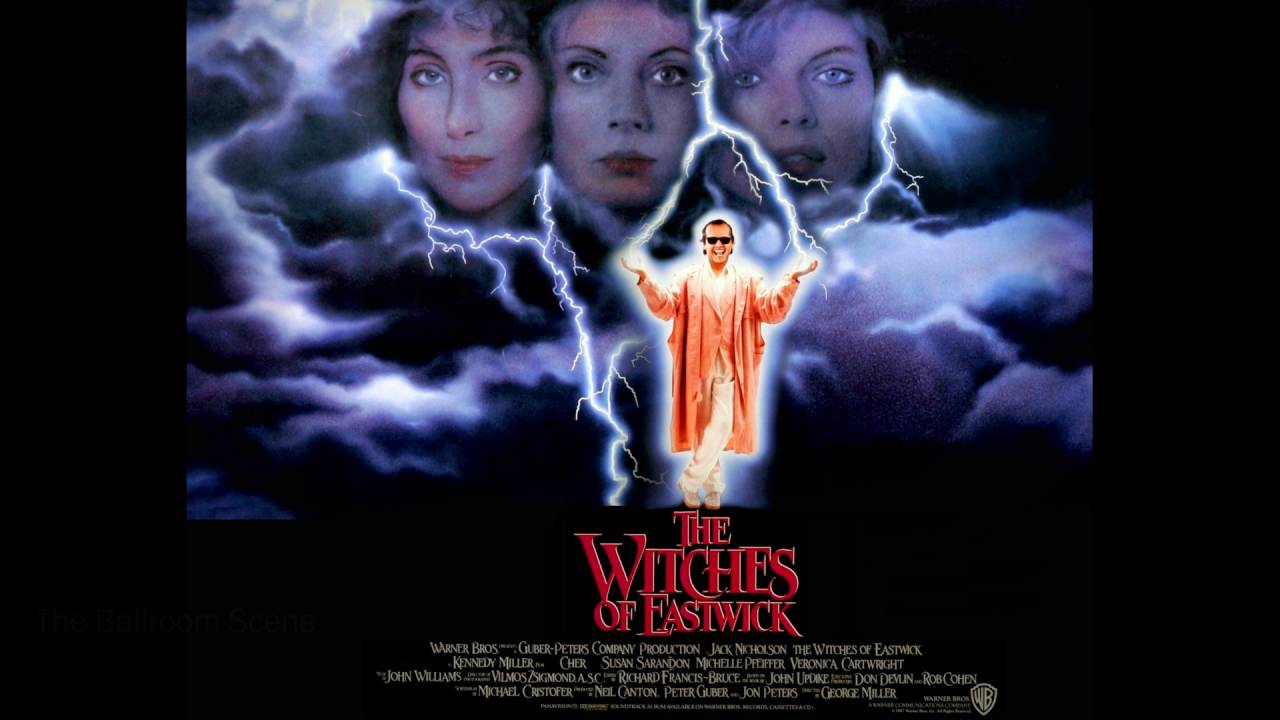
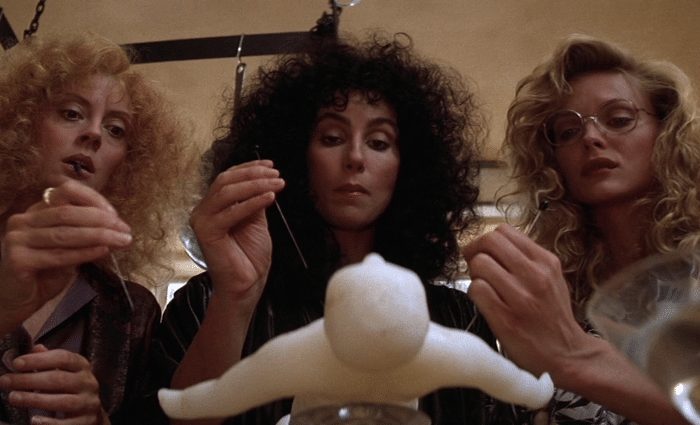
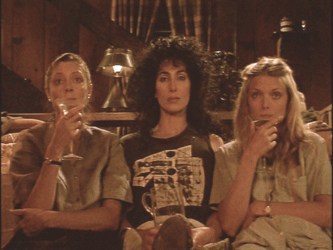
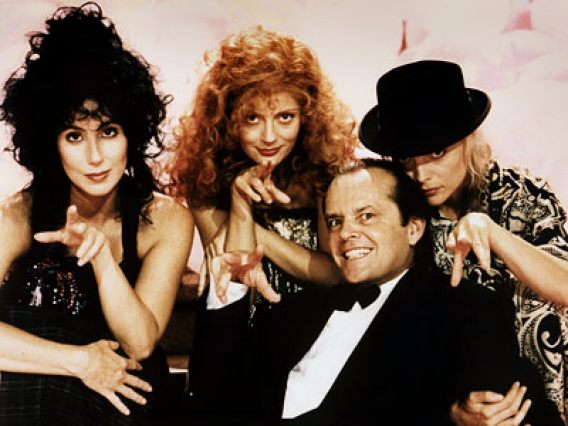
Sukie (Michelle Pfeiffer), Jane (Susan Sarandon), and Alex (Cher) are three lonely friends who can cause stuff to happen when they’re together, like make it rain on a boring school assembly. It seems like their mutual wish for a man is granted when a mysterious wealthy stranger breezes into town. All three fall for Daryl (Jack Nicholson), and all three date him simultaneously. Too late, they realize there’s something seriously evil about him (he’s in fact the Devil) and stop seeing him. But he won’t let them go that easily.

wit6

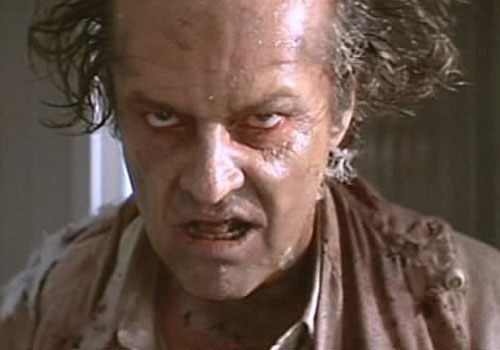
The movie is a comedy, but there’s a lot of creepy stuff going on, like Daryl making Sukie’s nemesis Felicia (Veronica Cartwright) uncontrollably vomit cherry pits. Her husband’s (Richard Jenkins) ambivalent feelings about her make his reaction chilling. There is also a fairly suspenseful scene when the ladies cast a spell on Daryl, and he returns home furious.

wit3
I’ll spare you a “little prick” joke

I can’t decide if this movie is feminist or misogynistic. There seems to be a strong womyn power vibe, for example the ladies’ ability to do magic because of their powerful female bond. Then there are Daryl’s impassioned speeches to Alex (about how men are insecure and constantly “trying to put their dicks into everything”), to Jane (about how men are threatened by women and are motivated by “fear of losing their hard-on”), and to Sukie (about how amazing it is that women can give birth to babies and make milk to feed them). Yet before Daryl shows up, they spend a goodish amount of time griping about how they want a boyfriend; when he appears, they each hop into bed with him the first time they meet him. Then they fight over him. But they do come back into their power when they decide they don’t need him.

wit2
Alex: “I don’t thnk that men are the answer to everything.” Sukie: “No.” Jane: “Then why do we always end up talking about them?”–actual quote

Something that amuses me about the movie is that it’s rated R, but somehow there’s no nudity. There are sexual situations and a whole lot of crude language, but the movie is surprisingly chaste when it comes to the sexual acts themselves. The camera cuts away before showing anything more graphic than Daryl finding his three paramours waiting for him in his bed. I first saw the film at age ten, a much younger age than I should have, and most of the innuendo went over my head, like Daryl having deep scratches on his face after his first meeting with Jane.

wit5

The film is dear to my heart, and not just because of nostalgia. Give it a look if you’re in the mood for something funny but occasionally creepy.

wit4
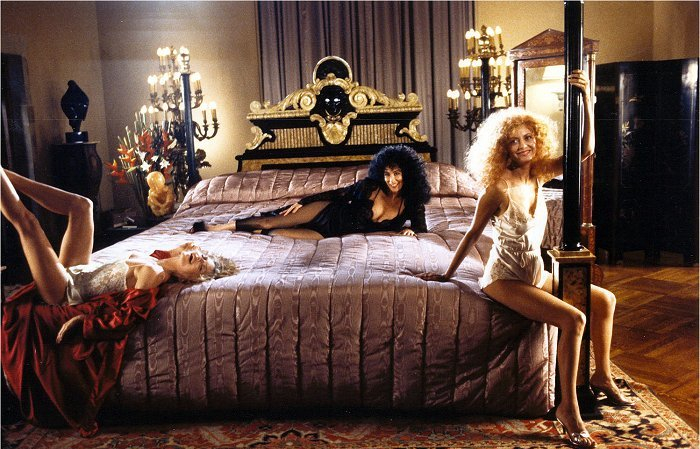
This publicity photo is adorable

‘Wishcraft’: Pizzle, I Say, Pizzle!

Brett (Michael Weston) is a nerdy high schooler with a crush on Sam (Alexandra Holden), a popular girl with a jock boyfriend. His life changes seemingly for the better when an unknown benefactor gives him a wishing totem (a “bull pizzle”). He wishes that Sam would be his girlfriend, which she does. But he wonders if she likes him for him or for his pizzle. Meanwhile, a serial killer is on the loose, and it’s up to Brett and his pizzle to stop it.

wis2
That she ends up here is a surprise to no one

I first watched Wishcraft because I was curious to see a movie with Meat Loaf and Zelda Rubinstein (a seriously underused actor); I also kinda like Michael Weston. But as movies like The Secret Life of Pets 2 prove, a good cast does not necessarily good watchin’ make. This movie puts me in the mood to gripe, in a much more raw and emotional way than I prefer. I can’t remember how I reacted the first time I watched Wishcraft, but this time I couldn’t wait for it to be over. It’s cheesy without even trying to be scary. It would have worked better as a murder-free comedy. Then I would have avoided it entirely. Bumpers is a last name that belongs in a comedy. So do heroines who say things like, “Why do we have to study World War II?” I’m so tired of movies when the protagonist has no motivation to pursue the heroine besides her appearance.

wis1.png
Yep, here comes the implied sex scene

Sam is dumb as a post, but Brett insists, “She’s just going through a superficial stage. It’ll pass.” It bugs me that for some reason the actors’ faces look powdery. I have a hard time buying Weston as an outcast—he’s Hollywood pretty—maybe with stereotypical movie geek gear, a pair of glasses or a bad haircut or something. I hate Brett’s best friend Howie (A.J. Buckley)—he’s aggravating beyond the typical sidekick. Someone also thought it was a good idea that there be a death by bowling ball. Give it a look if you’re in the mood for something corny and awful.

zzz
Awesome, but not worth the pain

2006’s ‘The Wicker Man’: A Towering Garbage Fire or Just the Remake We Needed?
Police officer Edward (Nicolas Cage) has been contacted by his ex-girlfriend Willow (Kate Beahan), who tells him that (a) they have a daughter named Rowan and (b) she’s missing. He heads down to Summersisle, a small island in Puget Sound, to find her. He runs afoul of a strange matriarchy of wannabe pagans who are having a hard time with their crops. After the unfriendly locals tell him either that Rowan doesn’t exist or that she’s dead, he’s left to wonder who’s lying. He begins to suspect a connection with human sacrifice and the failing crops, and the truth is more horrible than he could have imagined.

wic4

I don’t often like remakes, and initially I was dead-set against this one. I had fond memories of the original, and this film, while having many similarities, is just not as good. However, I watched the remake and the original together recently, and I may have changed my mind. I was all set to label Neil LaBute’s The Wicker Man as an unnecessary remake, but now I’m not sure. (Though I am sure that it’s hard to beat Christopher Lee and Ingrid Pitt.)

1973’s The Wicker Man concerns a Scottish island dominated by Lord Summerisle (Christopher Lee); it’s not a matriarchy, which eliminates some of the misogyny of the remake—the theme there seems to be that woman hate men and are irrational yet crafty, while men are good and strong. Then again, the women in the remake are powerful and dignified, while in the original they spend much of their time naked—but it doesn’t seem to be a patriarchal culture per se. In the remake, Edward punches a couple of women; I’m not sure if I should be offended or gratified that he is treating them like equals.

wic1

Another aspect I considered is the corniness factor, which both films have in spades. The original has the singin’est villagers you ever did see—they’re constantly breaking into a musical number. The remake has a haunting score by Angelo Badalamenti (best known for his work in David Lynch movies). The original has corny dialogue, but much of it is transferred over to the remake. My favorite unintentionally funny moment from 2006 (the unrated version) is when the baddies maliciously break Edward’s legs and he yells “Don’t move me!” My second favorite: “Not the bees! Aaaah!”

wic2

As a former Wiccan, a feature of both films that stands out to me is the portrayal of paganism. The original shows many real aspects of Wicca, such as the maypole, jumping over a flame, and love of nature. I understand Wiccans tend to hate this movie, and I don’t blame them—who wants their religion falsely associated with ignorance and human sacrifice? The townsfolk in the remake encompass less recognizable bits of Wicca; the only thing that I see is Sister Summersisle’s (Ellen Burstyn) triple-moon necklace (though it shouldn’t be three crescents, but two crescents and a circle to represent the waxing, waning, and full moon).

wic3

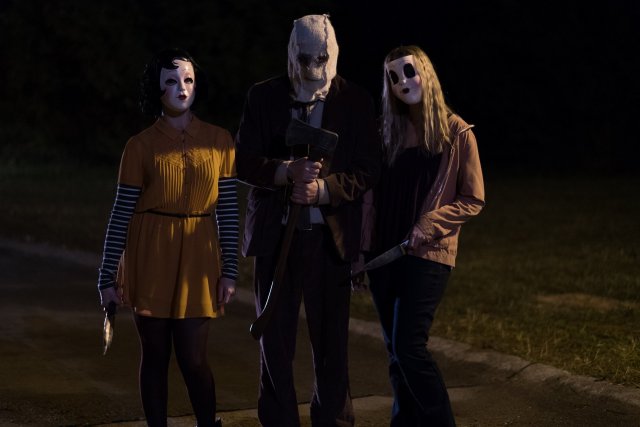
All gripes aside, the original is just that: original. The remake can copy the shocking ending and add more violence, but it’s still just a copy. However, both films are creepy, disturbing, and well-acted (Cage does the best he can with the goofy material, shut up, acting is hard!). Despite the corniness, both pose the possibility of modernity being detrimental: sure the townspeople are delusional (probably), but they work hard for what they have and Summerisle (and Summersisle) is undeniably peaceful. In the end, I recommend both films together—check them out if you’re in the mood for suspense and kids in creepy masks.

‘White Zombie’: A Couple of Powerful Scenes and a Mighty Heap of Issues

The movie Rob Zombie’s original band was named after. Couple Madeline (Madge Bellamy) and Neil (John Harron) are about to be married in the West Indies. Alas, Madeline’s friend Charles (Robert Frazer) wants her for himself, and enlists the help of Legendre (Bela Lugosi) to make her a zombie. (Not a flesh-eating zombie, but the Haitian kind that tend to become peoples’ slaves—Legendre’s zombies work in a sugar mill.) Charles realizes too late that zombies don’t make the best conversational partners, and decides to change her back. But Legendre has his own plans for her.

whi5
“I just had an idea!”

It’s 1932, so there are a lot of aspects of the film that modern viewers may be annoyed by. The special effects are less grand than today (though there is a neat shot of Legendre’s eyes superimposed on Madeline and Neil’s carriage–here’s a gif). The sound is terrible on two levels: because of the wear and tear of time and also errors like birds that are heard squawking but have their beaks closed. The editing is also poor at times, with characters moving around inconsistently. According to the Netflix synopsis of the movie, it was made in eleven days. It also gets pretty melodramatic, with a dash of overacting, particularly by Lugosi. And of course it’s predictable.

whi6

As can be expected, there is some racism (though actually all the zombie slaves and even Madeline’s maid is white), from the stereotypical superstitious carriage driver to Neil’s hysterical speculation of what happened to Madeline: “Surely you don’t think she’s alive? In the hands of natives? Oh no, surely better dead than that!”

whi4
So this fellow is a combination of clown, superstitious native, and servant

There is a creepy moment or two; there’s one barrel-chested guy who makes a convincing zombie, with his blank expression and wide, dead eyes. There’s also the scene when Legendre is turning Charles into a zombie, which entails a slow paralysis. He uses the last of his strength to put his hand on Legendre’s arm, by way of pleading. Legendre reminds Charles he refused to shake hands with Legendre once, and continues what he’s doing. And on the plus side, since it’s so old, it was actually original in the period it was made.

whi2

My question: is zombie labor really worth it? Sure they work long hours for free, but they’re extremely slow and increase work-related incidents exponentially—like the zombie in the movie that falls in the sugar mill. I know I don’t want to eat zombie sugar.

whi1
Do you want zombie cookies? ‘Cause that’s how you get zombie cookies! Image courtesy of http://www.royalicingqueen.com

Anywho, give it a look if you’re in the mood for something super old-timey.

Whispering Corridors: Memento Mori is Heartfelt, Pensive, and Lovely

Korean movie, the second in the Whispering Corridors series. Min-ah (Gyu-ri Kim) is a teenager at a girls’ school who finds a journal written by her classmates, couple Shi-eun (Yeong-jin Lee) and Hyo-shin (Park Yejin). They love each other, but the pressure surrounding them doesn’t make anything easy. When their relationship ends in tragedy, no one at the school is safe from an angry spirit.

mem3
Exactly!

The film is unpredictable, which is refreshing, but at times it can be a bit confusing. For example the opening sequence, which shows Hyo-shin and Shi-eun tied together and apparently committing joint suicide. Meanwhile, there’s some jibber-jabber by a voiceover about girls dying. The first time I watched it, I assumed that Shi-eun and Hyo-shin were dead when Min-ah finds their diary—they aren’t. Neither the drowning nor the accompanying dialogue is explored later in the movie, though someone mentions in passing that girls have been dying a lot lately. Also baffling is the cadre of teenage girls who are difficult to tell apart, since they’re all thrown at us at once and don’t initially do a lot to distinguish themselves. There are Ji-won (short hair) (Kong Hyu-jin), Yeon-ahn (ponytail) (Jae-in Kim), Min-ah (longest hair), Hyo-shin (hair down to her earlobes) and Shi-eun (bobbed hair).

mem2

It’s hard to see this film and not compare it to the original. I’d say the previous film has a much clearer vision and themes than its sequel. This film similarly takes place entirely at the school, but the teachers are a lot less vicious and often absent from the classroom. As near as I can tell, there were no gay undertones or overtones in the original film. I don’t know much about Korean culture, but I don’t think being gay is celebrated, given the schoolgirls’ disgusted reaction when Shi-eun and Hyo-shin go public with their relationship by kissing in the classroom, which also prompts a hearty slap from their instructor. Shi-eun avoids Hyo-shin afterward, seemingly out of shame. Which isn’t to say it’s all a bleak picture; there are some endearing moments between them, like when Hyo-shin says, “I heard church bells when I first saw you.”

mem1

Overall, the cinematography and love story is worth the convoluted plotline. Give it a look if you’re in the mood for a ghostly tale of revenge.

mem5
And crying. All the crying.

‘Whispering Corridors’: High School is Terrifying

Korean movie directed by Ky-heong Park, AKA Yeogo Goedam. According to its theatrical trailer, this is the movie that started the “Asian horror revolution” (now that’s a movement I can get behind!). Eun-young (Mi-yeon Lee) is a new teacher at the private girls’ school that she once graduated from. She’s haunted by the memory of her friend Jin-ju, who died at the school nine years ago—shortly after Eun-young, prompted by mean teacher Mrs. Park, snubbed her. Meanwhile, outcast Jae-yi (Kang-hee Choi) has made friends with popular girl Ji-oh (Gyu-ri Kim). Eun-young notices parallels between their friendship and her friendship with Jin-ju, and when people who have mistreated the two girls begin dying off, Eun-young wonders if Jin-ju has returned.

whis3

Something interesting about the film is that it’s a bit teen angst-y, but not in a whiny John Hughes way. The movie highlights how brutal school can be, especially Eastern schools. The girls have a massive workload and are pressured to have perfect grades and to make the school look good. The instructors verbally, physically, and even sexually abuse the students. The entire movie takes place at the school, which emphasizes how much of their lives are devoted to working hard and studying (and we as viewers are stuck at school with them). Look how huge the school is, and how tiny the people are by contrast:

Even when Jae-yi and Ji-oh are hanging out, they’re on school grounds. Ji-oh sees a corpse, and deals with the shock by painting a picture of the event, explaining that sometimes “school is a horrifying place.” Accordingly, her teacher Mr. Oh destroys the painting and calls her a “psycho.”

whis4

Often while watching any foreign movie I feel a little culture shock. I also experience what I think of as WAOTS (what an odd thing to say) moments. This movie has more of those than most. There’s the amusing: [about fellow student Jung-sook] Ji-oh: “…she’s possessed.” Jae-yi: “Possessed?” Ji-oh: “You know, by the study demon—one with a low I.Q., though.” Then there’s the bemusing: “It’s not that I don’t want to call the spirits with you. It’s just so childish that I don’t want to do it anymore.” And my favorite: “You can’t call it suicide just because she hung herself.”

whis6

All jabs aside, this is one of my all-time favorite horror movies. It’s a tense, compelling watch. The acting is decent and the special effects are great. It’s a little predictable, but you have to give it points for originality, since after all it’s the Che Guevara of Asian horror. Long live the revolution!

‘When a Stranger Calls Back’: Classy Horror with Genuine Scares

As with When a Stranger Calls, this one concerns a babysitter (Jill Schoelen) menaced by a scary guy (only this one comes to the door, making a liar of the title) (Gene Lythgow) who won’t leave her alone, even returning five years later to hassle her in college. Julia is assisted by Jill (Carol Kane), the girl from the original, who—conveniently enough—is a counselor at her college. The two of them, with the help of John (Charles Durning), the detective from the first movie, try to catch the stalker. But he has lots of nifty tricks that they haven’t seen before.

when2
“Now, get your hands up higher, and yell ‘Pew! Pew!'” “When do I get an actual gun?” “When you have mastered the ‘Pew! Pew!'”

This movie more than meets my sequel criteria—it exceeds them. The writer and director of the original, Fred Walton, returns to again write and direct, and not just one but two actors from the first film reprise their roles. It directly follows the storyline from the original, and keeps the same logic. In many ways I like it better than the previous film, which after the terrifying first fifteen minutes or so, gets rather dry and boring. The stalker may kill people, but his social life, which makes up the bulk of the plot, is dull. This one keeps the action going, but not in a cheap way, like with jump scares. I’d say this villain, William, is creepier, too, with his ability to throw his voice and paint himself into a wall.

when4
That’s talent! If he put that much energy into developing his skills as an artist as he does stalking and murdering, he’d probably be a lot more well-adjusted

I also enjoy Jill’s transformation into a woman who refuses to be a victim. She and Julia are curious characters for a horror movie; they don’t get naked or even wear skimpy clothes; they don’t cower, and they don’t have men. Julia could actually be construed as gay, if you want to go with ’90s stereotypes—she has a mullet and dresses like a lumberjack. Even her sleepwear is an oversized sweatshirt. When she mentions the possibility of being a relationship, she doesn’t use a masculine pronoun; she says, “A person who maybe has someone.” She spends a lot of time at Jill’s place, and Jill’s husband from the first movie is out of the picture. Of course they’re both traumatized women who have trust issues—I’m just sayin.

I do have a couple of issues with the movie, mostly the notion that William can be outside and sound like he’s inside, and vice versa. I like how enigmatic and interesting his character is (for example performing in a nightclub with a dummy that has no face), but I don’t see how these glimpses into his life relate to his other hobby of killing children and stalking people. But overall, it’s good watchin.’

I first saw this at my friend Hope’s 12th birthday slumber party. She had already seen it, and made much of the scene when Julia is making tea, but turns the burner off. A few minutes later, Julia runs to the kitchen to turn off the shrieking teapot, the inference being that she’s not alone in the house—the man at the front door is actually inside with her. It’s a scary scene, and it has stuck with me for the couple decades, and not just because of the nostalgia factor. Check it out if you feel like watching a creepy home invasion movie—it’s great for slumber parties.

What Ever Happened to Baby Jane? is Twisted and Thrilling

1917: Baby Jane is basically Shirley Temple, a child star singing and dancing her way to fame. She’s extremely spoiled, and mistreats her sister Blanche, who looks more like Wednesday Addams. Flash forward 18 years: Blanche (Joan Crawford) is an established movie star, while Jane (Bette Davis) is pretty much booed out of Hollywood for not being able to act. Their careers are both stopped short when a car accident leaves Blanche paralyzed, and Jane is blamed. Flash forward twenty-seven years: Blanche is still sweet and humble, while Jane is bitter and demented. When she learns Blanche is planning to sell the house they live in and put her away in a mental hospital, Jane tortures her, doing things like alternately starving her and feeding her horrible things. The situation escalates until Jane is driven to murder.

what2

Besides the question of why Blanche’s room is upstairs, the most striking thing about the film to me is the performances. Davis is extremely unsettling as Jane; she has a child’s selfishness combined with an adult’s malevolence. But despite her anger, she’s also fragile. There’s a scene when she recites from her childhood act; she’s trying for cute and innocent, but her droopy face and cracked voice are just pathetic and creepy—she sees herself in a mirror and starts bawling. Crawford as Blanche is also stellar; if Mommie Dearest can be believed, she must have been working extra hard to appear kind and rational.

what3

Also interesting (but sadder) is the character of Elvira (Maidie Norman), the sisters’ Black maid. Being suspicious of Jane and strongly protective of Blanche, she’s the voice of reason and the smartest person in the movie. She becomes really hostile to Jane, and in one scene has Jane cowed when she catches her being cruel to Blanche. She’s so likable and such a strong character (hey, it’s the ’60s, a little cheekiness was often the best you could hope for in terms of Black characters) that it’s devastating (but not surprising, alas) when Jane kills her.

what4
The face of a woman you don’t want to piss off

The plot is pretty original, and the film is really disturbing—we never know what Jane’s going to do next, but it’s bound to be unpleasant. This is one of those classic horror films that I never ended up seeing until my twenties. I’m glad I finally got around to it. It’s dark and intelligent; check it out if you’re in the mood for something psychological. As a special treat, I’ve included a clip of Davis singing “What Ever Happened to Baby Jane?” mashed up with Susan Sarandon performing it in character as Davis on Feud: Bette and Joan. Good luck getting it out of your head.

‘Vile’: Earnest, Fascinating, and Absolutely Disgusting

Nine people are drugged and wake up to find themselves in a house with a strange videotaped message. They are told they have to inflict pain on themselves in order to collect enough dopamine, serotonin, and adrenaline to fill up the vials inserted in the back of their necks. As the woman on the recording (Maria Olsen) puts it, “Pain will be your only way out of this house.” Ripping out the vials ends in death, as does not obeying the weirdo on the tape and filling up the vials like good little captives. As a fun bonus, if a person dies, his or her pain counter goes back to zero. Thus, they are left to try to work together to survive.

vile1
“Rock, paper, scissors, boiling water…”

The characters are mostly likable. Despite being mainly white (natch), they’re surprisingly easy to tell apart. Basically they’re couple Tayler (April Matson) and Nick (Eric Jay Beck) and their friends Kai (Elisha Skorman) and Tony (Akeem Smith), whom the movie opens with. Less importantly, there are guy who dies shortly after everybody wakes up, Tara, the standard slasher movie obnoxious character who should die first but never does (Maya Hazen), blond lady Lisa (Heidi Mueller), guy with a secret Greg (Rob Kirkland), and Sam (Greg Cipes). It’s hard not to imagine being in that situation, so the characters are easy to feel sympathy for. I felt particular empathy for Tayler, who is pregnant, especially since the first time I saw the film I was pregnant myself. Even Tara’s well-deserved comeuppance made me nauseated. I felt bad for my husband, who was on the computer with his back to the movie; to him the whole thing must have sounded like ninety minutes of hollering.

vile1
“This bite stick is totally tubular!”

It’s kind of a silly premise, but the film is so dark that it works. The hormones being harvested are being used to make drugs, ironically painkillers (if you need a deeper meaning I guess you can read the movie as an allegory for the evils of Big Pharma). The gore is pretty thickly laid on, with little in the way of comic relief. Though I was amused at a character who, while figuring out how best to brutalize her housemate, asks, “Should I hit him with my shoe or something?” The film has a creepy vibe. The grotesqueries are unpredictable, and the house is decrepit and filthy and filled with potential weapons. The torture sequences are many, and they are sickening. I find movie characters in pain more tolerable to watch if they aren’t having an emotional reaction, but these folks are screamers and criers.

vile2
And creepy grinners

Overall, the film isn’t scary as much as graphic and disturbing. It’s not mindless gore or what I would classify as torture porn; the characters work together, and I find it an interesting psychological study of people under severe duress. Check it out if you’re in the mood for something intense. If you’re a Tool fan, watch for Maynard James Keenan as Special Agent Ford.

‘Videodrome’: Way Ahead of its Time

In the not-too-distant future, Max (James Woods) is the president of Channel 83, which specializes in showing sex and violence. His interest is piqued by a Malaysian broadcast called Videodrome, which stages rape, torture, and murder. He runs into trouble when he goes looking to buy it for his station, and finds out that not only is it made in America, but the savage acts are real. Meanwhile, watching the show is giving him hallucinations about hurting people, as well as bizarre situations like his gun disappearing into a hole in his stomach. Before long, the creators of Videodrome have him programmed for their own use.

vid2
“Ah, that’ll keep the ol’ gun warm.”

It’s quite a complex movie, but its themes seem to revolve around how the media affects us, from desensitization to loss of reality. Max is looking for something not “soft” or “too sweet” but “tough” and “grotesque.” He enjoys Videodrome because “It’s just torture and murder—no plot, no characters.” Max loses his ability to tell what’s actually happening in his life; in one scene, he whips his lover Nicki (Debbie Harry) while she’s inside a TV, but then she turns into Max’s colleague Masha (Lynne Gorman), and he wakes up next to her corpse in his bed. He calls his friend over for confirmation the body is real, and nothing is there—the entire event was an illusion.

vid3

But it’s not just Max who lives in “over-stimulated times.” One of the creepier scenes in the film is when Max visits the Cathode Ray Mission, where homeless people go to watch television. As one character points out, “Television is reality,” and “Nothing is real outside our perception of reality.” The movie is over forty years old, but it’s extremely visionary in terms of portraying media saturation. We really do live in “savage new times,” with so much reality TV (I can think of five shows off the top of my head that revolve around people eating disgusting things to survive), and the internet. Similar to movies like Feardotcom and Untraceable that feature snuff websites, Videodrome asks the question: is something real if you’re merely watching and not acting? Or is it the only thing that’s real?

vid4
Ye gods, that looks like murder on your neck!

I hadn’t seen Videodrome in years, and since then it was referenced on Family Guy, when James Woods makes Peter watch it. I recommend this especially to Family Guy fans; it’s totally worth watching, even if like me thanks to that episode you always find Woods hilarious–at least when he’s acting. The movie’s way too weird and eerie to laugh at, except the use of Betamax tapes—how quaint!